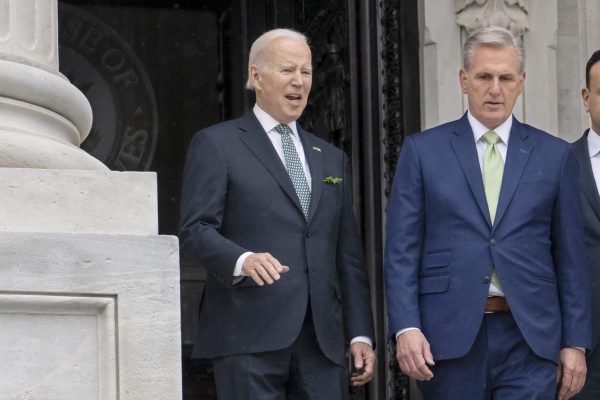
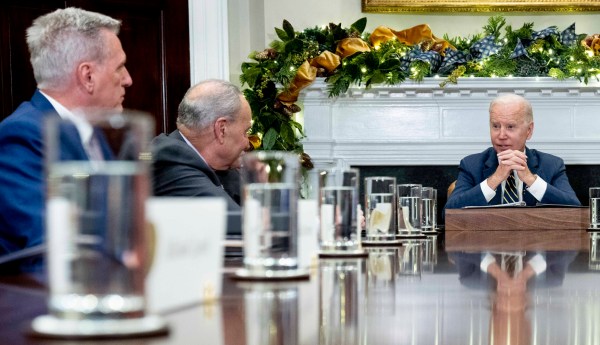
President Joe Biden‘s highly anticipated meeting with House Speaker Kevin McCarthy (R-CA) is a tentative first step toward avoiding a default after the country reached its $31.4 trillion debt limit last month.
But although Biden has criticized Republicans and their economic policies less this week, White House aides and their congressional Democratic counterparts have not, lowering expectations regarding the prospect of a breakthrough and potentially undermining trust between the president, McCarthy, and the new speaker’s conference.
WHITE HOUSE PRESSED ON BIDEN PHYSICAL EXAM AFTER BLOWING PAST JANUARY DEADLINE
McCarthy had framed Wednesday’s meeting as a political win after Biden and his aides were adamant that the president would not negotiate and that the debt ceiling should be raised without conditions. But the White House has sought to counter Republican rhetoric, circulating a memo by National Economic Council Director Brian Deese and Office of Management and Budget Director Shalanda Young. In it, they detail Biden’s strategy, contending the president will put the pressure back on McCarthy by asking him to commit to averting a default and to releasing a budget.
The White House’s hardball tactics come after hard-line members of McCarthy’s conference forced his leadership to be decided by an unprecedented 15 ballots. The impasse ended with demands McCarthy reduce the federal debt and annual deficits in addition to considering entitlement reform. McCarthy had to dismiss the possibility of Social Security and Medicare cuts last weekend, but that has not stopped Biden and his aides from repeating the speaker and other House Republicans pose a threat to the programs and implying McCarthy will have problems with his colleagues.
“McCarthy, look — look what he had to do,” Biden told donors in New York City on Tuesday. “He had to make commitments that are just absolutely off the wall for a speaker of the House to make in terms of being able to become the leader.”
Biden did describe McCarthy as “a decent man,” but House Republicans, such as one of the 18 GOP lawmakers who represents a district Biden won in 2020 and whose support the White House is poised to need in the future, have bristled at the president’s adversarial tone and posture.
“What makes us different than some of the other members of our conference is we’re not going to promise the moon on these negotiations,” Rep. Don Bacon (R-NE) told the Washington Examiner, referring to his group, the Main Street Republicans. “It’s got to be realistic. Both sides have got to give, and we’ve got to meet somewhere in the middle.”
Bacon downplayed speculation McCarthy has been politically damaged by the speakership stalemate, scrutinizing McCarthy’s Republican dissenters instead because “what they did hurt the GOP brand.”
“I hope he’s not weakened because we need a strong speaker,” he said. “When you weaken the speaker, you weaken the majority.”
One House Republican staffer was more vocal in his criticism of Biden and his aides’ approach, complaining their position is: “We’re going to work around the margins but not work with you guys.” Even before the White House specified its March 9 budget publication date, the source expressed GOP lawmakers’ desire to pass all 12 appropriations measures since the conference “can actually influence a lot of policy because we have power of the purse.”
“Our hope is that we get those done and our appropriations bills speak for themselves about what our priorities are,” he said, “and then hopefully bringing the Senate to a negotiating table to work on things before we get to the point where you’re just writing a huge omnibus.”
The risk the White House and House Republicans are taking is whether debt limit negotiations, as well as the relevant budget and appropriations discussions, can conclude before June, when the country is projected to default on its loans.
In response to the White House, McCarthy, helped by Rep. George Santos‘s (R-NY) announcement he will recuse himself from his committee assignments but hindered by Republican disagreement over how to handle Rep. Ilhan Omar (D-MN) and signature immigration legislation, tweeted he had “received” Deese and Young’s memo.
“I’m not interested in political games,” McCarthy wrote. “I’m coming to negotiate for the American people.”
Mr. President: I received your staff’s memo.
I’m not interested in political games.
I’m coming to negotiate for the American people.
— Kevin McCarthy (@SpeakerMcCarthy) January 31, 2023
Biden had earlier told reporters his overarching message to McCarthy will be, “Show me your budget, I’ll show you mine.”
En route to Biden’s infrastructure event and fundraiser in New York City, appearances that were less political than his economic address last week in Virginia, White House deputy press secretary Olivia Dalton underscored what the president has already done to decrease federal debt, reiterating he has cut the deficit by “a record $1.7 trillion.”
“The deficit increased every single year under [former President] Donald Trump,” she said on Air Force One, not mentioning the COVID-19 pandemic. “His four years in office are responsible for 25% of our total national debt in the last 230 years.”
Dalton, White House press secretary Karine Jean-Pierre’s No. 2, also cited House Republicans’ attempt to repeal $80 billion in IRS funding for new agents, which Democrats claim is in-kind tax relief for the wealthy who are more likely to be audited, and their endorsement of Trump’s tax cuts.
“The president is happy to talk with anyone with ideas to responsibly lower the deficit, and he’s put forward several proposals to do so by making the rich and big corporations pay their fair share,” she said. “What’s the Republican plan? Is it to cut Social Security and Medicare? Is it to raise the retirement age? Speaker McCarthy claims he doesn’t want to do what he has previously voted for in this regard. He should share what his plan is.”
Dalton amplified Deese and Young’s memo, which asserts Affordable Care Act health coverage could be in jeopardy too.
CLICK HERE TO READ MORE FROM THE WASHINGTON EXAMINER
“To understand the impact of cuts of that magnitude, the American people are presently left to look at past House Republican budgets, including last year’s budget from the House Republican Study Committee (which more than three fourths of last year’s House Republican Caucus belonged to), or track rumors of private agreements on deep cuts to the part of the federal budget that funds research, education, law enforcement, border security, and food safety,” they wrote.