
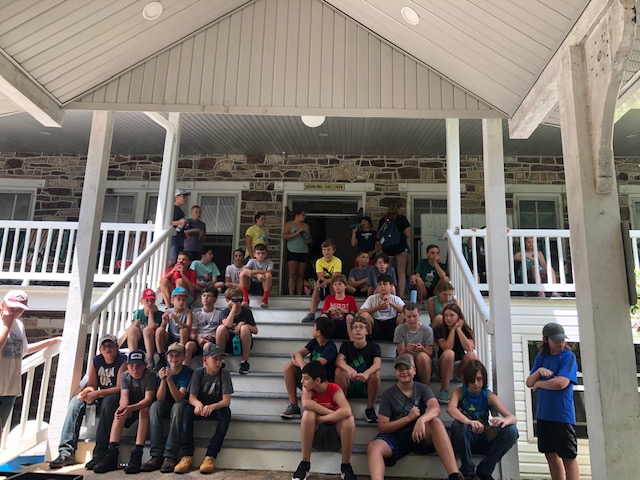
DOUBLING GAP, Pennsylvania — This is where the magic happens.
The elegant White Sulphur Hotel still sits along the top of the Blue Mountain ridge; its formidable presence in the thicket of the southern edge of the Tuscarora State Forest is just as much a delightful surprise today to summer campers arriving to experience sleepover camp as it was to 19th-century elites coming to partake in the healing powers of the springs in luxurious surroundings tucked away in the Appalachian Mountains.
There is this controlled chaos of children ranging from kindergarten to high school students whisking off in all directions with their camp counselors; the seventh graders were on their way to a hike to the Flat Rock Vista on top of the North Mountain to enjoy the panoramic view of the Cumberland Valley, an older group was off to kayak along the lake, a group of pre-teen girls were just finished making silk screen T-shirts in the art room, once the billiard room of the once prestigious hotel.
For over 100 years, this resort provided luxury and healing to people across the Mid-Atlantic, for the past 80 years, however, it has provided an extraordinary summer camp experience as Camp Yolijwa for approximately 2,000 children ranging from kindergarten age to seniors in high school, as well as several nontraditional camps for children with special needs, family camp, father-son camp, mother-daughter camp, and even a senior citizen camp.
They either live in the former hotel rooms that are now dormitories, or if they opt for the wilderness camp, they will sleep in shelters, tents, or out under the stars and cook their own food.
There is a climbing wall, zip line, hiking, canoeing, paintball, horseback riding, dodgeball, volleyball, swimming, boating, low-ropes course, arts and crafts, as well as Bible teaching and connecting the children to God and nature.
Ryan Long, the incoming executive director and current program director, explains the children hail from all over Pennsylvania and parts of New Jersey. They also come from inner-city neighborhoods, small towns, and posh suburbs. What they all gain from coming here, Long said, is a sense of freedom, responsibility, and independence.
“As well as a greater purpose. It is one of the many things we pride ourselves in. There’s such a vast uniqueness in their experience from the time they arrive on Sunday until they leave on Saturday,” he explained.
“We are in a pretty isolated unique niche of the mountain up here; that gives them that uniqueness of the destination as well. And we are a community, and we’re all in this together. And we’re all just experiencing things,” he says.
“When I give them the rules on Sunday, I say, there’s a reason we have to cover rules because there’s 190 of us living together this week. And we all need to be operating under the same expectations, same guidelines, because that’s the challenge,” he said.
Long has been here most of his life. He was literally raised here because his father was the past executive director of the facilities. He met his wife Andrea here. Now they along with their three young children live here in a wing of the former resort.
“I started officially working here after leaving high school education as a teacher in 2008 when I became the program director,” said Long, who is constantly interrupted by children and staff with questions or just hellos as he walks the grounds.
Summer camp has its roots as a tradition for American children in the late 19th century, first for boys in the 1890’s, then for the girls a few short years later. Wealthy families were the first to send their children, but middle-class and working-class families, through the YMCA, Boy Scouts, and Girls Scouts, along with other fraternal organizations and churches, soon made summer camp available for kids no matter what your families income was.

“There is really nothing that compares to the camaraderie, confidence, loyalty, time away from your parents, electronic devices, as well as all of the fun provided at overnight summer camp,” said Long.
Rebecca Fickle was leading a group of younger children for a hike. She grew up attending Camp Yolijwa throughout her childhood. Now the senior at Shippensburg University is a camp counselor for the summer. “Everything I learned about friendships, fending for myself and just having fun, began in my summers here,” Fickle said.
Long said there have been two downturns in turnout since he can remember, “Just after the 2008 recession, probably the summer of 2009, and, of course, last year during the pandemic.”
The American Camp Association reported in 2009 attendance at the nation’s 12,000 summer camps dropped 15 percentage points that year. In 2020, Tom Rosenberg, president of the American Camp Association, told CNBC only 20% to 30% of ACA overnight camps would be operating this summer because of the restrictions put in place because of the coronavirus pandemic.
At the time, the ACA estimated the direct revenue lost last summer was about $16 billion, 19.5 million children lost as well when they were unable to have those camp experiences.
“Last year was a setback. Our summer camps were able to run at two-thirds of what our 2019 budget was, which was difficult because when we set our budget at the beginning of 2020, you know, we, we didn’t budget in January of 2020 for a 60% attendance income summer,” he said.

Long explained they were unable to do several of the things they traditionally do. “So from a revenue standpoint, 2020 was challenging.”
This summer, however, is a completely different story. Enthusiasm was up for kids to attend. Long said they even had to add extra employees and programs to fulfill the overflow of requests they received from parents to get their children to camp, “We even had a waiting list.”
They weren’t alone. Calls to several camps across the state and in neighboring states showed most of them in the same upward position.
Of the thousands of children that have spent their summer here, only one had not been able to overcome the homesickness that Long typically sees passing after a day or two, “We try to give it a day. Encourage them, you know, try to hook them up with a buddy, figure out what their interests are. But if they really just can’t keep their mind off home, and mom and dad are OK with it being an early departure, then we’ll call home, and they will come pick them up.”
As far as smartphones go, there are none because they are prohibited; so, you’ll see no Instagram photos from kids coming here or texting with friends, “The kids are pretty busy here. They are up at 7:00 a.m. and it is lights out at 10:30 p.m. and a lot of activity in between, so they really have no time to miss having a device,” Long said.
Long says it is not the kids who get upset they are separated from their phones, “Believe it or not, there are probably more parents that are afraid to cut that connection than kids,” he said.
The kids, Long said, are not here to plugin and repeat the same things they do at home, “They are here for the adventure.”
