

President Joe Biden promised to hit the campaign trail to help Democrats in the November midterms, but as Election Day nears, candidates are seeing more and more of his administration’s top surrogates.
Recommended Stories



Biden pushed his infrastructure and healthcare legislation in visits to Oregon, Colorado, and California last week and will soon make campaign stops in Pennsylvania and Florida.
But in Georgia, Wisconsin, Nevada, and other states where Democrats are on the ropes, the White House is sending members of the president’s Cabinet, his vice president, and the first lady to boost candidates and make the administration’s case.
During one recent stretch, first lady Jill Biden stopped off in Atlanta to campaign for voting rights activist Stacey Abrams (D-GA), who is struggling to make up ground against incumbent Gov. Brian Kemp (R-GA) in a rematch of the governor’s race. Next, she was in Florida to tour a breast cancer research facility and attend events with Rep. Val Demings (D-FL), who is challenging Sen. Marco Rubio (R-FL), and Charlie Crist (D), who is running for governor against incumbent Ron DeSantis (R). At one point, the first lady gave an interview to Newsmax, a conservative television network.
The move suggests the White House views Jill Biden as a unique asset capable of reaching voters across party lines. By contrast, the president’s sit-down interviews have been largely conducted with major cable networks or with partisan interviewers, and the same is true for Vice President Kamala Harris.
BIDEN LENDS BOOST TO ‘SOON-TO-BE MS. MAYOR’ KAREN BASS IN LOS ANGELES
Last week, Harris was on the airwaves in Nevada last week urging Democrats to turn out for Sen. Catherine Cortez Masto (D-NV), the Democrat most at risk of losing her seat and a race that could signal disaster for the party’s Senate majority. The vice president also dialed into local radio stations in Georgia, Michigan, Minnesota, Pennsylvania, and Wisconsin to make the Democrats’ case.
On Saturday, Harris campaigned in Detroit for Gov. Gretchen Whitmer (D-MI), whose race is tightening against Republican challenger Tudor Dixon. Last month in Milwaukee, she met with university students and delivered remarks at a conference of Democratic attorneys general.
Transportation Secretary Pete Buttigieg is also in high demand, according to CNN, headlining events for Cortez Masto and Nan Whaley, the Democratic nominee running to unseat Gov. Mike DeWine (R-OH).
Sending the first lady and other top surrogates on the midterm campaign trail is not new. Suffering from low approval ratings in 2014, then-President Barack Obama held back as Michelle Obama attended dozens of rallies and campaign events across nearly a dozen states in the weeks leading up to Election Day. The same was true of Laura Bush in 2006 and Hillary Clinton in 1998.
Despite a late summer revival, Joe Biden’s approval rating in polls is still underwater. Yet the president’s policies score better, and Democrats are winning the vote of some voters who disapprove of the president.
The split highlights the challenge for a White House eager to pull out all the stops to boost Democrats as the party fights to keep control of Congress without weighing candidates down.
According to a new New York Times-Siena College poll, Republicans are faring better with voters in the home stretch. Whereas last month, Democrats held a 1-point lead in the survey, 49% of likely voters now say they would vote for a Republican candidate, compared to 45% who said they plan to vote for a Democrat.
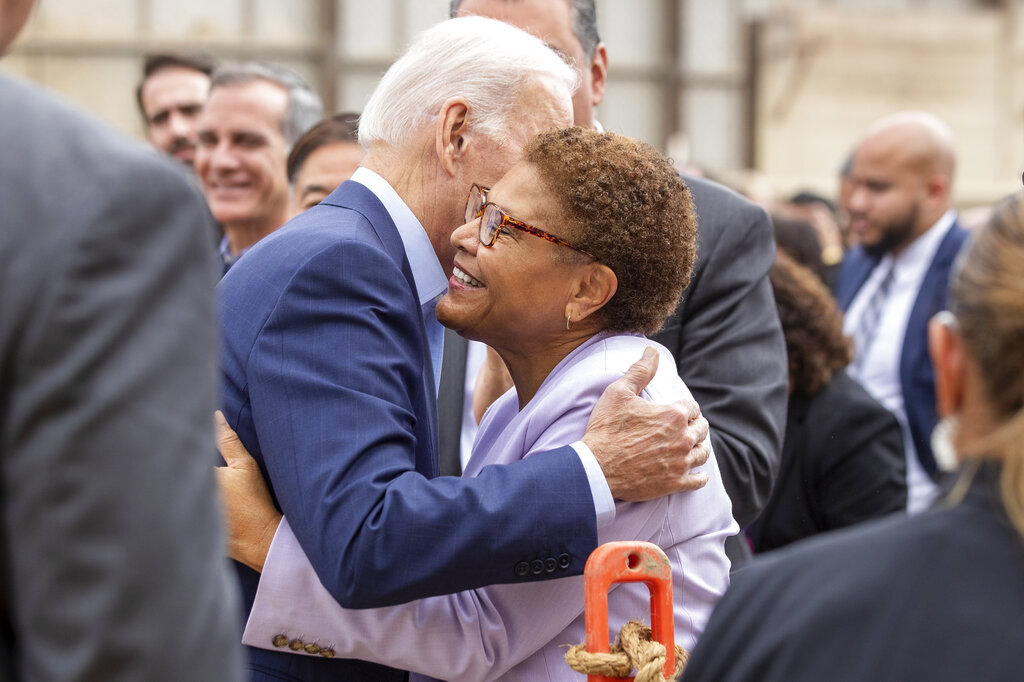
Joe Biden has kept his distance from some razors-edge races. At a private fundraiser in Los Angeles last week, the president was joined by representatives from Nevada. Earlier in the day, he appeared alongside Rep. Karen Bass (D-CA), who is running for mayor of LA against a local businessman. But despite the trouble facing Cortez Masto one state over, the president did not make the visit.
Asked why the president did not stop in Nevada on last week’s swing out west or Arizona, where Democrat Katie Hobbs is in an uphill race for governor against Republican Kari Lake, White House press secretary Karine Jean-Pierre demurred.
“He’s been on the road nonstop, and he will continue to be on the road nonstop,” Jean-Pierre told reporters, “And, you know, where he is needed, he will go.”
She said the White House would add more travel as needed but did not give a reason why the president had not attended any rallies or public-facing campaign events with candidates in recent weeks.
Joe Biden’s most challenging issue is an electorate worried about the economy. The Biden administration has struggled to control rising prices, with inflation rising above projections last month.
According to the New York Times-Siena College poll, the share of likely voters whose top concerns were the economy and inflation has increased by nearly double digits since July, to 44% from 36%, far exceeding any other issue. The voters most worried about the economy said they believed Republicans were best equipped to handle the issue.
While Joe Biden’s approval rating earned a bounce after the president signed legislation on top Democratic climate and healthcare priorities, his numbers remain underwater, with 39% approval, compared to 58% disapproval. Among those who disapprove of his job, 45% say they feel strongly.
Still, the poll indicates that about half of voters who somewhat disapprove of the president plan to back Democrats in the November elections.
These are voters who could swing the balance in a close race and for whom a candidate’s close association with the president could prove a deal-breaker.
Democratic strategist Jim Manley said these are the outcomes weighing on candidates as they wonder whether a boost from the president could help or hinder their chances as they march toward the finish line.
CLICK HERE TO READ MORE FROM THE WASHINGTON EXAMINER
“A lot of things go into the calculation: the president’s approval rating, what you’re messaging on, whether you’re trying to keep the race local, whether it’s a Senate race versus a House race,” he said.
The goal is to do best by the candidate, Manley continued.
“Sometimes you want to bring the president in to help nationalize things; other times you want to keep the race local and do it more on your own terms,” he said. “It’s an age-old tension.”
