

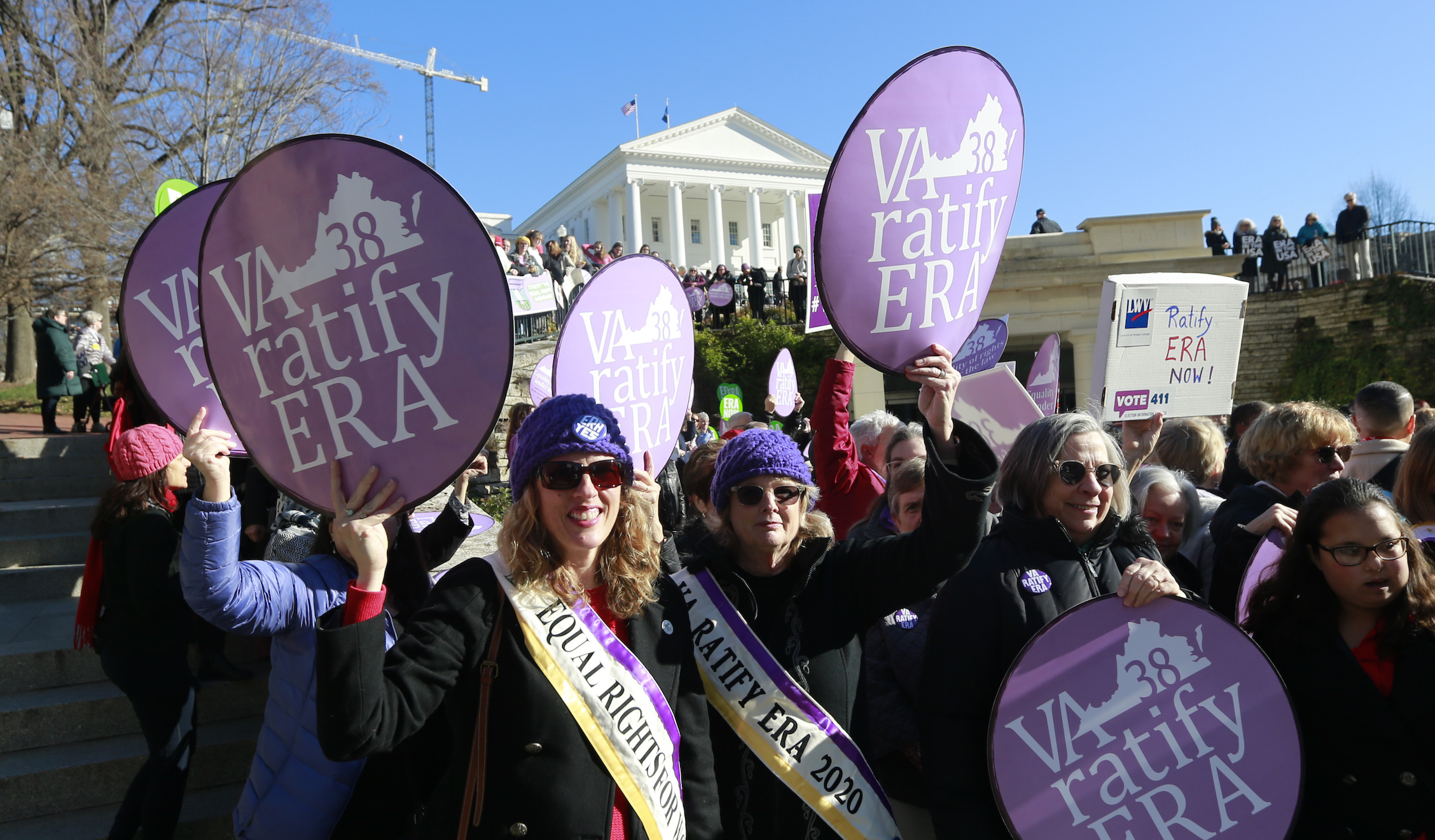
The House on Thursday passed a resolution that would revive the dormant Equal Rights Amendment by repealing the 1982 deadline states failed to meet to ratify it.
The measure passed 232-183, with five Republicans in support and no Democrats opposing it. But it is likely never to become law. Republican Senate Majority Leader Mitch McConnell said he did not support the measure and that it faced legal challenges.
Recommended Stories


The measure, H.J. Res. 79, would permanently reopen the ratification process for the amendment by striking the 1982 deadline.
“If Congress can set a deadline, Congress can remove a deadline,” House Judiciary Committee Chairman Jerry Nadler, a New York Democrat, said.
Republicans who opposed the resolution said it would promote abortion by expanding access, making it impossible to install limits, and requiring taxpayer funding for the procedure.
“It would permanently allow abortion until birth for any reason throughout the nation,” said Rep. Carol Miller, a West Virginia Republican. “We cannot allow that.”
Democrats said the measure ensures that the Constitution guarantees women equal rights, such as equal pay and other protections in the workforce.
The Justice Department has ruled it would be unconstitutional to remove the deadline retroactively.
The Office of Legal Counsel ruled in January that House lawmakers must start over if they wish to ratify the ERA.
“Congress may not revive a proposed amendment after a deadline for its ratification has expired,” the OLC wrote. “Should Congress wish to propose the amendment anew, it may do so through the same procedures required to propose an amendment in the first instance.”
The amendment was first introduced nearly a century ago but did not gain traction until the 92nd Congress in 1972, when it cleared both chambers with the required two-thirds supermajority.
The amendment states, “Equality of rights under the law shall not be denied or abridged by the United States or by any state on account of sex.”
Congress imposed a seven-year deadline for the required 38 states to ratify it. That deadline was eventually extended to 1982, but the amendment failed to win ratification, falling short by three states.
Since the time the deadline passed, five states have withdrawn their support for the amendment, while three others, Nevada, Illinois, and Virginia, have voted to ratify it.
The Democrat-led Virginia General Assembly passed the amendment on Jan. 15.
Proponents of the amendment have ignored the five states that withdrew support and pronounced Virginia to be the 38th state, the final one required to ratify the amendment.
Justice Ruth Bader Ginsburg weighed in on the resolution this week during a Georgetown Law event. She said Congress should restart the process, rather than try to reset the deadline retroactively. Ginsburg said even though additional states had ratified the amendment since the deadline has passed, five states have withdrawn their support.
House Democrats nonetheless celebrated the resolution and questioned why anyone would oppose an amendment that guarantees equality to both genders.
“How can you have a problem with that?” House Speaker Nancy Pelosi said. She said the bill “has nothing to do with the abortion issue” and called the GOP claim “an excuse” for opposing the measure.
Rep. Pramila Jayapal, a Washington state Democrat and head of the House Progressive Caucus, said the vote would send a positive signal to women.
“What a glorious day this is,” Jayapal said. “With our vote today and Virginia’s historic vote, little girls, their moms, and women across this great nation will now say that yes, our Constitution can, will, and must enshrine a ban on discrimination on the basis of sex.”
