


Welcome to Byron York’s Daily Memo newsletter.
Was this email forwarded to you? Sign up here to receive the newsletter.
TWITTER, FACEBOOK OUTRAGE. Wednesday was a deeply troubling day for the future of free expression in the United States. It began when the New York Post published a story headlined, “Smoking-gun emails reveal how Hunter Biden introduced Ukrainian businessman to VP dad.” The piece alleged that Joe Biden, when he was vice president, met with an executive from Burisma, the corrupt Ukrainian energy company that was paying his son Hunter Biden $50,000 a month to do nearly nothing. That meeting took place “less than a year before the elder Biden pressured government officials in Ukraine into firing a prosecutor who was investigating the company,” the Post reported.
Recommended Stories


It was a very important story, and one measure of its importance was the number of people who immediately began trying to suppress it. Lefty voices at media outlets urged that it be ignored. Others pronounced it disinformation. Still others said it was all fake. And then the biggest voices of all, at Facebook and Twitter, announced that they would censor the story and limit its reach. “I want to be clear that this story is eligible to be fact checked by Fakebook’s third-party fact checking partners,” Facebook spokesman Andy Stone tweeted. “In the meantime, we are reducing its distribution in our system.”
Subscribe today to the Washington Examiner magazine that will keep you up to date with what’s going on in Washington. SUBSCRIBE NOW: Just $1.00 an issue!
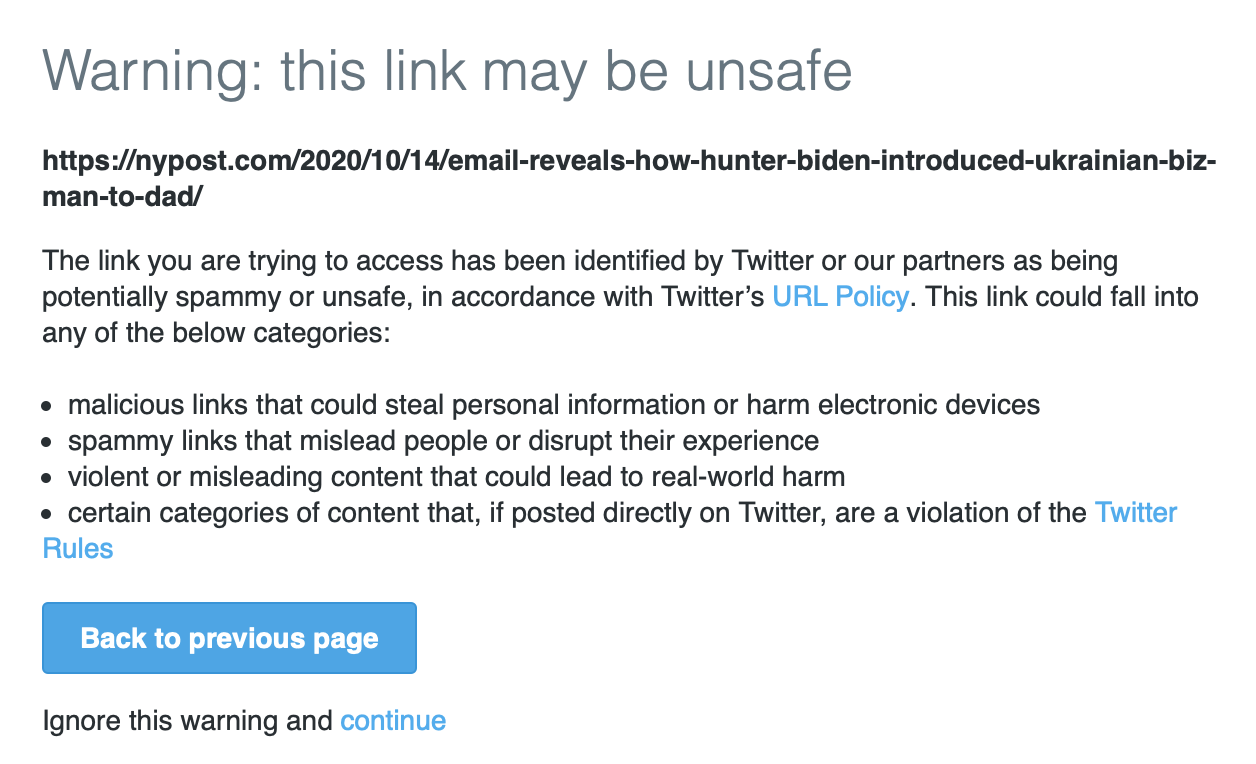
Twitter went even further. It blocked the story on its site — if you clinked a link to the story, you saw this:
Twitter banned users from tweeting the link, and even from sending it to one another via direct message:
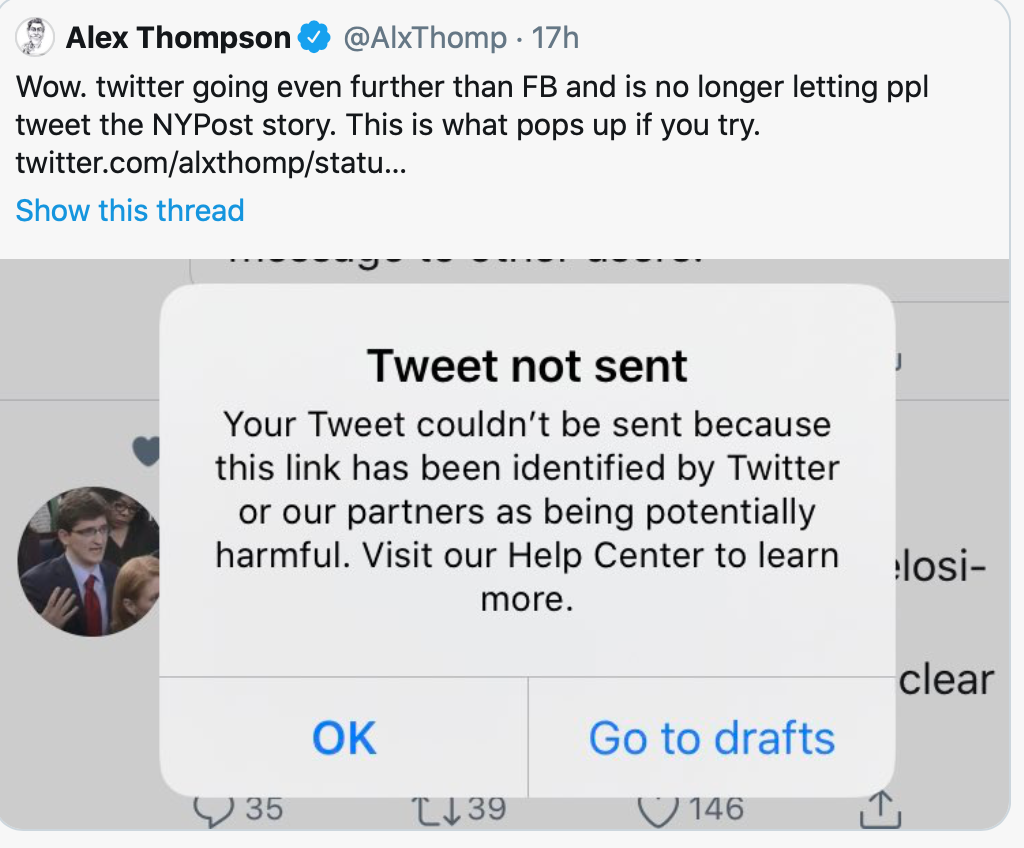
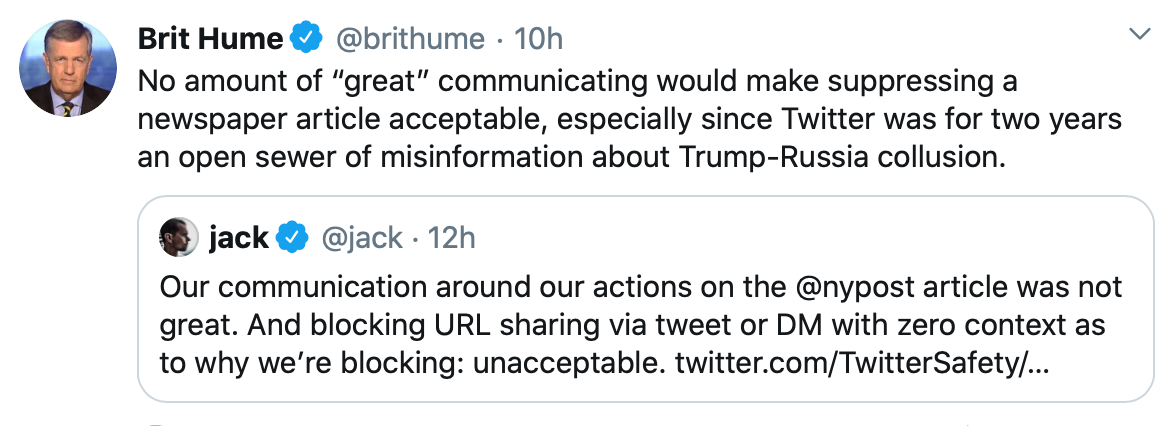
There was no doubt Twitter’s move was politically-motivated censorship. Block stories of dubious provenance? Well, if you want to tweet the Steele dossier — the most outrageous disinformation of recent years — Twitter has no problem at all. Later, Twitter founder Jack Dorsey began to try to explain himself, apologizing not for blocking the New York Post report but for not explaining carefully enough why he was blocking the report. “Our communication around our actions on the @nypost article was not great,” Dorsey tweeted. “And blocking URL sharing via tweet or DM with zero context as to why we’re blocking: unacceptable.” Again, no apology for censoring content — an apology for not fully justifying the censorship.
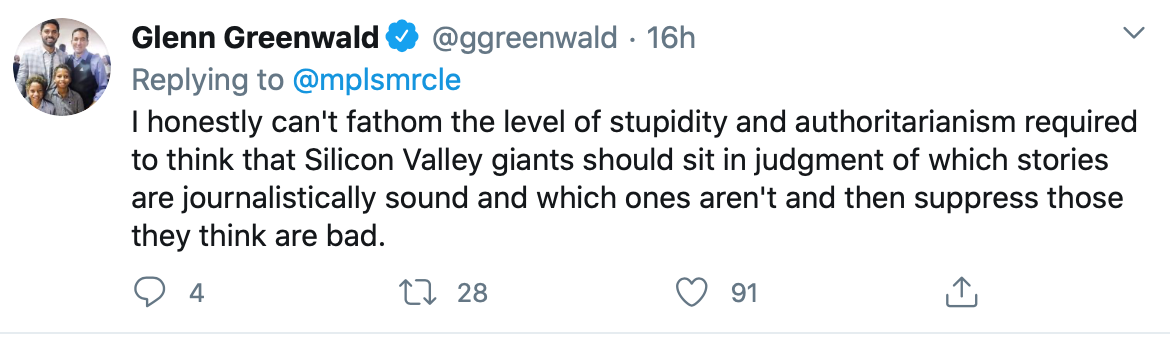
But the censorship can’t really be explained as anything other than pure censorship. And fortunately, some of the most effective condemnations of Twitter’s censorship came…on Twitter. We’ll end with a look at a few of those:
.png)
