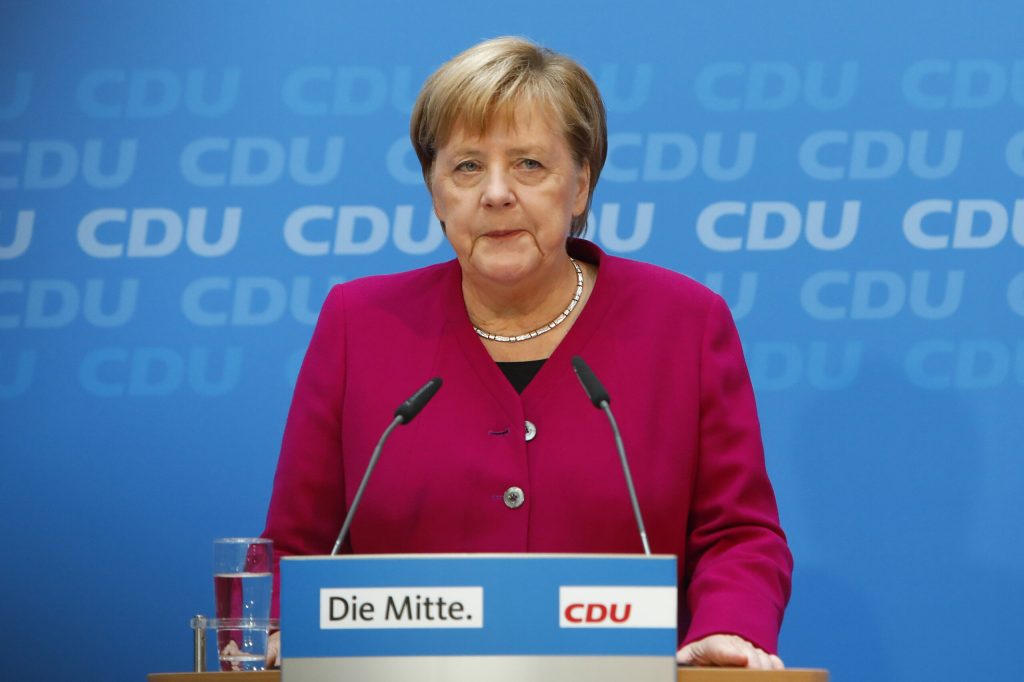
Every so often, one of the Middle Eastern migrants Chancellor Angela Merkel invited to Germany in the autumn of 2015 commits a horrible crime, and headaches for her coalition government ensue. There ought to be nothing surprising about this: About a million and a half people, most of them young men, drifted into Germany after Merkel’s appeal. Even if they committed crime at German rates, you could expect a murder a month and several sexual assaults. But when a 35-year-old local carpenter was stabbed to death at the end of August, allegedly by a pair of Middle Eastern migrants, in the city of Chemnitz, Germans suddenly lost their inclination to take such things in stride. Chemnitz, formerly Karl-Marx-Stadt, filled up with thousands of anti-immigration marchers, some of them making Hitler salutes and harassing foreign-looking people. These incidents were captured on video, and the fallout brought Merkel’s government to the verge of collapse.
Germany has a basic problem. As the columnist Berthold Kohler put it, the country cannot decide whether it has more to fear from Ausländer (foreigners) or Ausländerfeinde (xenophobes). The public is firmly of the former view. The government is invested in the latter. Eventually the public will win, because it has an internal logic and Merkel’s coalition does not. In three out of the four most recent elections, neither of the traditional establishment parties has been able to muster a governing majority. So the two have formed a “grand coalition,” which Merkel has held together by pursuing the agenda of the (once-socialistic) Social Democrats in the name of her own (once-conservative) Christian Democrats. People gave both parties historic drubbings at the polls last fall, with the Social Democrats falling to barely a fifth of the vote. The result was a narrower majority for Merkel, a much bigger role for the Social Democrats (who then had to be bribed with cabinet posts to agree to renew an arrangement that had so damaged them), and a veto on almost all policy for one of the rare conservatives in Merkel’s cabinet, interior minister Horst Seehofer of Bavaria’s Christian Social Union.