

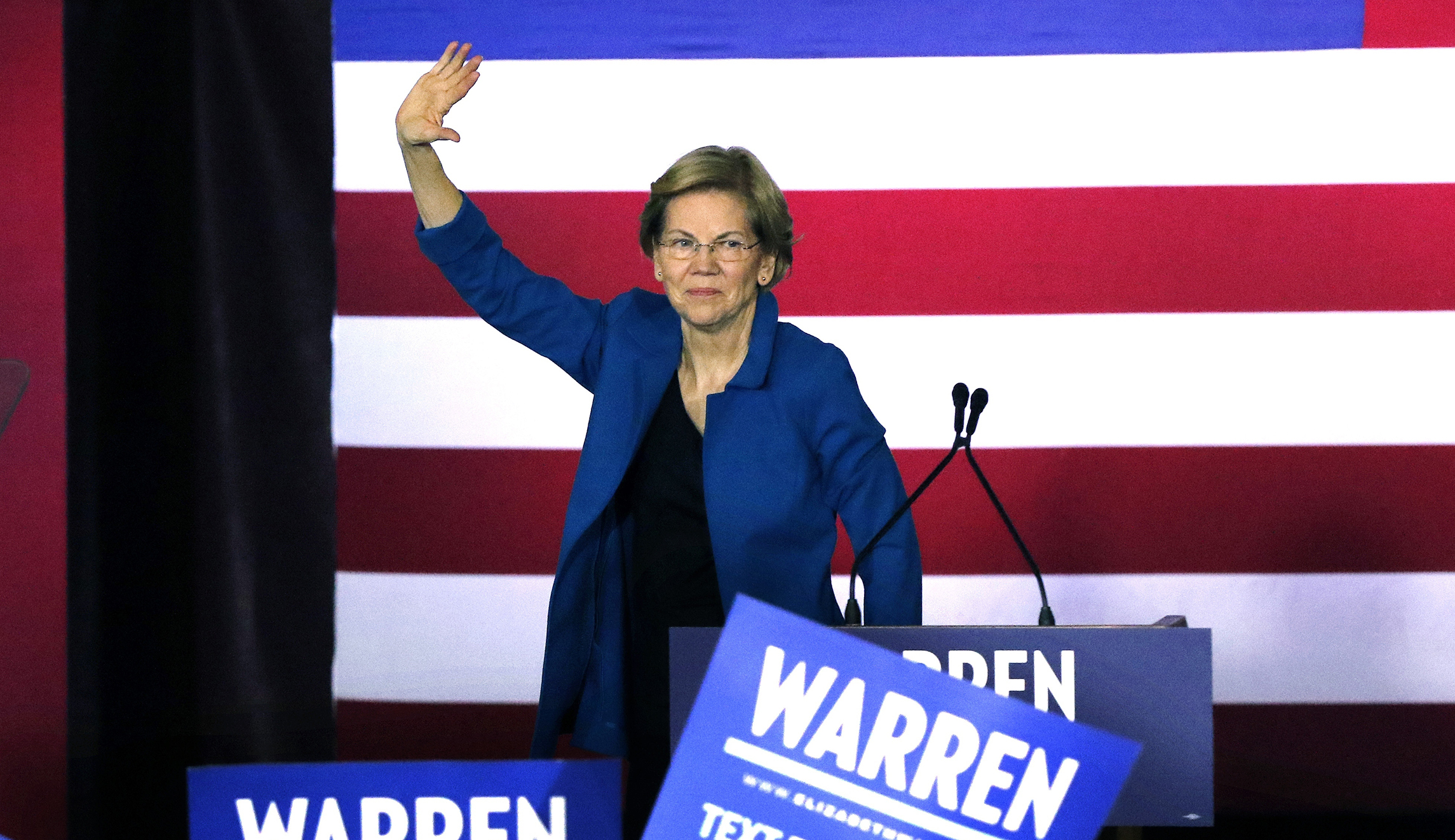
MANCHESTER, New Hampshire — For a brief moment, concerned looks crossed the faces of some Elizabeth Warren supporters gathered for her election night event in a cavernous building near the Manchester airport. There were no TVs visible to most of the crowd, a common feature for a struggling campaign that doesn’t want the audience to see bad news. There was no warmup speaker. At 8:20 p.m., facing a fourth-place finish in New Hampshire after a third-place showing a week ago in Iowa, Warren walked onstage without fanfare.
She began by acknowledging that Bernie Sanders and Pete Buttigieg “had strong nights.” Then, she congratulated Amy Klobuchar for her surprise showing. And then, she said what caused those concerned looks.
Recommended Stories


“Since we’re here tonight among family and friends, I also want us to be honest with ourselves as Democrats,” Warren said. That’s when some quietly thought: Wait a minute. Where is she going with this? Is she going to quit?
“She came out, and the way she started, it sounded like she was going to throw her support behind Klobuchar,” said one slightly rattled fan.
“I thought she was going to endorse Amy for a minute there,” said another.
Instead, Warren delivered a plea for party unity, which she suggested could somehow be achieved in the middle of a deeply fractious nomination battle. The Democratic Party could be “headed for another one of those long primary fights that last for months,” she said. Battling between factions has “taken a sharp turn in recent weeks,” she noted, a development that threatens the future of the party. And then she said the solution was … Elizabeth Warren. “Our campaign is best positioned to beat Donald Trump in November — because we can unite our party.”
So, Warren is still in. She has the organization and money to keep going, at least for a few more states. But to what end?
For a while three months ago, Warren, a senator from neighboring Massachusetts, led the polls in New Hampshire. Since then, her trajectory has been down, down, down. What has been remarkable about the last week is how seldom she was mentioned when politicos discussed the latest in primary news. The story was the durability of Sanders’s lead, or Buttigieg’s surge, or the nearly-as-big surge from Klobuchar. Perhaps biggest of all was the implosion of Joe Biden, who led the RealClearPolitics average of New Hampshire polls as recently as Jan. 15.
But nothing about Warren. In some parts of New Hampshire, it seemed as if she did not exist.
By election night, former front-runners Warren and Biden were mired in fourth and fifth place, Warren with 9.3% of the vote and Biden with 8.4%. Both were far, far behind Sanders, who won with 26%.
That left the supporters who joined Warren on election night baffled. What had happened?
“We had hoped she’d do better,” said Brian Pellerin, of Derry, speaking for himself and wife Ann. “I think it might be gender-related — sadly.”
Some pointed to attacks on Warren. Some pointed to a field they said was too big. But a number pointed to Sanders, saying he should not be in the race.
“I like Bernie, I like what he says,” said Pellerin. “But I’m a little scared of the label of socialist … The label is terrible, and the fact that he owns it is a little scary.”
“He shouldn’t have run this time,” said John Tehan, who had come from Milford, Massachusetts, with wife Jen. “I’m disappointed that he did.”
“I’m worried about the heart attack,” added Jen. “I’m not going to bash him for it. One of the things we try not to do is attack other candidates, but it is a concern for me.”
“Do you think he’s too old?”
“Not as much too old, but he’s had a heart attack,” said John.
“Who’s he going to bring in [to the party]?” asked Stephen Gagnon, of Manchester, who supported Sanders in 2016. “It’s just all about Bernie.”
“He’s not my guy,” said Kathleen Hutchins, of Londonderry. “I think he’s too old. I like a lot of his ideas … but I think he’s too old.”
But Sanders was in the race, and he blew Warren away in the so-called progressive lane of the Democratic race.
On Tuesday afternoon, long before any votes were counted, Warren campaign manager Roger Lau sent out a memo trying to find bits of good news from Iowa and New Hampshire. Warren won the most votes in both the bluest county and the reddest county in Iowa, he said. In New Hampshire, she had her best debate-day fundraising, and the campaign hit 138% of its get-out-the-vote goal for phone calls and door knocks.
Lau went on to argue that each of Warren’s rivals, Sanders, Buttigieg, Klobuchar, and Michael Bloomberg, will face problems down the road. Warren is better positioned than they are for the March 3 Super Tuesday contests, he added.
But the fact is, Warren had a lackluster finish in Iowa and did worse in New Hampshire. On Tuesday, she finished far behind the top three, Sanders, Buttigieg, and Klobuchar. She is trending downward while they are trending upward.
Warren’s supporters still cannot figure out quite how it happened. But they sense that she is now in a very difficult position, with no indication that things will get better anytime soon.
