

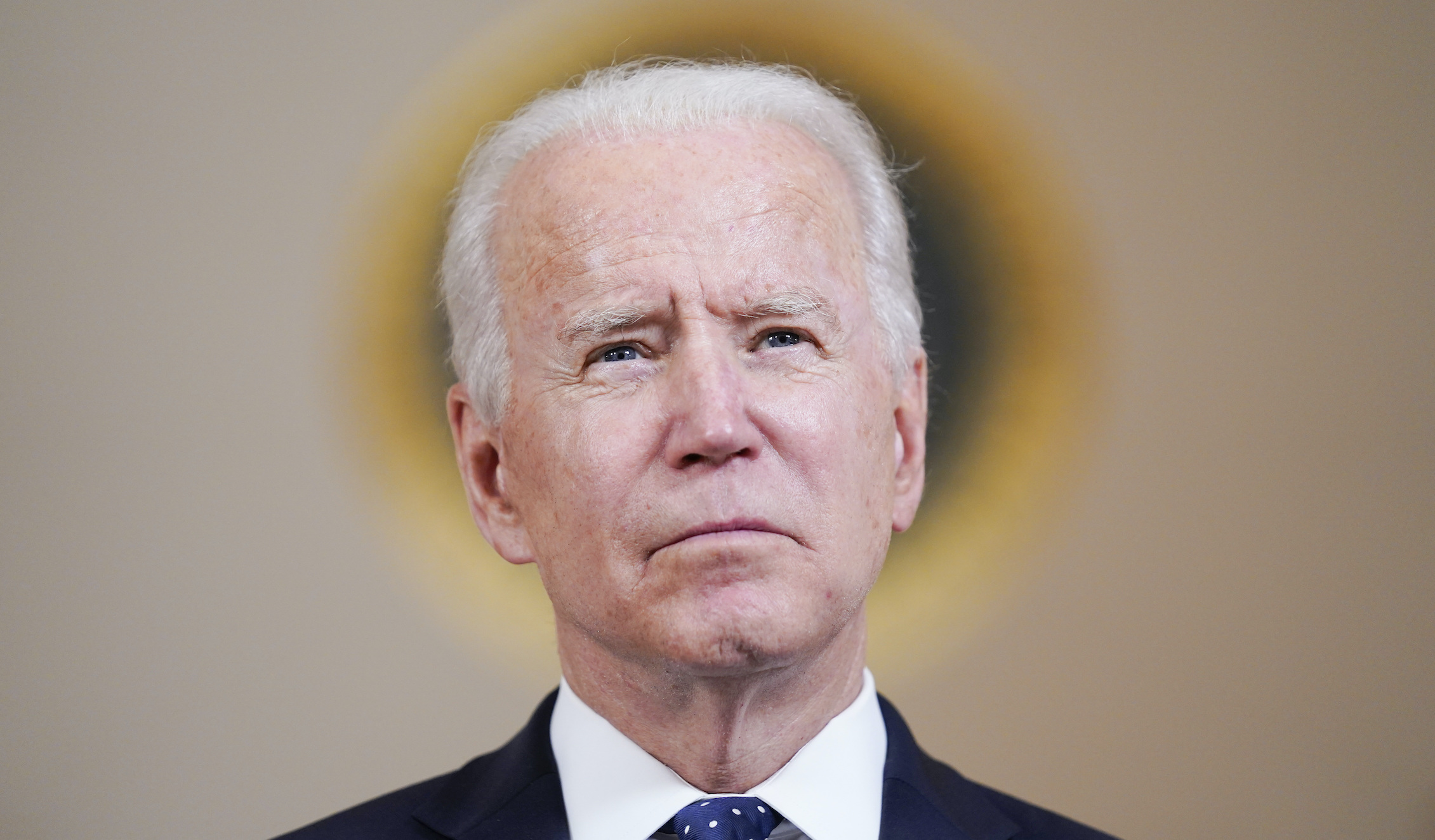
President Joe Biden’s hands-off approach to policing reform will be tested after Congress failed to meet his deadline to pass a legislative response to George Floyd’s death.
Tuesday marks one year since Floyd died under the knee of former Minneapolis police officer Derek Chauvin, who is white, after the 46-year-old black man allegedly used a counterfeit note to buy cigarettes. But after last year’s worldwide protests and racial reckoning, Biden has spent the first 100-plus days of his presidency concentrating on the COVID-19 pandemic, a possible bipartisan infrastructure deal, and a list of global challenges.
Recommended Stories


AWKWARD MOMENTS LOOM FOR MISTAKE-PRONE BIDEN AFTER PANDEMIC
Democrats are not concerned lawmakers missed Tuesday’s deadline — as long as the issue remains a priority for Biden, said Democratic strategist Antjuan Seawright.
“One could argue that direction is more important than speed, but I do think there is a need to get something done sooner rather than later because it’s one of those issues that the American people, above 50%, believe we need to get something done,” he told the Washington Examiner. “And that supersedes Democratic and Republican politics. That’s the American people.”
Seawright said he is satisfied with the White House and the congressional negotiators’ performance so far because he hoped for an end result that “moves the needle, and not just something that checks a box.”
“This has always been on the agenda. But now, I think, more than ever, it has to move up the priority list,” he said.
For George Mason University politics professor Jeremy Mayer, the significance of Biden’s deadline would dissipate if a policing reform bill is sent to the White House “in a month or two.” But Democrats only have a small window of time to enact changes while they cling on to majorities on Capitol Hill, he contended.
“If we get to the midterms, and there is nothing to show, that will hurt Democrats, particularly with black turnout and support,” he said. “If it’s 2024 and nothing has happened on policing in a big way, the Democratic ticket will be hit hard by black activists. It’s like delivering for any part of your coalition, whether you are Republican or Democrat.”
The issue driving a wedge between lawmakers is what is known as qualified immunity, according to Mayer, an academic and author who has written on race in politics. That protects law enforcement from civil liability unless an officer is determined to have violated a suspect’s statutory or constitutional rights, as defined by the U.S. Supreme Court.
“The GOP is probably wise to stand on this ground because it will further cement the loyalty of the only public employee union that leans their way: the police,” he said.
But to the White House’s credit, delegating talks to Congress was a “reasonably smart approach” because, if they tank, Biden can “aggressively enter the debate with his own proposal,” he went on.
Biden is scheduled to welcome Floyd’s family privately to the White House Tuesday to commemorate the first anniversary of his death. Those invited include George Floyd’s daughter Gianna and her mother Roxie Washington; Floyd’s brothers Philonise, Rodney, and Terrence; sister Bridgett; sister-in-law Keeta; and nephew Brandon Williams.
Biden has spoken with the Floyd family intermittently since he met them in person last summer before Floyd’s Houston funeral, during which he delivered remarks via video link. He even called them before Chauvin was found guilty last month of four charges related to Floyd’s death, attracting criticism for telling reporters he was “praying” for the jury to return the “right verdict” after the panel retired to consider the evidence.
“We’re all so relieved,” Biden told Floyd’s family afterward. “We’re going to get a lot more done.”
“Nothing can ever bring their brother, their father back,” he added during a prime-time speech. “But this can be a giant step forward in the march toward justice in America.”
White House press secretary Jen Psaki defended Biden’s policing reform strategy and May 25 deadline, which was set last month during the president’s first address to a joint session of Congress. She has repeated his position the George Floyd Justice in Policing Act is the right bill to “rebuild trust in communities” as part of his “bold and ambitious” agenda.
On Monday, Psaki said Biden spoke to New Jersey Sen. Cory Booker as recently as last Friday and that the president was encouraged by the “path forward.” Booker and California Rep. Karen Bass are the top Democratic negotiators working with South Carolina Republican Sen. Tim Scott on the bill. Their discussions have been contrasted with less successful efforts for their length and narrow focus, as well as the level of trust and lack of leaks.
“While we are still working through our differences, we continue to make progress toward a compromise and remain optimistic about the prospects of achieving that goal,” the trio wrote in a statement Monday.
White House adviser Cedric Richmond, a former chairman of the Congressional Black Caucus, sought to ensure black Democrats the Biden administration was “going to give 200% to try to make [policing reform] happen” last weekend during an interview with CNN.
“The president called for it by the anniversary, but meaningful talks are still going on, and it’s better to have a meaningful bill than worry about a deadline,” he later told MSNBC.
The George Floyd Justice in Policing Act passed the House in February but has yet to receive a vote in the Senate. The bill introduces measures to enhance law enforcement misconduct transparency, accountability, and data collection, including federal funding for body cameras and a “bad cop” list. It also outlines best practices and training requirements while rolling back policing tactics, such as “no-knock” warrants and choke-holds.
Disagreements over qualified immunity, which shields police officers from some lawsuits, and Section 242, which covers the use of excessive force, are being blamed for holding up the process.
CLICK HERE TO READ MORE FROM THE WASHINGTON EXAMINER
Biden is simultaneously attempting to strike a bipartisan deal for “hard” infrastructure worth $1.7 trillion after muscling through his $1.9 trillion coronavirus spending package in March.
