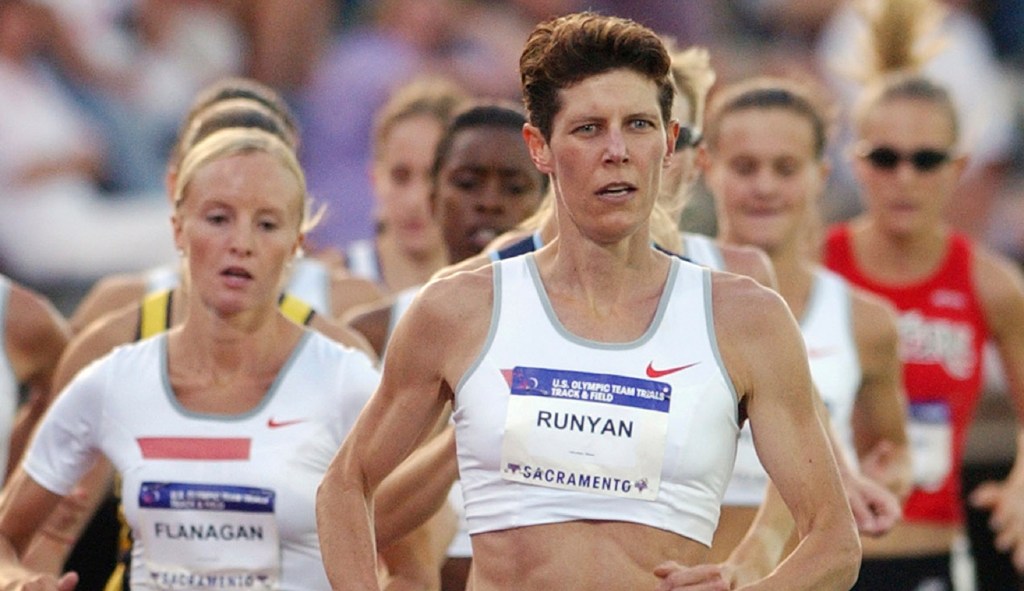
There are many athletes with disabilities who perform exceptionally well at the Paralympics. But aside from four gold medals at the 1992 Barcelona Paralympic Games, Marla Runyan won the 1500 meters at the Pan American Games in 1999, finished eighth over the same distance at the 2000 Summer Olympics in Sydney, and won the United States 5000 meters three times in a row in 2001, 2002, and 2003. Runyan is legally blind — she can see the feet and the colors of her competitors’ jerseys and the red surface of the running track, but she can’t see the finish line. In her autobiography, No Finish Line: My Life As I See It, she explains: “When I run a race, I don’t always know whether I’ve won or lost. I can’t see the clocks, or the lap counters, or the scoreboards. I only know that the finish is at the end of the straightaway.”
At the age of eight, she noticed a blob before her eyes. One day, her teacher called Runyan’s mother and told her to have Runyan’s eyes checked because she could only read if her books were no more than a few inches from her face. Over the next few months, Runyan’s mother took her from one doctor to another. One said it must be psychosomatic, and her mother and father stayed up all night desperately trying to work out whether it was their parenting that was causing the problem. Then, they went to a nutritionist who advised Runyan to stop eating Rice Krispies and drinking 7UP. But changing her diet did not help.