

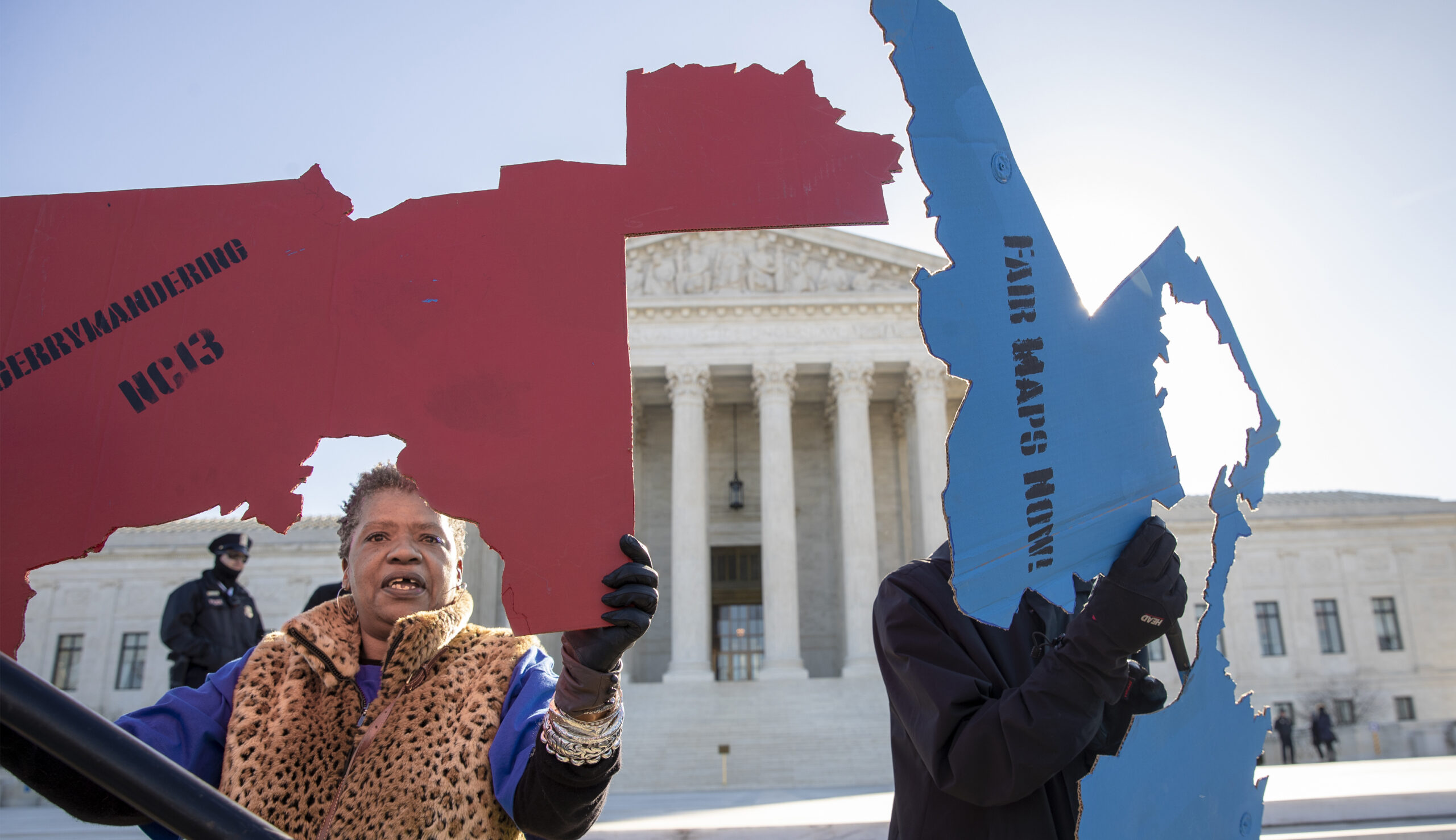
The Supreme Court on Thursday ruled that claims of partisan gerrymandering are beyond the reach of the federal courts, delivering a sharp blow to challengers who hoped the justices would endorse a standard for determining when a map is so infected with politics it violates the Constitution.
The court split 5-4 along ideological lines, with Chief Justice John Roberts writing for the conservative majority. The ruling, in two cases involving voting maps from Maryland and North Carolina, effectively forecloses the courts to hearing future partisan gerrymandering claims.
Recommended Stories


“We conclude that partisan gerrymandering claims present political questions beyond the reach of the federal courts,” Roberts wrote. “Federal judges have no license to reallocate political power between the two major political parties, with no plausible grant of authority in the Constitution, and no legal standards to limit and direct their decisions.”
Roberts noted that the high court has never struck down a partisan gerrymander as unconstitutional despite multiple requests to do so and warned that if the court were to weigh in on such claims, it would mark an expansion of judicial authority “into one of the most intensely partisan aspects of American political life.”
“Consideration of the impact of today’s ruling on democratic principles cannot ignore the effect of the unelected and politically unaccountable branch of the federal government assuming such an extraordinary and unprecedented role,” Roberts wrote.
But Justice Elena Kagan, writing for the Supreme Court’s liberal bloc, said the two gerrymandered maps before the court “violated the constitutional rights of many hundreds of thousands of American citizens and warned that “in giving such gerrymanders a pass from judicial review, the majority goes tragically wrong.”
“Of all the times to abandon the court’s duty to declare the law, this was not the one,” Kagan wrote. “The practices challenged in these cases imperil our system of government. Part of the court’s role in that system is to defend its foundations. None is more important than free and fair elections.”
The two cases before the high court — one from Maryland and one from North Carolina — marked the second time in so many years the justices were confronted with questions of whether the practice of drawing maps to entrench the party in power runs afoul of the Constitution and whether such challenges can be adjudicated by the courts.
Those questions evaded the justices in their last term, when the Supreme Court heard the Maryland dispute and a separate partisan gerrymandering case involving Wisconsin’s legislative map. The court issued technical rulings in those cases and sent them back to the lower courts.
Then, challengers had hoped Justice Anthony Kennedy would help craft a workable standard for determining when partisan gerrymandering is unconstitutional, but the justices were unable to come up with such a test.
Kennedy retired from the high court last year and was replaced by Justice Brett Kavanaugh, whose views on partisan gerrymandering were a mystery, as he never confronted the issue as a judge on the federal appeals court in the District of Columbia.
The case out of Maryland centered around GOP voters in the state’s 6th Congressional District who claimed Democratic lawmakers retaliated against them for their support of Republicans in violation of the First Amendment. The district had been held by Republican Rep. Roscoe Bartlett for more than 20 years until 2012, the first election held after the district was redrawn, when he was unseated by a Democrat.
A three-judge panel in November ruled the district lines were unconstitutional and ordered the state to draw new ones.
In the North Carolina case, which involves the state’s full congressional map, Democratic voters argued the GOP-controlled state legislature drew the voting lines to undercut Democrats’ chances of getting elected. With the Republican-drawn map in place, the GOP won 10 of the state’s 13 congressional districts while Republican candidates won 53% of the statewide vote in 2016.
A three-judge panel there struck down the map as an unconstitutional partisan gerrymander and noted comments from state Rep. David Lewis, a Republican, who explicitly stated in 2016 the districts were drawn with politics in mind.
“I think electing Republicans is better than electing Democrats,” he said. “So I drew this map to help foster what I think is better for the country.”
The court tossed out the lower court rulings invalidating the North Carolina and Maryland voting maps and instructed the lower courts to dismiss them for lack of jurisdiction. While the Supreme Court has ruled that racial gerrymandering is unconstitutional, it has never struck down maps as being so infected with politics they violate the Constitution.
Opponents of the practice had hoped the court would issue a ruling that set a standard for when partisan gerrymandering crosses a constitutional line, especially as state legislatures gear up for the next round of redistricting after the 2020 census.
States, meanwhile, have undertaken their own efforts to combat partisan gerrymandering, with voters in a handful approving ballot measures in November to reform the redistricting process.
Roberts highlighted the efforts at the state level, as well as legislation passed by the Democrat-controlled House this year that would require states to establish independent redistricting commissions to draw voting lines, and noted other avenues exist for rooting out partisanship in the redistricting process.
Karen Hobert Flynn, president of Common Cause, which challenged North Carolina’s map, said the battle over partisan gerrymandering must be fought elsewhere.
“Without recourse to the Supreme Court, the American people must continue to take the battle to the state courts, to the polls, and to the streets, to make their voices heard and to end partisan gerrymandering once and for all,” she said in a statement.
