

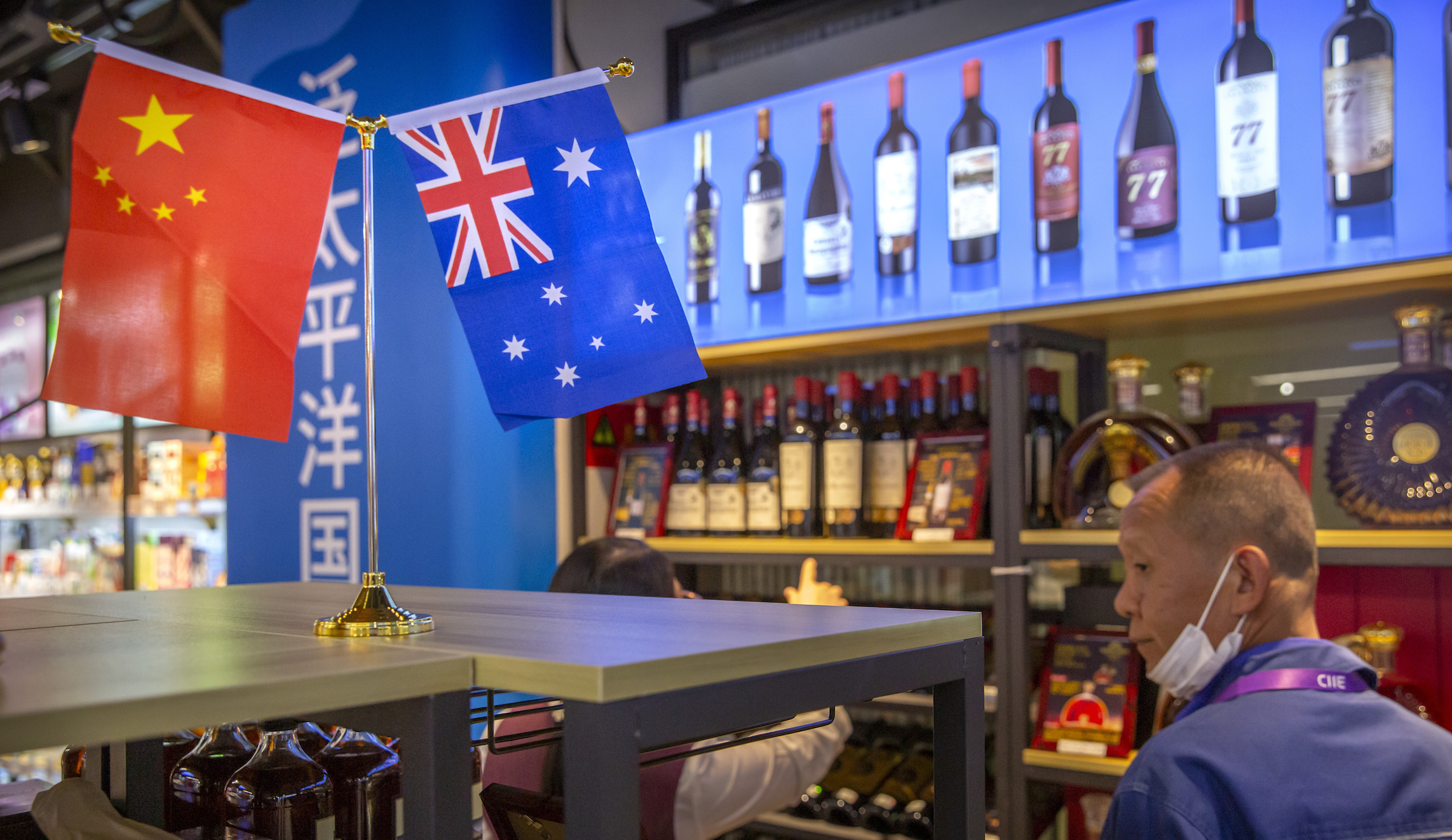
China is using its economic leverage over Australia to punish the key U.S. ally for criticizing Beijing and warn other countries against partnering with Washington, according to diplomatic sources and analysts.
“There’s no mystery anymore: This is a bully,” said the American Enterprise Institute’s Dan Blumenthal, author of the new book The China Nightmare. “They coerce, and they intimidate smaller countries if those countries dare to cross them.”
Recommended Stories


Chinese officials have directed a series of rhetorical barbs and economic sanctions against Australia in the months since Canberra led an international call for an investigation into the origins of the coronavirus pandemic. Yet the root of the acrimony runs deeper than that dispute, as Australian officials say openly they need to improve their military due to the growing risk of conflict with China’s People’s Liberation Army.
“A number of countries — but, in particular, China and the PLA — have grown very sophisticated capabilities [to the point] where Australia’s regional superiority is very much in question,” Australian Defense Secretary Greg Moriarty said last week during an event with Australian National University’s National Security College. “We wish to regrow our deterrent capability … to hold at risk an adversary’s assets and infrastructure.”
That project puts a premium on cyberattack capabilities and “potential hypersonic missiles” to strike prospective Chinese military assets.
“We will be investing very significantly in these capabilities to be able to hold an adversary at risk at longer range,” Moriarty said. “It’s about changing an adversary’s risk calculus.”
That desire reflects a wariness about China’s ambitions that has moved Australia to the vanguard of countries seeking to prevent Beijing from gaining leverage in key foreign capitals. Australian investigators have exposed how China’s United Front network sought to turn prominent Australian politicians into clients of the Chinese Communist Party. Australia also banned Huawei from its next-generation wireless technology networks in 2018, due to the tech giant’s suspected ties to Chinese intelligence agencies, and leapt to build a high-speed internet cable to the Solomon Islands and Papua New Guinea in order to prevent Huawei from gaining the contract.
Moriarty’s remarks also suggest that Australia and other members of the Quad — a quartet that also includes the United States, India, and Japan — may look to aid each other in a conflict with China, even if they stop short of establishing the “mini-NATO” that Beijing fears.
“It’s quite obvious that the Australians feel … the threat perception obviously is increasing,” an Indo-Pacific official said. “So there will be certain noises being made, certain steps being taken to say that we need to equip ourselves for a situation which could come up as a result of [China’s] aggressive behavior.”
Chinese officials have used several maneuvers to target Australian exports, starting in May with a decision to suspend the imports from Australia’s four largest beef producers. Throughout the fall, dozens of ships bearing Australian coal crowded the coast of mainland China, only to hear after months of silence that Beijing has a new misgiving about the “environmental” quality of the coal. In late November, Australia’s world-renowned winemakers learned that China would impose tariffs that spike the cost of the drinks by roughly 200%. And Chinese Communist propaganda organs are clear about Beijing’s political motives.
“Australia needs to really change its attitude towards China and make adjustments in its actions, instead of helping the United States bite China,” state-run Global Times editor Hu Xijin said last week. “Otherwise, I predict that China-Australia relations will hardly pick up, and Australia will continue to pay the price for its unreasonable China policy.”
For Australian leaders and Indo-Pacific strategists, these economic disputes are skirmishes in a very high-stakes competition for influence and security. “If this goes on without any recalibration by China, the chances of some kind of an accident, some kind of a problem or conflict, is very real,” the Indo-Pacific official also said. “So you have to be ready for that, you have to be prepared.”
That preparation has been underway for years, often in places far removed from the most obvious global power centers. When Secretary of State Mike Pompeo visited the Federated States of Micronesia last year, he sought to preserve an obscure agreement that prevents China from acquiring the access to ports that would let the PLA cut U.S. military supply lines from Hawaii to Guam. And as Australian officials watched China cultivate influence in the Solomon Islands, they, too, understood that Beijing’s maneuvering to expel American forces retraced the steps that Japan took to isolate Australia from the U.S. and other countries in the region.
“Australia has no interest in being caught inside a hard sphere of Chinese influence,” the Heritage Foundation’s Jim Carafano said. “If you look today, where the Chinese are looking to get themselves in, in all these little islands … these are exactly the places that the Japanese wanted to go in 1942 and for exactly the same reasons.”
That analysis helps explain Australia’s willingness to “bite the bullet” and bear the economic costs of angering China, according to Carafano. It also illuminates China’s incentive to target Australia’s economy, in order to deprive Canberra of the funds needed to pay for such military upgrades and investment in Pacific island countries.
“We have to wait and see how this can actually translate into action,” in light of the economic fallout from the pandemic, the Indo-Pacific official added. “Very few countries will be able to allocate the large amount of resources that would be required for really upgrading some of your weaponry.”
Those concerns might warrant an effort by the U.S. and democratic allies to pool resources to help Australia win the economic battle with China, according to Blumenthal, the AEI scholar.
“We should organize a global, free-world effort right now to buy up what’s being boycotted in Australia,” he said.
