

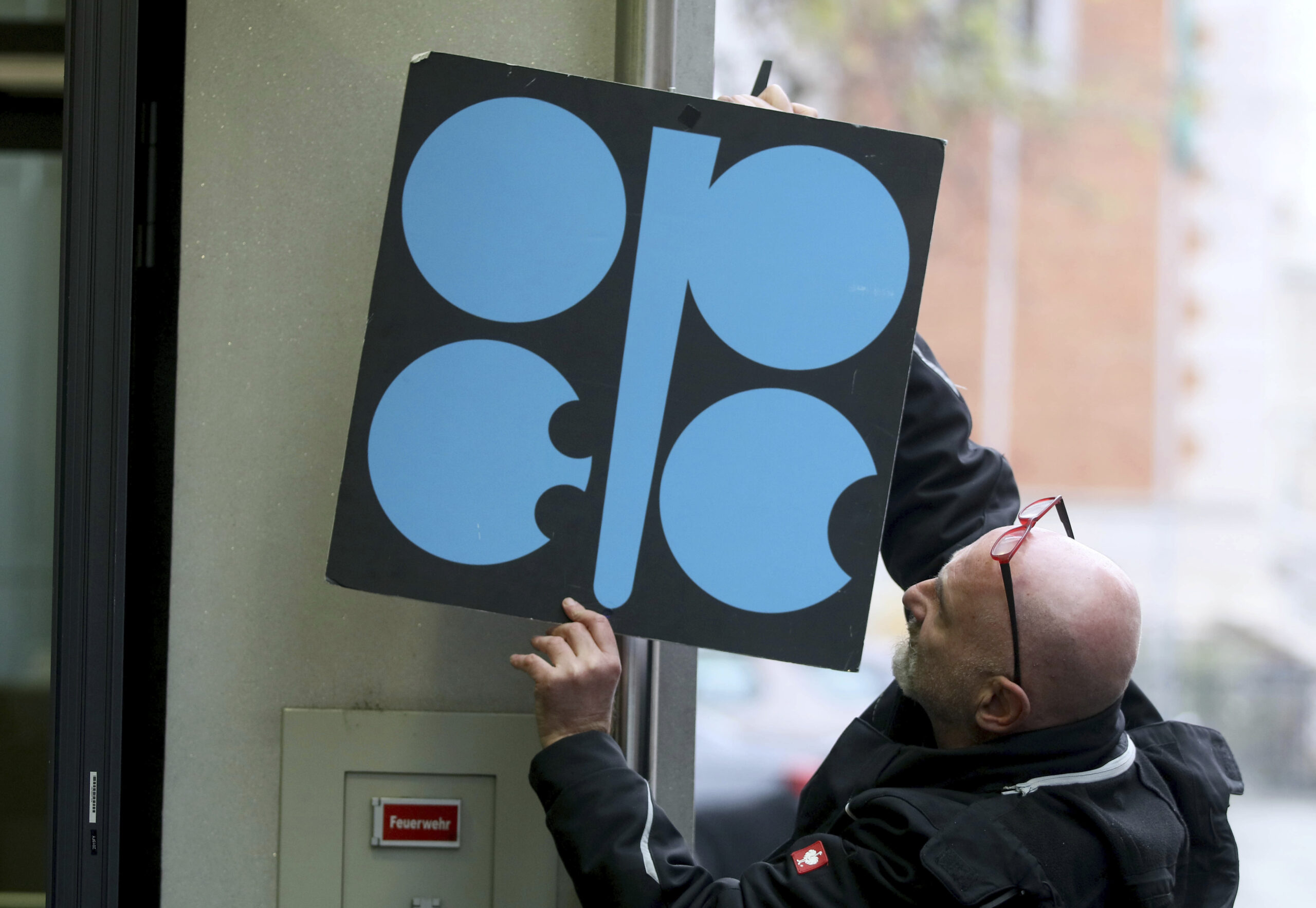
Energy security advocates and one of President Trump’s top energy confidantes have been pushing a way the president could keep better tabs on OPEC.
The creation of an OPEC commission was an idea suggested to Trump by Rep. Kevin Cramer, R-N.D., during the presidential campaign. He has been in touch with senior Trump aides to discuss the commission and says it can be created by executive action.
Recommended Stories


“He and I have not personally talked about it for a long time,” Cramer told the Washington Examiner. “However, I have on a pretty regular basis been in touch with folks in the White House.”
He admits that with former White House international energy aide George David Banks gone and Mike Catanzaro leaving it will be challenging to stand up the commission. “They’re the ones with the most institutional knowledge of my request in terms of an administrative approach, which is quite honestly, the most likely,” Cramer said.
The idea of a commission to monitor OPEC came to fore publicly Friday after Trump tweeted about the oil cartel being “at it again” by “artificially” driving up oil prices.
“Looks like OPEC is at it again,” Trump tweeted. “Oil prices are artificially Very High! No good and will not be accepted!”
Oil prices reached a three-year high of above $69 per barrel the week of April 20. Prices quickly slumped after Trump’s comments.
But the fact remains that the Saudi-led coalition of OPEC and non-OPEC countries are keeping supply cuts to drive up the price. The OPEC commission, or “energy security commission,” would look to monitor and report that type of activity, which runs counter to free-market principles.
Cramer introduced legislation to create the special commission in 2017, but the best approach now would be to have Trump create it administratively, through executive order, he said. However, if the White House chooses that route, the commission likely would look a little different than the idea he originally proposed.
“What I suggest to the White House is that we form a commission basically as the legislation describes it, but we would call it an ‘energy security commission’ to not just confine it to OPEC nations,” Cramer said. “I think that has proven to make sense given the recent partnership with Russia” as a non-OPEC member of the Saudi-led coalition trying to drive up oil prices, he said.
Cramer is not sure what Trump will do or if the commission was on his mind when he tweeted Friday morning. “When the president tweets something you never know what causes it, but I suspect it’s some of the ongoing discussion,” Cramer said. “It certainly creates an opportunity for me to follow up both legislatively and with the administration to say, ‘Hey, we do have a template here that might make some sense.’”
Cramer said that even dropping legislation creates “buzz” around the world that the U.S. is serious about keeping a closer eye on market manipulation.
Robbie Diamond, one of Washington’s top energy security advocates, also has been in talks with the White House about setting up the commission. Diamond is the president and CEO of Securing America’s Future Energy, a group made up of former senior military officials and current industry CEOs to advocate for policies that keep energy supplies stable for the United States.
Diamond was one of the first to respond to Trump’s tweet with a statement saying now is the time to establish the commission.
“Just as they called out steel and aluminum and created commissions to look at should they put on tariffs or not, clearly oil rises even higher than those, because if oil markets get out of control, and we allow people to continue manipulating it, the entire economy can stop in its tracks,” Diamond said in an interview. He says oil needs to be the highest priority on the president’s list of national security interests.
Diamond said the shale oil boom, in which the U.S. has become a major oil producer, has led the nation into “complacency” by making Americans think the nation no longer needs to worry about oil from abroad. But as oil prices rise, it will become obvious that the U.S. is still affected by global markets.
“We’ve had lots of meetings at the White House as well as on Capitol Hill, and I think people have been interested in [the commission],” Diamond said. “But when oil prices are low, other things rise to the top of the agenda, and it won’t be the first administration, or the first set of political leaders, who have been burned by not doing the long-term things we need to deal with this problem.”
Still, some Trump donors see U.S. shale production as a way to keep oil prices from climbing out of control.
“The soaring oil price is a result of excess supply burned off due to Hurricane Harvey, synchronized global growth and the OPEC supply reduction,” Dan Eberhart, an oil service magnate and Trump donor, told the Washington Examiner. “A mitigating factor would be soaring U.S. shale production.”
“I think Trump is mostly at the mercy of the oil markets similar to the way he is at the mercy of the stock market,” Eberhart said. “He can impact prices around the edge with macro geopolitical or policy events but has little direct ‘control.’”
Eberhart is CEO of Canary, which provides well equipment for drillers in shale oil and natural gas fields.
