

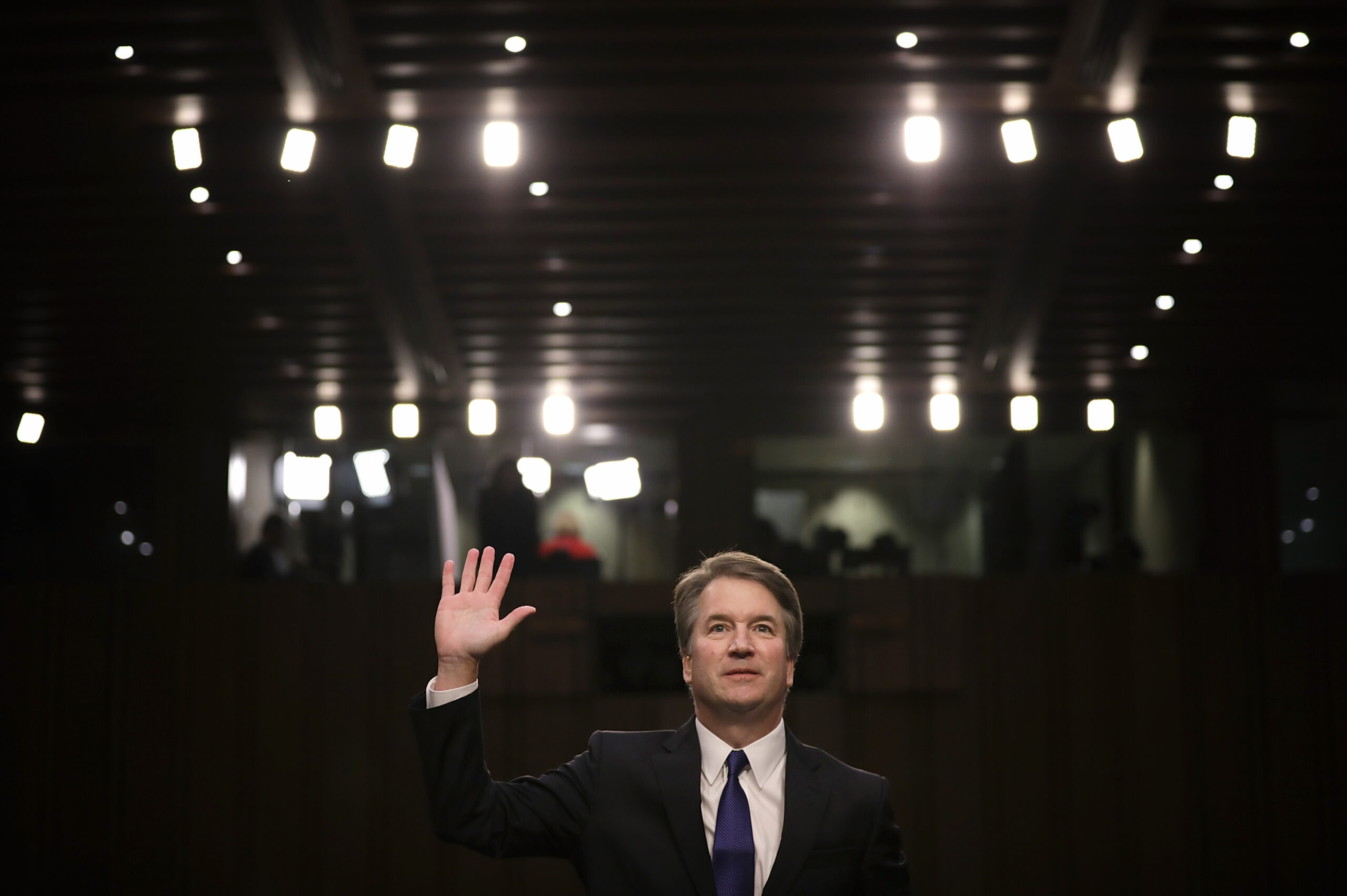
Watching the Democratic party and its cheerleaders in the media pretend they care about what Brett Kavanaugh did in the early 1980s is quite a spectacle. Nearly every day, the Washington Post or the New York Times or the Atlantic runs another piece on the author’s experience with sexual assault or the party culture at Georgetown Prep and Yale—all designed to suggest that Kavanaugh did what Christine Blasey Ford says he did but without supplementing the meager and contradictory evidence so far adduced to support her allegation.
The work of innuendo and evidence-free suggestion will, we assume, continue all week. On Sunday night the New Yorker posted a report in which a woman, Deborah Ramirez, claims that, as a student at Yale, she was once a victim of Kavanaugh’s aggressions. The piece prefaces Ramirez’s accusation, however, with this amazing specimen of deceptive euphemism:
Recommended Stories


Those six days of careful memory-assessing and attorney-consulting led Ramirez to the view adopted by Senate Democrats—namely that Brett Kavanaugh is a terrible person and must be stopped. By contrast to the Blasey Ford allegations, however, this time there’s corroboration—sort of. Another Kavanaugh contemporary has confirmed Ramirez’s maybe-probably-definitely recollection:
Come on.
This was too much even for the New York Times, which couldn’t substantiate the new claims and in an understated but blunt critique of the New Yorker noted the problems with the story:
Let’s review. The chief witness couldn’t be sure that she was correct in leveling her accusation so she called around seeking to confirm her suspicions. Finding no other first-hand witnesses, she spent six days “assessing her memories” with the hope that they might tell her what preceding 35 years could not. Eventually, she pronounced herself “confident enough” to say something happened. The New Yorker couldn’t even place Kavanaugh at the party in question and the only support for these newly-assessed memories comes from an anonymous, secondhand witness who could only say he “was told” it happened.
To take any of this seriously, we fear, is to forget that few of the progressive politicos and journalists bent on defeating Kavanaugh’s confirmation actually cares about what he did or didn’t do as a teenager. The concern here has exclusively to do with his judicial philosophy and, in particular, abortion. We would have far more respect for Congressional Democrats and liberal journalists if they would simply state the nature of their objections to Kavanaugh and save us all from this defamatory pantomime.
On that score, we commend Sen. Mazie Hirono of Hawaii for exhibiting a bit of honesty, inadvertent though it probably was. Asked by CNN’s Jake Tapper if Kavanaugh has the same presumption of innocence as everyone else in America, Hirono said: “I put his denial in the context of everything that I know about him in terms of how he approaches his cases.” “He has,” Hirono went on, “a very ideological agenda.”
The point, in other words, isn’t whether Kavanaugh is actually guilty of the conduct of which he’s been accused. The point is: he’s a conservative.
It was a chilling admission: Hawaii’s junior senator believes a man is guilty of a crime because of his worldview and his judicial philosophy. Still, it beats the feculence flung by her fellow Democrats and their allies in the media. If only more of them would say what they so obviously think—that Kavanaugh is guilty because he doesn’t share their views.
