

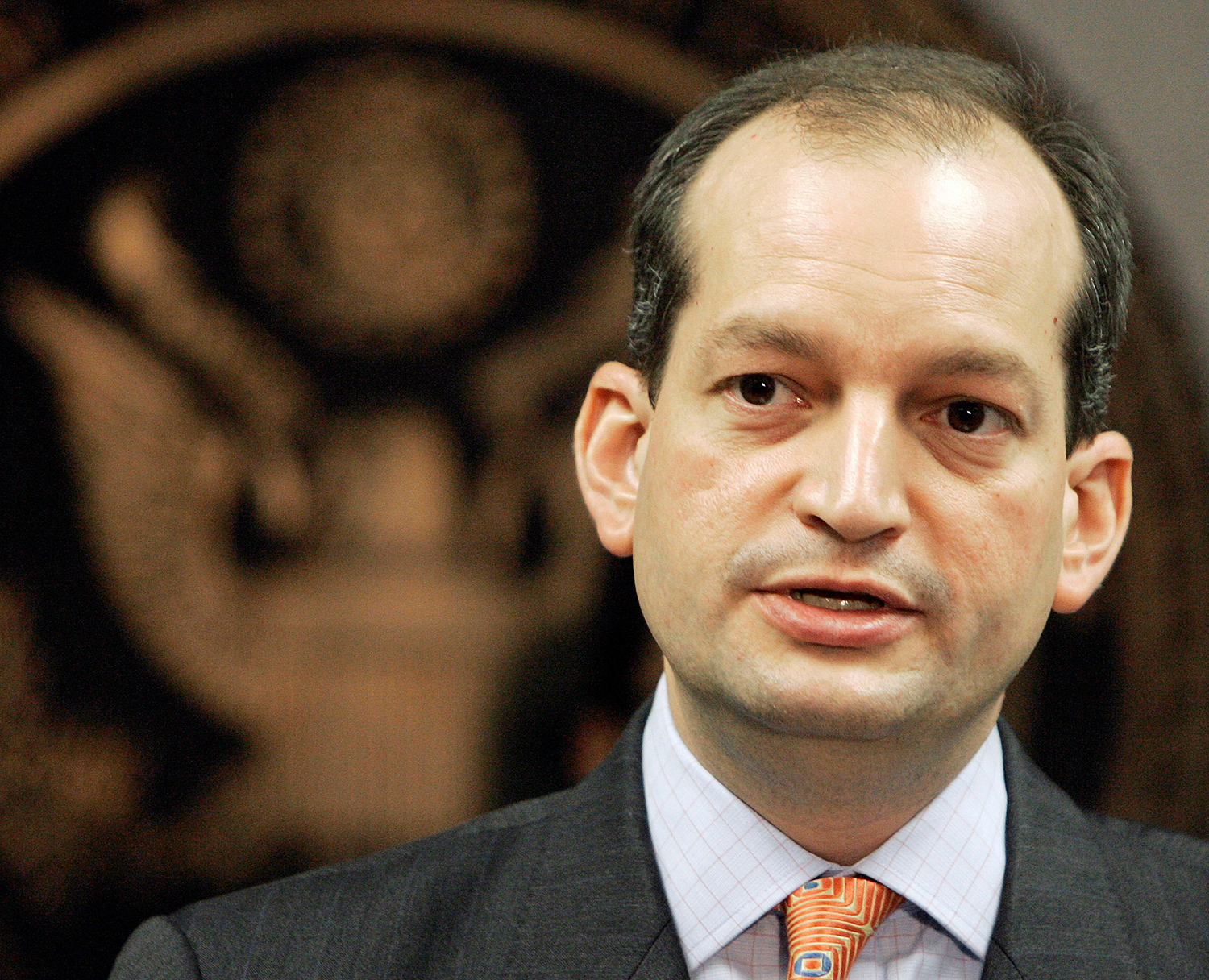
President Trump’s nominee to head the Labor Department, Alexander Acosta, had a notable career as a civil rights lawyer and advocate for minorities while working at the Justice Department. That raises the question of how Acosta, the son of Cuban immigrants, would enforce immigration laws under the Trump administration.
Recommended Stories


While Justice and Homeland Security are the most prominent departments in enforcing immigration policy, the Labor Department has a significant role as well since immigration enforcement often involves workplaces.
The Labor Department is the first stop for certifying foreign workers for visa programs. How rigorously it enforces those rules is a major factor in determining how many immigrants come into the U.S. Its workplace investigations can uncover illegal hiring, though the policy under former President Barack Obama did not prioritize alerting immigration authorities to people without proper documentation.
It is a mystery even to the people who closely follow labor law how Acosta would navigate the issue. He served for one year on the National Labor Relations Board, but otherwise little of Acosta’s career has involved labor issues.
“He is not known as an ideologue. He is not known for taking the strident approach,” said Rich Meneghello, a labor lawyer for the management-side firm Fisher and Phillips. Beyond that it is a gray area.
Ali Noorani, executive director of the liberal National Immigration Forum, said much will depend on what Acosta says at his Senate confirmation hearing.
“He does know what the proper role of the government is in terms of protecting minority rights,” Noorani said. The question is whether Acosta will be a “constructive voice” in the administration or just take orders. “Those are the questions he has to answer.”
Noorani notes that Trump’s previous pick for labor secretary, fast-food businessman Andrew Puzder, downplayed his prior support for immigrant rights after he was nominated.
Conservative anti-immigration groups are wary of Acosta for essentially the same reason. Robert Law, legislative director of the Federation for American Immigration Reform, said he appears “no better than” Puzder.
“It is another nominee who would support mass amnesty rather than the needs of the American work force,” Law said.
FAIR has not formally come out against Acosta though, Law said. “We’re taking a ‘wait and see’ approach to how he answers questions before the Senate.”
Mark Krikorian, executive director of the restrictionist Center for Immigration Studies, said Acosta seems “less bad” than Puzder but only because he had been “less out front on the issue.”
The thing to look for, Krikorian says, is how Acosta would handle workplace investigations that uncover potential illegal immigrations. “Will he bring [Immigration and Customs Enforcement] into the loop?” he asked.
Nevertheless, conservative Republicans have given Acosta the thumbs up.
“I really like him,” Sen. Mike Lee, R-Utah, told the Washington Examiner. “He’s a good, strong conservative, understands the law … He’s one of these people who will study the law and understand what is within his power and what isn’t. He’ll be a straight shooter.”
The nomination was endorsed by the Laborer’s International Union of North America, citing his “fairness and respect for justice.” The union has long called for scaling back the Labor Department’s H2-B visa program, which brings unskilled laborers into the U.S.
Acosta, 50, is the dean of the Florida International University Law School. He was a member of the NLRB, the main federal labor law enforcement agency, from 2002-2003. He then served as an assistant attorney general for civil rights at the Justice Department from 2003-2005. Acosta then became the U.S. attorney for the Southern District of Florida from 2003-2009. Among his prosecutions was the notorious lobbyist Jack Abramoff.
During his time at the Justice Department, Acosta was part of the effort to ensure there wasn’t a backlash against Arab-Americans or Muslim-Americans.
“The department has investigated more than 630 ‘backlash incidents,’ which resulted in more than 150 state and local prosecutions and the federal prosecution … in 22 cases,” he told the Senate Judiciary Committee in a 2006 hearing.
He added: “These efforts following 9/11 were important. They set the tone.”
He was zealous in defense of minority rights in other areas, too. In 2003, he had the Justice Department block a planned annexation of land by the town of North, South Carolina, on the grounds that the action would expand North’s white voting base while “largely ignor[ing]” similar requests from black residents.
In a 2004 case, he had Justice intervene on behalf of a Muslim student in Oklahoma who sued her school for prohibiting her from wearing a hijab. “No student should be forced to choose between following her faith and enjoying the benefits of a public education,” Acosta said at the time.
