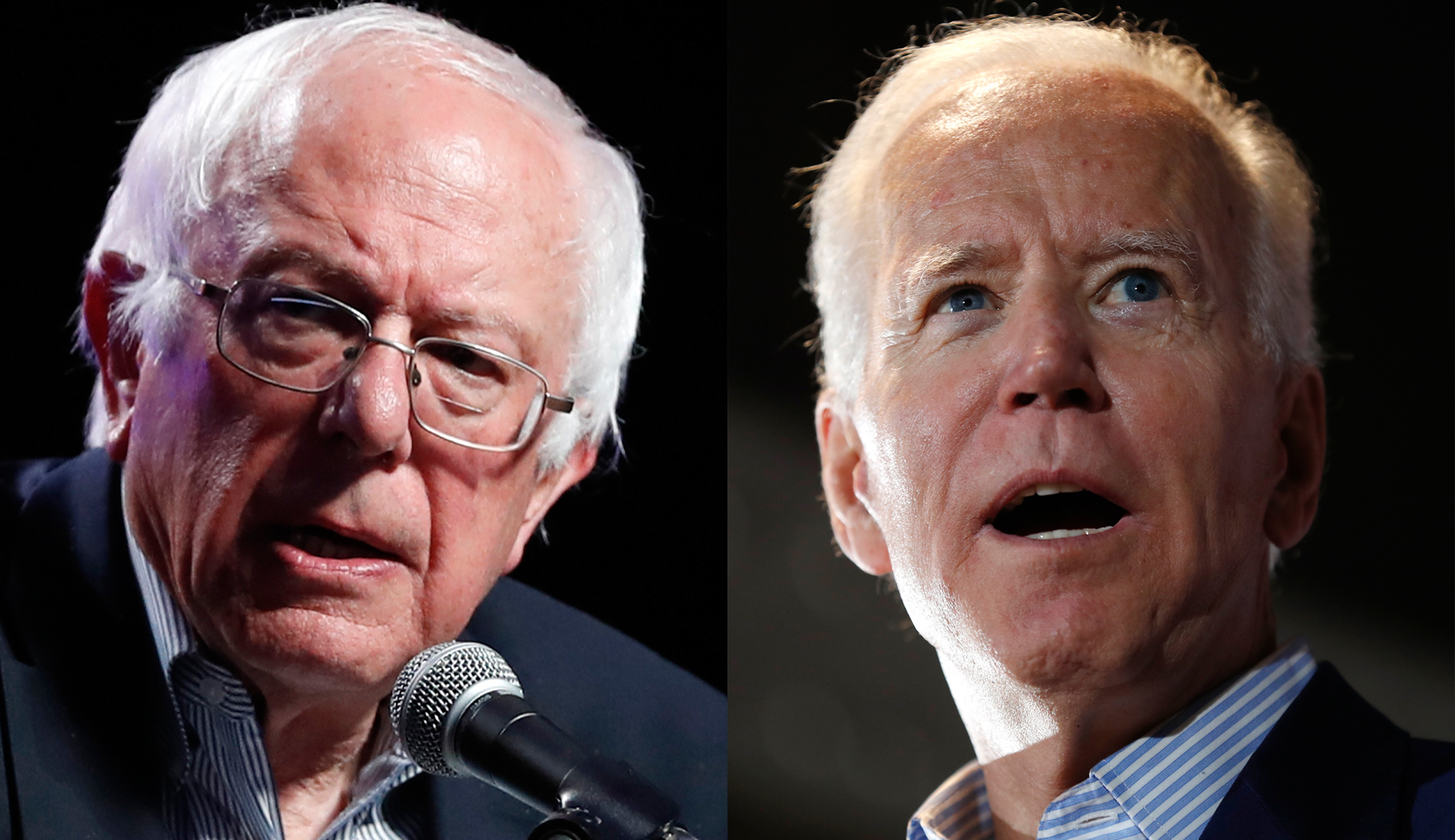
LAS VEGAS — Two months ago, Bernie Sanders’s presidential aspirations seemed doomed after he suffered a heart attack and began to crater in polls.
But the socialist Vermont senator, 78, is showing fresh signs of momentum in the 15-person race for the Democratic White House nomination, and the right to challenge President Trump in fall 2020.
After leaving the hospital in early October and proclaiming that he was “healthy” and “feeling great,” Democratic primary voters are flocking back into his camp. Polling averages now show Sanders as the second-favorite candidate for the party’s presidential nomination, behind former Vice President Joe Biden.
A Monmouth poll released earlier this month found Sanders overtaking Massachusetts Sen. Elizabeth Warren, a left-wing populist who poses the most direct threat to his voting base. That survey found Sanders trailing former Vice President Joe Biden by five points with 21% support. Warren earned 17%.
After his medical emergency in October, Sanders’ numbers nationally sunk as low as 11%. His numbers in Iowa, which hosts caucuses on Feb. 3, were even grimmer, with one poll following his release from the hospital showing his support at 9%.
Yet Sanders promised supporters that he would not bow out of the race, and just weeks after his health scare, Democratic firebrand Rep. Alexandria Ocasio-Cortez of New York announced her endorsement of his candidacy at the largest rally of the entire Democratic primary thus far on Oct. 19.
Soon after, Sanders’ numbers began rising.
Last week, a UC Berkeley Institute of Governmental Studies poll of California Democrats showed Sanders squeaking ahead of his rivals in the state, with 24% support.
“I’ve noticed several big and helpful differences this time around. First, Bernie is much more of a known quantity in this state today, making get-out-the-vote activity on his behalf easier for the March primary, with both old and new supporters,” said Steve Early, who co-founded Labor for Bernie in 2016. “Unlike last time — when Hillary Clinton had already pretty much been declared the likely nominee by June of 2016 — our much earlier primary voting in 2020 lends a far great sense of urgency and importance to Sanders’ grassroots efforts.”
On Tuesday, Sanders addressed the Culinary Workers Union in Las Vegas, drawing over 400 organized labor supporters and workers, far more than the some 300 who turned out for Warren on Monday night. The moderator for the event, Ted Pappageorge, the Culinary Union President, exclaimed that Sanders’s crowd was just as energized at 11 a.m., when most service-worker employees in Las Vegas are just getting out of bed.
His remarks were part of a two-day tour of the state, which began Monday in Reno and Carson City. During a speech at a Native American community center, Sanders expressed confidence that the first three nominating contests are his to win, citing the Iowa Caucuses, New Hampshire Primary on Feb. 11, and Nevada Caucuses on Feb. 22.
“We think we have an excellent chance to win here in Nevada,” Sanders said. “We have an excellent chance in Iowa and New Hampshire. If we win those three states, we’ll be on the way to a victory to transform this country,”
Those close to the Sanders campaign have told the Washington Examiner that the campaign’s strategy is focused less on national numbers and more on maintaining a consistent level of support in states like Iowa and New Hampshire, where polling averages have him placed in second place, behind South Bend, Indiana, Mayor Pete Buttigieg. Supporters of Sanders say the structure of Iowa’s election, a caucus versus a traditional election, will allow him to over-perform his current polling numbers. In 2016, Sanders lost Nevada to Clinton by under .01% of the vote.
A victory there, those close to the Sanders campaign say, would cause a domino effect that will lead to future primary victories and pressure his competitors to drop out.
“Factoring in enthusiasm and the registration of new voters who are often not reflected in polls, I would say Sanders is likely to be doing even better,” than polls suggest, said former Democratic National Committee official and Sanders supporter Nomiki Konst. “Bernie clearly has the most enthusiastic base — and as we near the first elections states, that base is rock solid. Other candidates have not weathered the storm the way Bernie has, given he spent the last five years growing a movement.”
