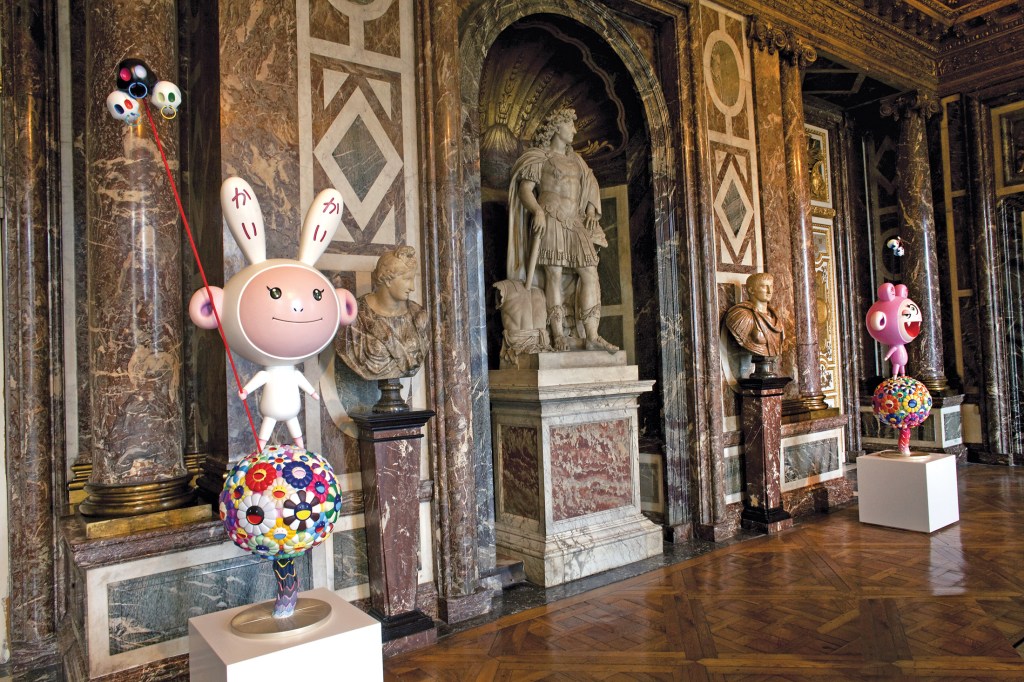
To those unfamiliar with Takashi Murakami, his art can seem almost psychedelic, bursting with color and manga-inspired designs. The 56-year-old is sometimes called the “Warhol of Japan” and his work, like Andy Warhol’s, is characterized by a postmodern project of uniting kitschy, mass-produced pop culture with high art. He is perhaps best known for his trademark “superflat” drawings and paintings; the name refers to the tradition of two-dimensionality that Murakami detects in traditional Japanese art as well as to the shallowness of Japanese consumer culture, which he playfully critiques. A couple of years ago, a pop-up café in Tokyo was dedicated entirely to his work, with even the hamburger buns imprinted with his signature smiling flower faces. A few years before that, Murakami’s work graced—or disgraced, depending on your view—the royal apartments at Versailles.
Murakami’s company, Kaikai Kiki—part art studio, part promotional and merchandising business—has offices in both Tokyo and New York. As the New York Times noted in 2005, Kaikai Kiki is run much like a factory, with long hours, timecards, and training manuals. With dozens of artists following his lead, Murakami creates large, fantastical paintings as well as sculptures of acrylic and fiberglass that meld manga (comics) and anime (cartoons) with traditional Japanese styles. He has risen to the level of contemporary art superstar by dint of hard work, originality, and a deep understanding of both historical and contemporary art traditions, Japanese and Western. Unlike Warhol, whose art largely commented on perception and commodification, or Roy Lichtenstein, whose merging of ad speak and comic-book imagery tried to blur the boundaries between the high and the low, Murakami’s work draws deeply from historical traditions. (In fact, Murakami holds a Ph.D. from Tokyo University in the traditional Japanese painting technique called Nihonga.) Murakami’s blending of new pop subjects with inherited themes results in projects that are sometimes immediately recognizable, sometimes strange and otherworldly.