

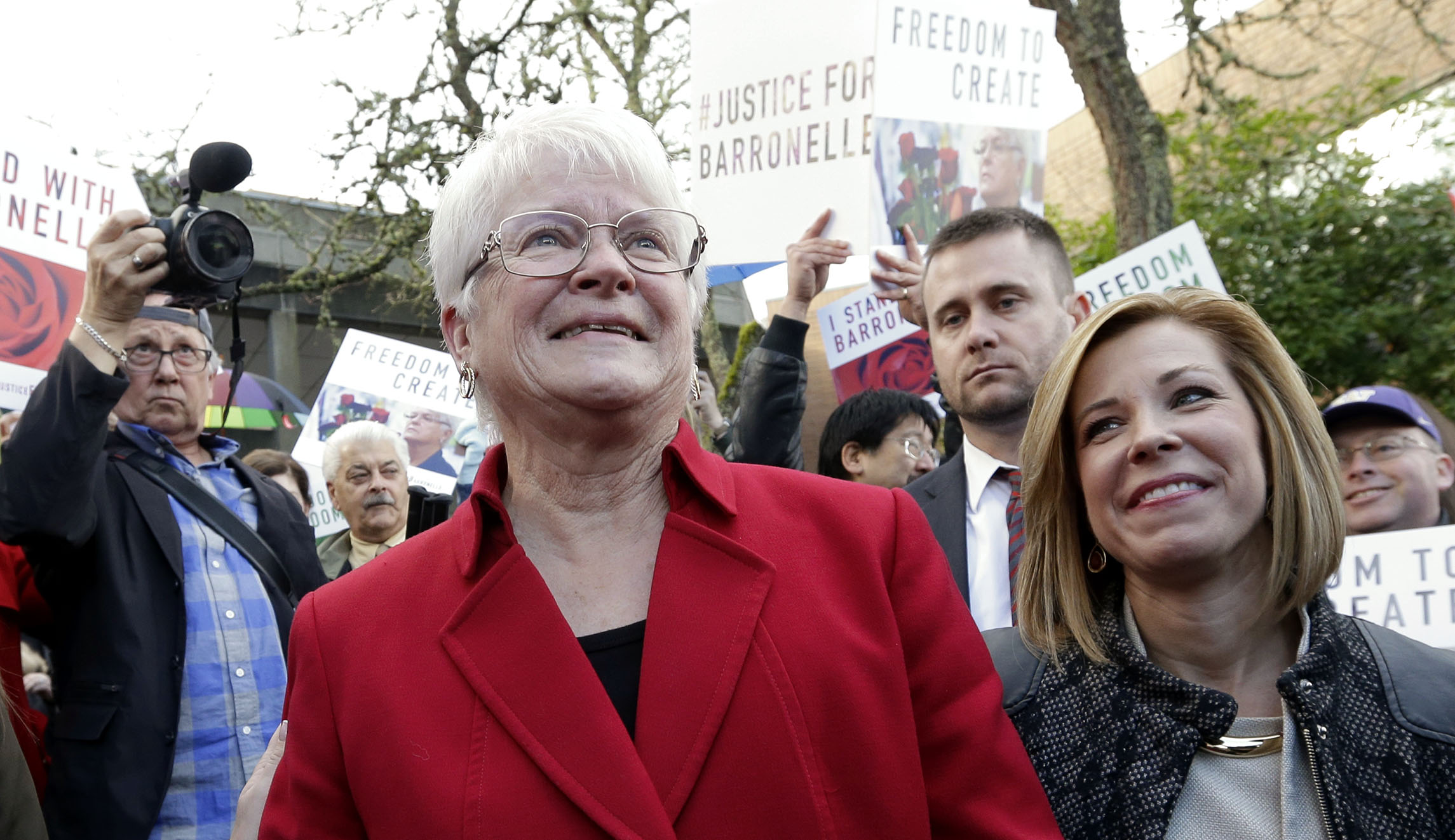
To know Barronelle Stutzman is to love her. She’s a warm-hearted grandmother, a hard-working small business owner, and an award-winning floral artist who for decades has devoted herself to creating unique floral creations for her customers. Barronelle takes deep pleasure in serving every person who walks through her door, whether it be a lovelorn teen, a husband celebrating an anniversary, or the gay man she’s served as a friend for almost a decade.
But when she declined to attend, support, and create artistic arrangements for a wedding which celebrated a view of marriage that was in deep conflict with her faith, the state of Washington sued her. And not just her business; it sued her as an individual in a determined effort to crush her business and control her conscience.
Recommended Stories



On June 6, the Washington Supreme Court brought the legal hammer down on Barronelle in State of Washington v. Arlene’s Flowers. The state court ruled that she does not have the right to choose which weddings she attends and creates custom floral artwork for. The effect of the decision is that religious business owners can be compelled to create artistic works communicating messages that directly conflict with their religious faith and conscience, or they will personally pay the price the state demands, including the loss of a 40-year business and vocation.
For over almost a decade, Barronelle had served and befriended a good customer, Rob Ingersoll. She loved working with Rob, who often gave her challenging and creative projects for birthdays, Mother’s Day, Valentine’s Day, and other occasions. Barronelle knew that Rob identified as gay, but they both loved flowers, and his being gay didn’t matter. She serves anyone, period.
But one day, Rob asked Barronelle to design custom arrangements to celebrate his same-sex wedding — a service which for good customers, like Rob, included her attending and preparing the floral displays for the ceremony.
Barronelle is a devout Christian who believes that marriage is the union between a man and a woman — a belief that the U.S. Supreme Court has described as “decent and honorable.” Barronelle graciously shared that with Rob and gave him the names of a few other florists. They chatted about the pending wedding and parted with a hug. She did not reject Rob that day. For Barronelle, the issue was not the man, but the event — an event held sacred by her faith.
Soon enough, Barronelle found herself being sued by her home state of Washington and the ACLU. Everything she owned was put at risk by the state attorney general.
This is Barronelle’s second loss in state court. Her case has already been to the U.S. Supreme Court once. In 2018, the high court ordered the Washington State Supreme Court to reconsider her case in light of its ruling in Masterpiece Cakeshop v. Colorado Civil Rights Commission. It merely ruled against her a second time. Masterpiece set a constitutional baseline forbidding government hostility against religious beliefs about marriage, whether that hostility was from government officials speaking or by unequal application of the law.
Masterpiece has since been joined by two more strong 2018 court decisions that upheld freedom of speech and freedom of conscience. In NIFLA v. Becerra, the Supreme Court held that all Americans — including people of faith — have a right to be free from government-compelled speech, which includes artistic expression. And in Janus v. AFSCME, the court ruled that compelled speech is unconstitutional and particularly reprehensible when it forces someone to violate his or her conscience.
These three cases form a powerful litany of freedom: No government hostility toward religious beliefs. Free speech must be protected. And the government cannot compel citizens to speak. No Supreme Court decision has ever compelled anyone to attend and assist at any religious ceremony.
But the state of Washington continues its demand that Barronelle be forced to violate her conscience and express support for something she believes to be wrong. Worse, the same attorney general prosecuting Barronelle refused to prosecute a business owner who — as documented in a viral video — ranted madly against Christian customers who were quietly enjoying a cup of coffee in his shop, obscenely berating them and driving them out of his store.
When discussing Barronelle’s case, the attorney general compared her religious convictions about marriage to pre-Civil War defenses of slavery. In his mind, if your religious beliefs about same-sex marriage differ from the state’s, you are akin to a racist. The U.S. Supreme Court, however, squarely rejected this idea, stating that it is “inappropriate” for the government to draw parallels between racial discrimination and religious beliefs about marriage.
But on June 6, the Washington Supreme Court decided that none of this mattered. So Barronelle is continuing to fight for her freedom to exercise her Christian beliefs about marriage. She will again appeal to the U.S. Supreme Court, which will have a second opportunity to protect her freedom.
And it’s not just her freedom at risk, but the freedom of all Americans who cherish their freedom of speech, conscience, and religion. It is the freedom for all who hold (or someday may hold) and exercise beliefs that the government does not agree with. She fights so that every American may live and work peacefully in accordance with his or her deeply held beliefs.
Countless Americans from faiths as diverse as Islam and Christianity believe that marriage is the union of a man and a woman. No one should be hounded by the state, banished from the marketplace, and ruined because of his or her good-faith views of marriage.
When Barronelle returns to court, she will be fighting for the freedom of all Americans. And a win for Barronelle will be, truly, a victory for us all.
Kristen Waggoner is senior vice president of the U.S. legal division for Alliance Defending Freedom and represents Barronelle Stutzman and her business, Arlene’s Flowers. Follow Kristen on Twitter @KWaggonerADF or follow ADF @AllianceDefends.
