

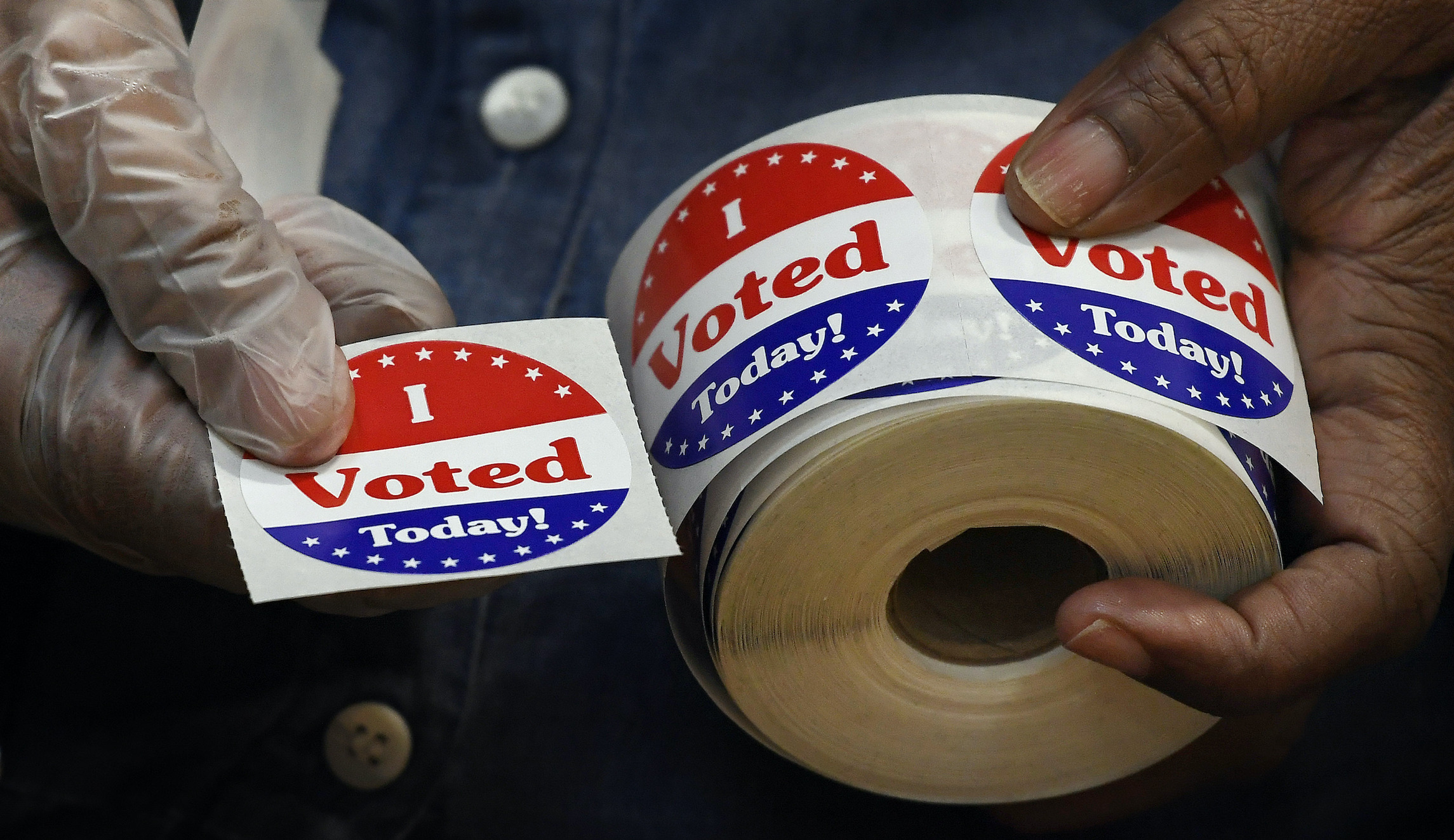
President Joe Biden framed his passionate plea for voting reform this week around the idea that Republicans alone stood between Democrats and greater ballot access, requiring legislation that would largely strip states of their election authority.
But some of the practices Biden characterized as restrictive, such as limits on who can vote by mail or where voters can return absentee ballots, are just as pervasive in blue states as in red ones.
Recommended Stories


The pair of bills Biden called on Congress to pass would together force uniform voting practices on states that presently have a diverse set of election rules — often not just at the state level but across various counties and precincts as well.
Here are how the voting practices Biden and Democrats have accused Republicans of restricting stack up across various states.
Vote by mail
Biden on Tuesday accused Georgia and more than a dozen other states of creating obstacles for voters who want to cast their ballots by mail.
Georgia is among the states that allow no-excuse absentee voting, meaning anyone can cast an absentee ballot without having to provide a reason, such as being sick or away from their precinct.
Sixteen states require voters to have an excuse to vote by mail, however, according to the National Council of State Legislatures.
That includes a number of Democratic-controlled states, among them Connecticut and Massachusetts.
Voters in New York, which in 2020 consisted of more than twice as many registered Democrats than Republicans, soundly rejected a ballot initiative in November that would have created no-excuse absentee voting.
Delaware, the president’s home state, requires voters to be away from their county on Election Day, sick or disabled, at work during all voting hours, or have a religious exemption to access a mail-in ballot, according to the NCSL.
Many states significantly expanded their mail-in voting practices during the 2020 election to accommodate public health concerns surrounding the pandemic
Democrats have often portrayed efforts by states to return to pre-pandemic rules, on vote-by-mail methods and beyond, as taking away the right to vote.
In Texas, for example, Republican lawmakers faced intense pushback for a new voting law that banned the use of drive-thru voting sites and put an end to 24-hour early voting. Those two practices were used for the first time and in a limited capacity by some precincts in 2020.
Early in-person voting
Democrats are pushing to expand early in-person voting as well. One of their bills, the Freedom to Vote Act, would mandate at least 15 days of early voting.
That is more expansive than the early voting periods currently allowed by a number of blue states, according to the NCSL, although the legislation has been framed as a way to counteract election conduct in red ones.
Early voting in deep-blue Massachusetts allows voting just 11 days before Election Day. New York’s early voting period begins 10 days before the election.
Delaware does not presently offer early in-person voting. Under a new reform, the state will begin the practice in 2022, allowing early voting 10 days before an election as well.
In his speech Tuesday, Biden cited voting statistics from a group that characterized Georgia’s voting law as serving to “limit voting days or hours.”
But Georgia’s law actually expands the time during which voters can cast their ballots early and in person.
It expands the number of days in the early voting period to 17 and gives counties the option to expand voting hours for early voting. While the previous law kept voting within business hours, the new law allows local officials, if they so choose, to keep early voting open from 7 a.m. to 7 p.m.
It also mandated at least one Saturday of early voting and left open the option to allow Sunday voting.
Ballot drop boxes
Biden specifically attacked limitations on the use of ballot drop boxes during his speech Tuesday, accusing Georgia lawmakers of trying to restrict the drop box option in a deliberate effort to keep certain people from voting.
The Georgia law actually authorizes the use of drop boxes for the first time, however. Officials allowed counties to utilize ballot drop boxes during the 2020 election as a pandemic measure.
Georgia lawmakers made drop boxes a permanent feature of future elections, with some regulations on how many could be concentrated in one area.
Some states offer no drop box options. According to Lawfare, a legal website, 10 states did not offer a drop box option in 2020.
Other states have enacted fresh restrictions on how and when drop boxes can be used.
Florida, for example, mandated that election officials must monitor all ballot drop boxes during the hours when voters can deposit their ballots.
