The latest on the COVID-19 vaccines rollout

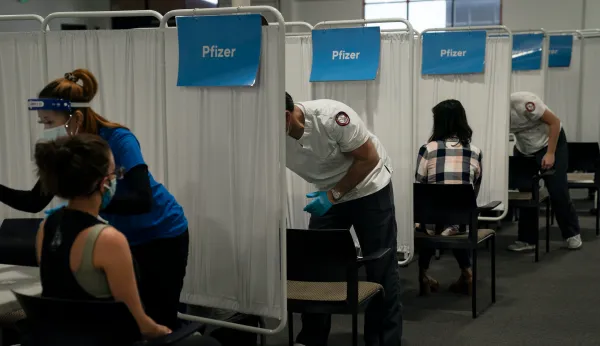
Experts on the Advisory Committee on Immunization Practices, the body within the Centers for Disease Control and Prevention, voted Tuesday 13 to 1 to include both healthcare workers and residents of long-term care facilities in the first group that will receive inoculations.

“We see that the individuals living in long term care facilities … are at an exceptional risk for mortality morbidity due to this virus and disease,” said Dr. Jose Romero, chairman of the committee. “I believe that my vote reflects maximum benefit, minimum harm.”

CDC Director Dr. Robert Redfield is expected to announce Wednesday whether the agency will accept the recommendation as formal guidance. Regardless of what the federal agency decides, however, the decisions around distributing and allocating the first doses will rest with state governors.

Earlier, the committee said that race and ethnicity could be the deciding factors in determining whether essential workers will be second in line for vaccination for the novel coronavirus. In an earlier committee meeting about how the coronavirus vaccine will be distributed, defenders of the position said that because COVID-19 harms a higher percentage of racial and ethnic minorities, they should be prioritized to get the vaccine earliest.

“If you look at the burden of disease and death in the U.S., it is disproportionately impacting communities of color,” Grace Lee, a member of the ACIP and professor of pediatrics at the Stanford University School of Medicine, told the Washington Examiner.

Meanwhile, critics contend that it amounts to racial discrimination.

“Apparently, the people on the committee implicitly believe that vaccine distribution and perhaps access to medical care generally should be conditional on having the right race/ethnicity,” said Linda Gorman, director of the Health Care Policy Center at the conservative Independence Institute.

Dr. Moncef Slaoui, the scientific head of Operation Warp Speed, said that between 10% and 15% of volunteers in Pfizer’s and Moderna’s coronavirus vaccine trials have “significantly noticeable” side effects that could last up to a day and a half. The reported side effects include fever, chills, muscle aches, and headaches, as well as reported redness and pain at the injection site. He also warned that “the very long-term safety is not yet understood by definition.”

To date, more than 13.6 million cases and over 270,000 deaths due to COVID-19 have been confirmed in the United States, according to Johns Hopkins University data. Many millions more people have been infected. The test positivity rate in the U.S. is also on the rise. It reached an average of 9.7% over the past seven days, the highest rate since early May.

House and Senate lawmakers, eager to pass a new round of coronavirus aid, are ramping up efforts to pass a bipartisan package with a flurry of last-minute phone negotiations that leaders say could produce a deal this month.

Senate Majority Leader Mitch McConnell is circulating a revised COVID-19 relief package in consultation with the Trump administration to be passed in the last days of the 116th Congress. Meanwhile, House Speaker Nancy Pelosi said she is also devising a package with the Trump administration, having already met with Treasury Secretary Steven Mnuchin several times to compromise on a package to no avail.

“We’re going to send that out to all the offices and get some feedback to see how our members react to a proposal that we can say for sure would be signed into law,” McConnell said.

New York Gov. Andrew Cuomo ordered hospitals to expand capacity and prepare for staff shortages in preparation for the U.S. coronavirus surge to accelerate after the Thanksgiving holiday, the Financial Times reported. Cuomo warned that the state was entering “a new phase in the war against COVID” when he announced the hospital measures as part of a five-point plan to contain the coronavirus through the winter until enough people will have access to a vaccine.

Meanwhile, New York City’s Health Commissioner Dr. Dave Chokshi warned older and more vulnerable people to stay home as much as possible as the citywide coronavirus infection rates climb to an average of 3.1%, the highest rate reported since May 30.

Oklahoma Gov. Kevin Stitt has declared Thursday a day of prayer and fasting in the state as the rate of coronavirus cases continues climbing in the state. Oklahoma’s test positive rate averaged about 19% over the past seven days, compared with an average of 13.2% reported on Friday.

“I believe we must continue to ask God to heal those who are sick, comfort those who are hurting and provide renewed strength and wisdom to all who are managing the effects of COVID-19,” Stitt said Monday.

At least 41 people who attended a swingers party in New Orleans last month have tested positive for the coronavirus, the Times-Picayune reported. Bob Hannaford, the event’s organizer, said one of the people was hospitalized and is in critical condition.

“If I could go back in time, I would not produce this event again,” Hannaford wrote Friday in a blog post about this year’s event. “I wouldn’t do it again if I knew then what I know now. It weighs on me and it will continue to weigh on me until everyone is 100% better.”

The coronavirus could have been circulating in the U.S. as early as Dec. 13, 2019, a month earlier than researchers thought, the New York Times reported. Scientists who analyzed blood donations taken from the American Red Cross found that samples from nine states sent to the CDC carried coronavirus antibodies, indicating they had already been infected with the virus.

Before this report, the earliest known case in the U.S. was on Jan. 19 in someone who had traveled from China. Still, the researchers could not say whether the early infections were due to travelers who caught the virus in another country or whether they led to widespread community transmission.

New members of the New Hampshire state Legislature will hold its Organization Day on an outdoor field hockey pitch at the University of New Hampshire rather than in an indoor gymnasium as initially planned. Officials changed course due to concerns about recent spikes in COVID-19 cases, NBC News in Boston reported.

“In light of the recent spike in the pandemic, and sadly with fatalities and hospitalizations going up, we realized what was originally proposed was just not practical,” said Rep. Steve Shurtleff, a Concord Democrat whose term as House speaker ends Tuesday.

Related Content