

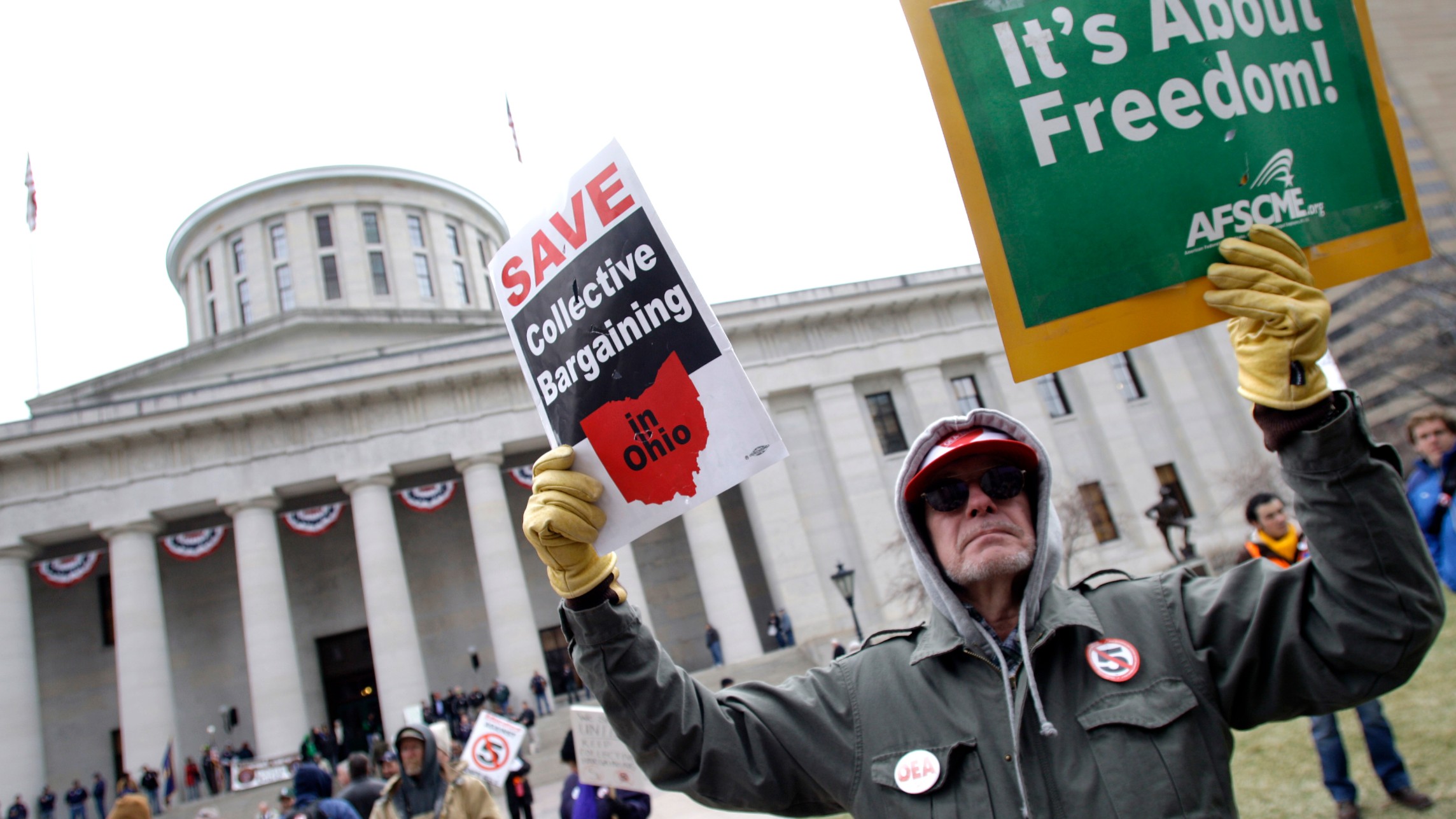
Ohio personifies America’s heartland. Its people work hard, play by the rules, and do their best to raise their children according to time-honored values.
To leftist elites, however, the entire Midwestern landscape is simply what one flies over when traveling from one coast to the other. They discovered the drawback to this attitude in 2016 when working-class voters in Ohio and the rest of the nation’s Rust Belt revolted after decades of watching their jobs outsourced, their values mocked, and their influence over their lives co-opted by powerful special interests.
Recommended Stories



For too long, groups with names such as SEIU, AFSCME, the Teamsters, and various teachers’ unions have enthusiastically supported left-wing ideology. They knew that every new public employee added to the payroll was another paycheck to be plundered and potentially used to buy more influence.
The Center for Union Facts has noted that between 2010 and 2018, unions across the board funneled well over $1 billion to liberal candidates and causes in the United States. And until very recently, workers in many states had no choice but to watch as their dues dollars were used to fund political speech they profoundly disagreed with if they wanted to keep their jobs.
In turn, elected officials corrupted by union dollars gratefully passed legislation making the whole enterprise legal and keeping the cycle moving.
A series of recent U.S. Supreme Court rulings, however, has affirmed that mandatory union membership and dues are violations of the First Amendment to the U.S. Constitution. By protecting the rights of workers to make their own decisions about workplace representation, these rulings can go a long way toward wresting control from union bosses and giving it back to the people.
Still, rights are worthless unless they’re exercised, and unions have developed elaborate schemes to prevent members from even knowing about their newly affirmed rights to opt out. They are actively making it as difficult as possible for those members who seek to quit.
That’s where the Freedom Foundation comes in. And starting this month, our organization will be open for business in Ohio.
Unlike traditional think tanks and policy organizations, the Freedom Foundation focuses all of its energy on combating the abuses of government employee unions. And its only weapons in the struggle are the truth and a willingness to work harder spreading it than unions do suppressing it.
Specifically, that involves educating workers about two key Supreme Court decisions that affect them.
Harris v. Quinn, decided in 2014, held that thousands of home caregivers and child care providers could not be considered public employees just because they received a stipend from Medicaid for their efforts. Consequently, they could not be forced to join a union or pay dues in states lacking right-to-work protections.
Janus v. AFSCME, a 2018 case, affirmed that mandatory union membership or dues for any public employee violates his or her constitutional rights to free speech and free association.
On paper, the two rulings are a body blow to the shadow government formed by unions and the politicians they’ve historically corrupted with cash confiscated from an ever-expanding public workforce. But laws and Supreme Court decisions are only as good as the enforcement efforts that back them up.
In the states of Washington, Oregon, and California, the Freedom Foundation has worked tirelessly to inform workers of their rights and help more than 60,000 of them opt out of union oppression in just the past year. That number continues to grow every day.
If the results haven’t been nearly as eye-popping as in other regions, it isn’t because workers there are happier with their union; it’s because unions have been more successful in keeping them in the dark about their rights.
That’s about to change in Ohio. The unions will ultimately lose there, too, but with so much at stake, they’re going to make things very entertaining first.
Aaron Withe is the national director of the Freedom Foundation, a nonprofit, nonpartisan policy organization.
