

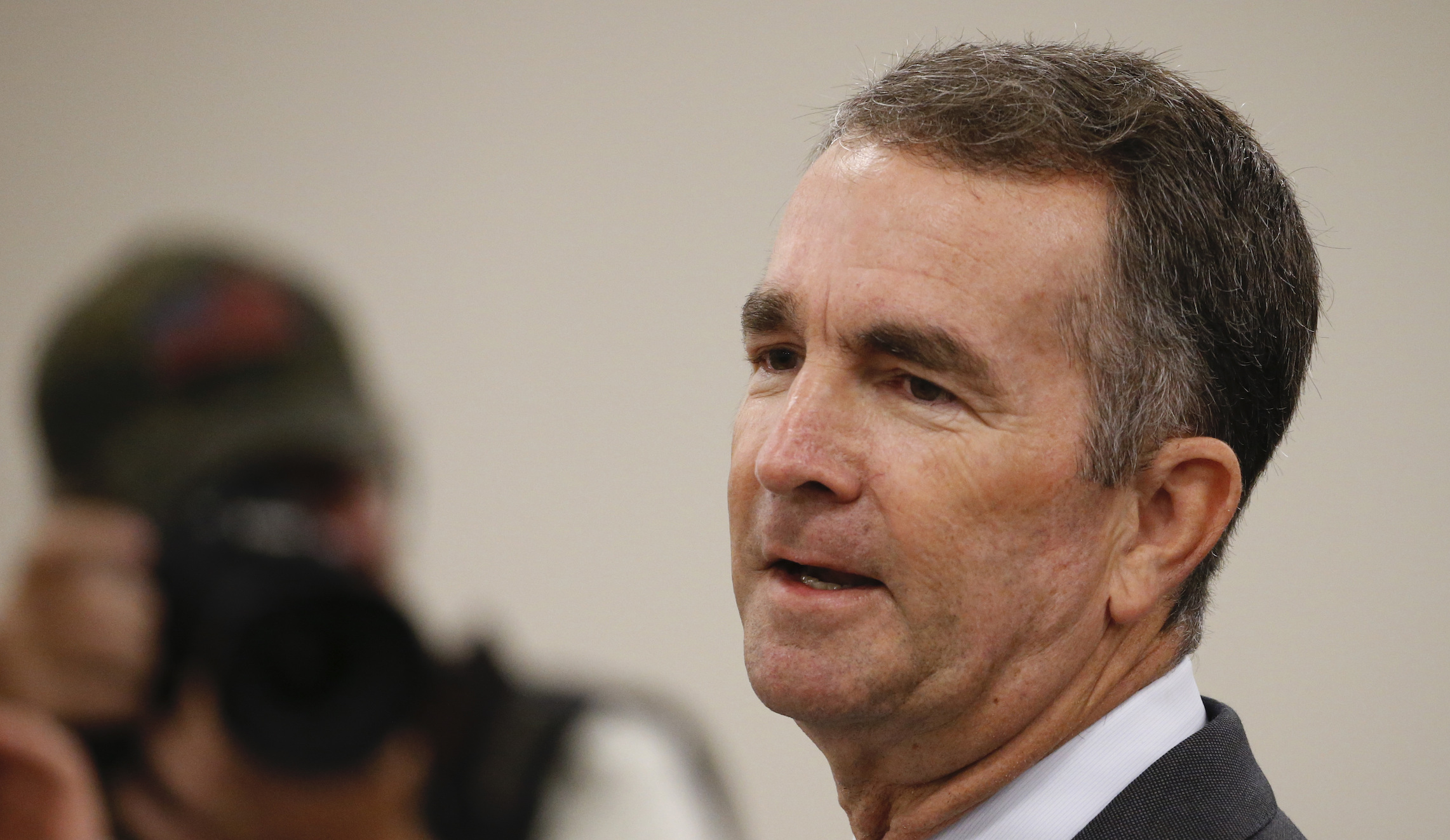
Full control of state government by Democrats gives Virginia Gov. Ralph Northam a chance to change perceptions of him, from the blackface guy to liberal leader pushing top-tier Democratic priorities. But Northam and fellow Democrats may find moving the state left isn’t so easy.
Northam, 60, was a rising Democratic star until Feb. 1, when he found himself on the defensive over a photograph from his 1984 Eastern Virginia Medical School yearbook that showed a pair of unidentified people in blackface, and a Ku Klux Klan hood. Northam withstood pressure to resign, but he was damaged goods politically.
Recommended Stories


After being dubbed “Governor Blackface,” Northam played a limited role in 2019 Virginia Democratic campaign, which led to the party flipped both chambers. Still, the turnover in Richmond now gives Democrats ample opportunity to enact their priorities and, at the same time, rehabilitate Northam’s public image.
Gun control, in some form, is likely to top the Democratic agenda.
“That is an issue that the Democratic governor wanted to move on and that many Democrats in the legislature wanted to move on and, very deliberately and publicly, the Republican majorities that existed then said no,” said George Mason University Professor Jeremy Mayer. Democratic victories could herald in a period of “dramatic change” given pressure from liberal activists in the party’s base to deliver on campaign promises ahead of the 2021 gubernatorial election, Mayer told the Washington Examiner.
Mayer floated specific gun reform measures, such as limits on the number of weapons Virginians can buy a month to more stringent background checks. Democrats will also focus on restoring voting rights to felons out of prison, an effort met with only partial success by Northam’s immediate predecessor, Democratic Gov. Terry McAuliffe.
“Virginia’s one of the last few states that doesn’t clearly give felons voting rights once they’ve served their time,” Mayer said.
Quentin Kidd, a Christopher Newport University political science professor, offered a more tepid forecast. Kidd foresees a “struggle” unfolding between liberal and more centrist Democrats. Even though more left-leaning Democrats are driving “energy” in the party, many members of the incoming caucus are moderates “who are more pro-business than not,” Kidd told the Washington Examiner.
Proposals to expand union membership also face long odds, Kidd said, in reference to “right to work” laws that mean employees can work in unionized workplaces without joining a guild.
“‘Right to Work’? I would be quite frankly shocked if ‘Right to Work made it to the governor’s desk,” Kidd said.
Even gun control measures may not pass so easily in a state with a still-influential rural population and where many Democrats on the campaign trail talked of defending Second Amendment rights, balanced with background checks and other limited proposals.
“But banning assault weapons, things like that, I don’t know. I think that stuff might have a harder time,” Kidd said.
Whatever the issues that arise under Democratic control, Northam has much to gain politically during the final year of his office. Still, his efforts to move on from the blackface scandal may only go so far. After his governorship ends in January 2021, “some position will open up for” Northam, Mayer said. “Maybe at a university somewhere,” but he’ll struggle to leverage the governorship into a Senate seat like predecessors such as Republican George Allen and the commonwealth’s current senators, Democrats Tim Kaine and Mark Warner.
Northam is no longer “a force in Democratic politics,” Mayer said. “For Democrats, in considering the Northam legacy, there’ll always be a very large asterisk.”
