

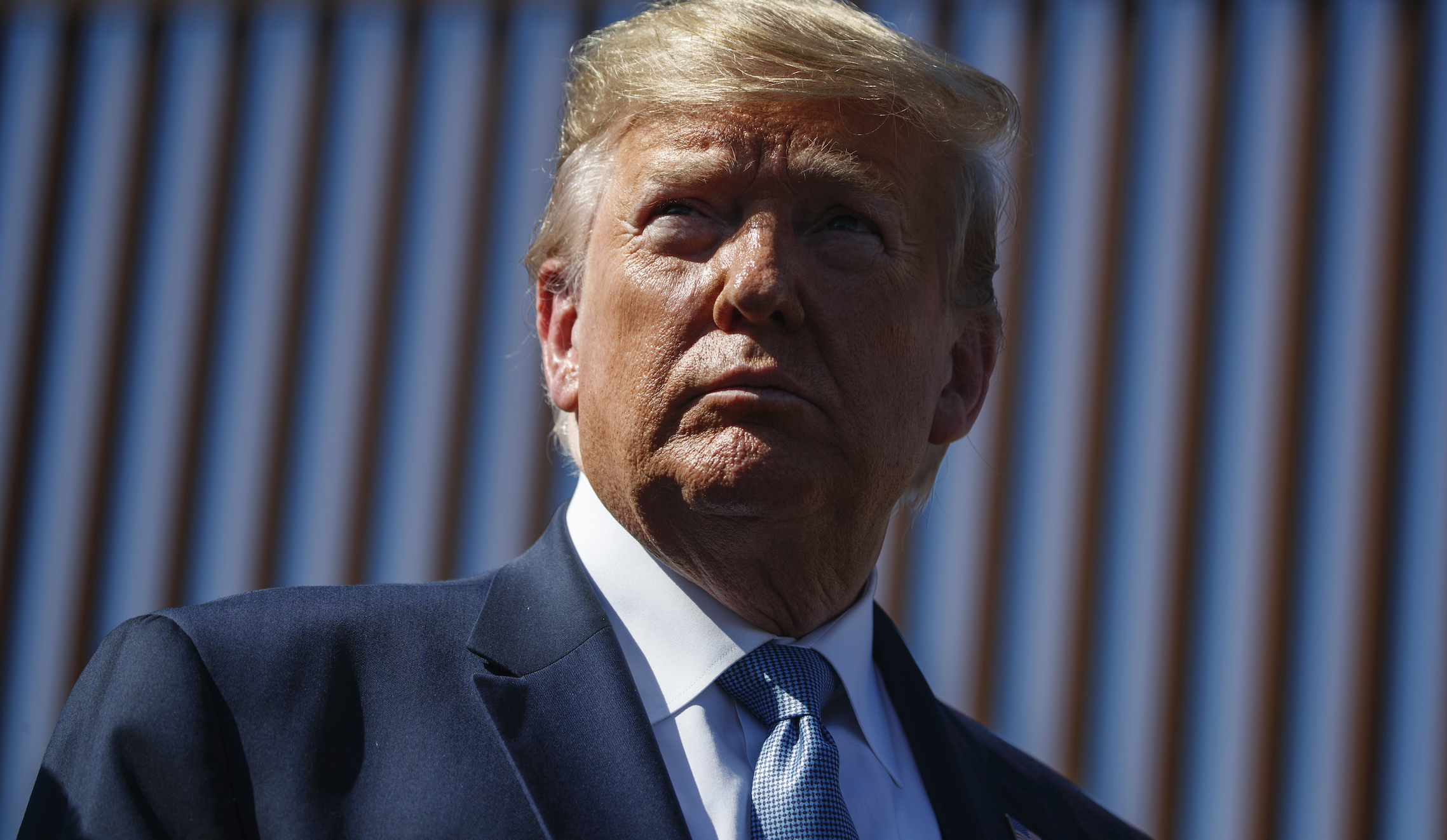
Nearly three years into President Trump’s tenure, the administration has yet to finish a single mile of barrier on a previously unfenced part of the 2,000-mile southern border, though construction has begun, a Washington Examiner review of government data revealed.
As of Nov. 15, 83 miles of barriers had been installed along the U.S.-Mexico border in the 34 months since Trump took office.
Recommended Stories


But the barriers are “in place of dilapidated and outdated designs,” according to a document written by U.S. Customs and Border Protection and the Army Corps of Engineers. “Construction is currently underway in locations where no barriers currently exist, which will increase the total miles of primary barriers on the southwest border as construction progresses,” the agency wrote. CBP, a Department of Homeland Security agency, selects where to build, while the Pentagon handles construction.
The lack of progress a year out from the 2020 election puts the Trump administration over budget and behind schedule on the president’s keystone campaign promise to build a wall on the U.S.-Mexico border. The absence of fencing on new land is exactly the kind of thing he said would not happen if someone with his construction background was elected.
The Washington Examiner first reported in July that the administration had not constructed a single new mile of fencing. Almost four months later, that remains true, though much work has started.
Nearly 510 miles of new border barrier is under construction. CBP expects 450 miles to be finished by December 2020, according to the same document.
About 285 miles of the 510 will replace older designs. A small amount of the replacement fence is for a duplicate fence that will go a few dozen feet north of the first. Duplicate fencing is used to prevent someone who crossed over the first fence from immediately fleeing the area. About 225 miles of the 510 total will go up in areas of the border that have never had fencing, but some of that is duplicate backup fencing, resulting in only 165 miles of brand-new barrier in never-before-secured areas.
About 650 miles of the 2,000-mile southern border has some sort of barrier that prevents people or vehicles from crossing between official crossing points.
On many occasions as a candidate in 2015 and 2016, Trump said he would build 1,000 miles of “wall” at a total cost of $4 billion. That campaign promise, which vastly understated what it would cost to build 1,000 miles of barrier, will not be met by December 2020.
DHS and CBP officials told the Washington Examiner this week several causes were to blame for the lack of progress.
“None of the DHS early Trump team educated the White House and took the lead to support early border security objectives that essentially have been agreed,” a former senior DHS official wrote in an email. That official also knocked Trump’s first DHS Secretary John Kelly and his then-chief of staff Kirstjen Nielsen for not engaging lawmakers early on in planning what types of border security components to fund, such as technology and infrastructure.
“There was an opportunity to add money to the [continuing resolution] right when Trump took office, as well as the first appropriations request by the administration — both severely missed opportunities made even worse by lack of even trying to present a clear and concise strategy to the Hill,” the same official said.
Congress allocated $341 million for 40 miles of projects in Trump’s first year. The following year, the administration was able to get four times that amount for 80 miles. But there was a catch: Congress provided guidelines for how the administration could spend the money.
“All of Fiscal Year (FY) 2017 funds and much of the FY 2018 funds are restricted for use in areas where outdated and dilapidated barriers were previously built,” a CBP spokesman wrote in an email to the Washington Examiner Thursday.
Lawmakers provided $1.375 billion in 2019, which CBP added to the $601 million Trump redirected from the Treasury Forfeiture Fund earlier this year, for a total of $1.976 billion. As part of Trump’s emergency declaration in February, $2.5 billion in counternarcotics funding was diverted to fund 129 miles, and $3.6 billion in military construction funding was redirected for 175 miles of fence.
Another leading cause of delay is the need to acquire private land. CBP said projects on federal land typically start construction quicker than those on private land.
“One of the reasons they’re prioritizing the replacement of the barrier is there’s no issue with acquiring the land,” said Theresa Cardinal Brown, immigration and cross-border director for the Bipartisan Policy Center and a former senior official at both CBP and DHS.
Although the Trump administration has waived environmental laws to get access to land, and the Bureau of Land Management recently transferred 70 miles of protected wilderness land to the Pentagon for barrier construction, the delays have added up. Cardinal Brown said the intense competitive bidding process likely took longer than Trump expected.
Even if the administration achieved its timeline, it would only put 165 miles of fence in previously unsecured areas of the 2,000-mile border, far short of something Trump once described as “very easy.”
