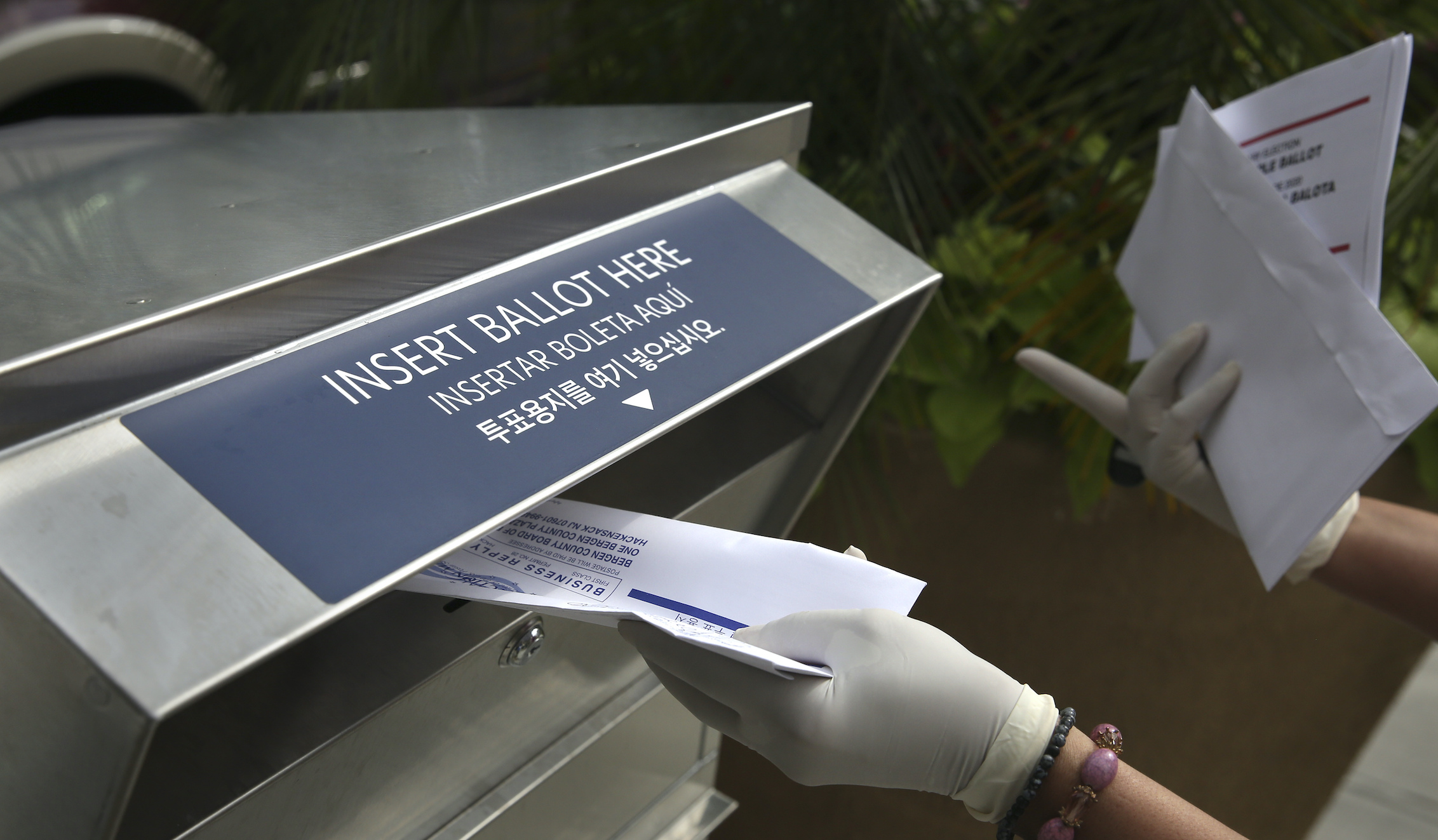
Despite Trump warnings, some Republicans enthusiastic about mail-in voting

CHARLOTTE, North Carolina — State Republican leaders aren’t all quite on the same page regarding how to talk about mail-in voting before an election that’s likely to rely heavily on the option as President Trump continues to cast aspersions on the method.

To some Republicans, universal mail-in voting isn’t all that bad.

Hawaii GOP Chairwoman Shirlene Ostrov, who heads a minority party in a small state dominated by Democrats, saw a benefit to Hawaii’s shift toward mail-in voting, introduced before the coronavirus pandemic through a 2019 bill. This year’s primaries were the new system’s first test and included mailing a ballot to every registered voter, expanding the electorate.

“It did motivate a lot of people, more people to vote,” Ostrov told the Washington Examiner. “We saw an uptick in voters, even for Republicans: 40,000 more Republicans voted in a primary election,” she said. About 31,000 people voted in the 2018 GOP gubernatorial primary compared to a combined almost 68,000 in this year’s two Republican congressional primaries. “We doubled.”

For Ostrov’s colleague, 2020 GOP convention Hawaii delegate Edwin Boyette, Trump’s bluster “engages people, so at least they’re taking a look, and they’re asking questions.”

“It makes people more aware of the voting process,” he said, before adding “I’m not sure if every state in the nation is ready for it.”

National Republicans have worked hard to try to distinguish “absentee voting” and “mail-in voting” after indications Democrats have an advantage with voters who plan to cast their ballots by mail. The latter, they and Trump say, is when a state automatically sends ballots to every voter on its voter roll, whereas they and Trump don’t believe there’s a problem with voters asking for an absentee ballot and mailing it in.

Most state party officials are attempting to follow that lead. “We don’t have what the Democrats are calling mail-in voting, we have what you call absentee voting, which is voter requests a ballot, and then the ballot is mailed to the voter,” said Michigan GOP Chairwoman Laura Cox at the in-person portion of the 2020 convention in Charlotte, North Carolina.

Technical terminology varies from state to state and doesn’t echo national Republicans’ talking points — Florida, long a no-excuse absentee voting state, changed its legal language in the last few years to refer only to mail-in voting rather than absentee voting.

Pennsylvania and Michigan reformed their laws before the pandemic to allow no-excuse absentee voting, permitting any voter to ask for a mail-in ballot for any reason. Because of the COVID-19 outbreak, 27 states and the District of Columbia that previously required voters to say they would be out of state or provide some other excuse to obtain an absentee ballot have altered their rules to allow fear of the coronavirus to be a valid reason to receive a ballot, or switched to no-excuse absentee voting. Now a total of 34 states have that framework. Voters in seven states still need a reason other than the virus to be eligible for an absentee ballot.

Other states, like Nevada, have drastically modified their systems to mail a ballot to every voter on its rolls — nine states and the District of Columbia have that worst-case scenario, according to the GOP. Another nine states are automatically mailing absentee ballot request forms to all voters, which Republicans are not happy with either, citing opportunities for fraud.

“Our state, like many states, we have a lot of people on our voter rolls that don’t even exist in our state anymore,” said Pennsylvania GOP Chairman Lawrence Tabas. “Think about the number of ballots that could be out there if you did universal mailing of ballots.”

Several Republicans in states that haven’t drastically changed their voting laws amid the pandemic are caught in a messaging gray area.

Tabas admitted he wasn’t the “biggest fan” of mail ballots, but encouraged “people to use all the legal methods of voting that are available.”

In some states with a strong history of mail-in voting, the GOP has effectively leveraged it to gain an electoral edge, causing them to be careful in their rhetoric after Trump’s criticisms so they can preserve their longstanding get-out-the-mail-vote practices while also pushing back against potential reforms.

Arizona, for instance, has allowed voters to opt-in to automatically receiving ballots for years. “We as Republicans are working very diligently to make sure that every citizen who is eligible to cast a vote is able to do so in an atmosphere of integrity, and that that vote is only counted once,” Arizona GOP Chairwoman Kelli Ward said, objecting to Democrats’ “radical plan to just mail out ballots randomly to everybody.”

Florida GOP Chairman Joe Gruters described his party’s goal as being “to make it as easy as possible to vote, but as hard as possible to cheat.”

“Anybody that feels more comfortable voting through absentee, we’re encouraging them, and we’ve sent out, the Republican Party of Florida, sent out I think two or three mailers over the last couple of weeks,” he said.

More voters than ever are expected to cast their ballots by mail this cycle before polls close on Nov. 3, increasing the likelihood of election result delays. Some states felt the brunt of the framework during the primaries. New York, for one, took many weeks to tabulate the outcome of House Oversight Chairwoman Carolyn Maloney’s hotly contested race, and legal battles over counting mail-in ballots are possible.

Related Content
