

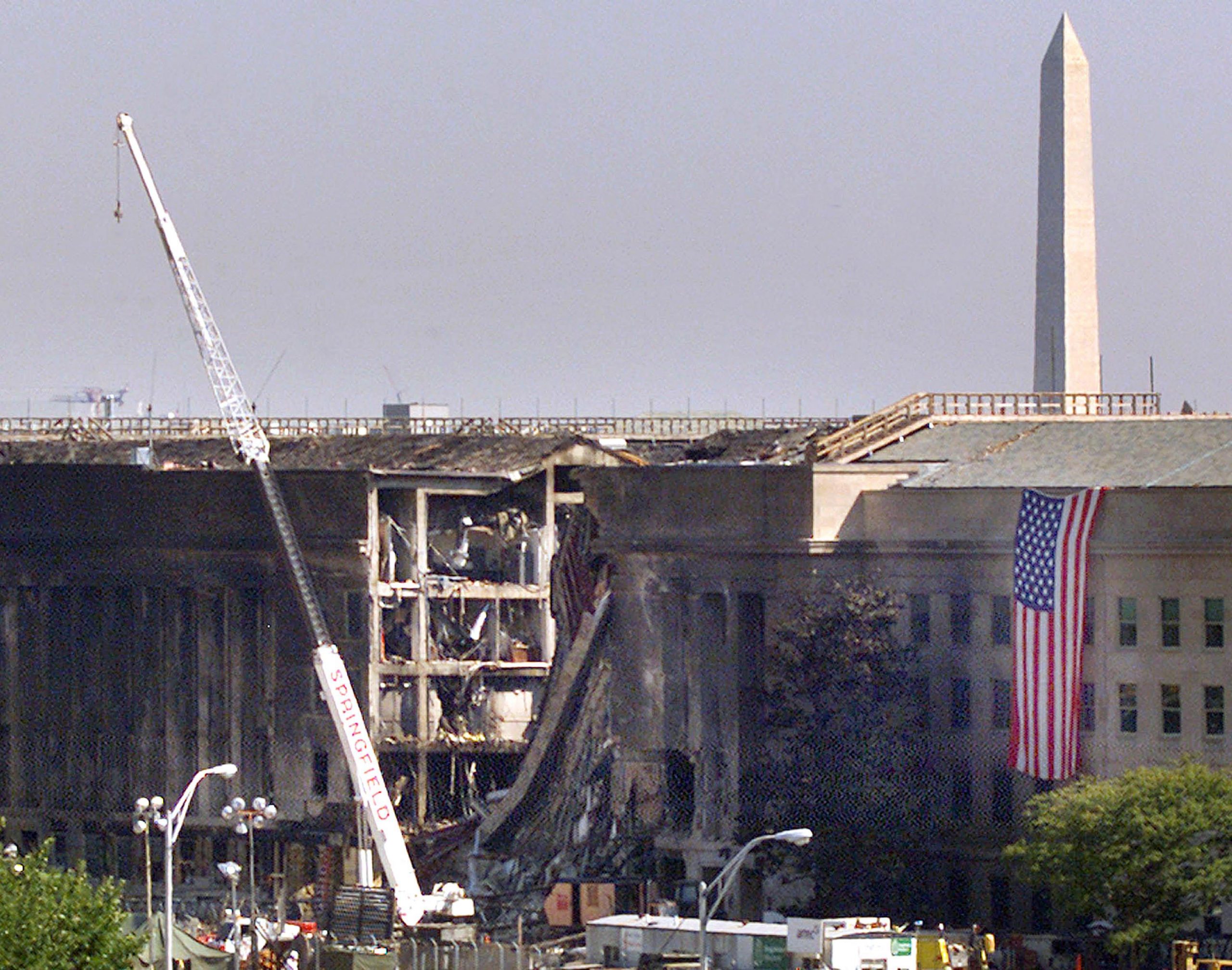
Dec. 7, 1941. Nov. 22, 1963. Sept. 11, 2001. All of us old enough to remember know exactly where we were and what we were doing when we first heard the awful news. We remember the stunning feeling that suddenly everything had changed, that nothing would be the same. We remember feeling that unknown horrors lay ahead.
Ten years after Pearl Harbor, the United States was mired in a stalemated war in Korea. But the nation had won a great victory in World War II, embarked on a generation of postwar prosperity, and confronted the Soviet Union in a Cold War that would take four decades to win.
Ten years after the assassination of John F. Kennedy, the United States went through a wrenching debate on the war in Vietnam and had a president mired in the scandal known as Watergate. But the nation had also passed landmark civil rights legislation, embarked on a war against poverty and landed the first men on the moon.
Ten years after the Sept. 11 attacks, the changes are less dramatic and less resolved, but they touch Americans every day. Airport pat-downs, barricades outside government offices, identification checks at private buildings, searches at sports stadiums, armed security officers at public events, long motorcades with Secret Service SUVs and police outriders — all these are the legacy of 9/11.
On Sept. 10, 2001, America was on a decadelong holiday from history. We were, as Bill Clinton’s Secretary of State Madeleine Albright said, “the indispensable nation,” seemingly without any serious enemies. The fall of the Berlin Wall in 1989 and the demise of the Soviet Union at the end of 1991 signaled with more clarity than is usual in history the end of the Cold War. We had mostly harmonious relations with Russia and our economy was increasingly intertwined with China’s.
It was a decade with fewer military conflicts and deaths than any for more than a century. And where America did intervene militarily, in Bosnia-Herzegovina and Kosovo, it did so without committing appreciable numbers of ground troops or incurring significant numbers of casualties.
Even more important, as Francis Fukuyama argued in his 1992 book “The End of History,” there seemed to be no system of governance competitive with liberal democracies and market capitalism. Nazism was long gone, Marxism was dead, and democracy was making vast gains in large parts of the world.
Sept. 11 ended this holiday from history. It became clear even before the Twin Towers fell that we had enemies determined to inflict enormous damage on our society. Al Qaeda and other Islamist extremists had the means to do so because of the proliferation of chemical, biological and nuclear weapons — weapons of mass destruction — which were being developed by regimes like Iran and North Korea.
The course of national policy and the sense Americans have of their place in the world, both transformed in response to Sept. 11, have remained largely in place, despite bitter partisan debate and sharp electoral swerves — toward Democrats in 2006 and 2008, toward Republicans in 2010. Amid all the alarms and diversions, there has been a surprising degree of continuity in public opinion and public policy.
In the immediate aftermath of Sept. 11, polls showed that most Americans believed that another terrorist attack was very or somewhat likely. They have continued to believe that over most of the past decade, and that fear has if anything strengthened during the past two years.
At the same time, the fears that Americans would retaliate violently against Muslims (or those perceived to be Muslims) at home have turned out to be unfounded. Americans have been able to appreciate that, even though most recent terrorists have been Muslim extremists, the large majority of Muslims are not terrorists and the large majority of Muslims in this country are not sympathetic with terrorists’ methods and aims. Violence against Muslims or those perceived to be Muslims has been exceedingly rare.
Aside from a few disputes about the location of mosques, there has been no move to suppress Muslim culture as there was to eradicate German culture during World War I. Nor has the government imposed anything like the internment of Japanese-Americans ordered by Franklin Roosevelt during World War II. There has been no evidence that either the Bush or Obama administrations have used tools of surveillance to spy on political opponents or for political advantage.
Indeed government has leaned in the other direction. Airport security treats grandmothers from North Dakota the same as Muslims toting Korans. Passengers of all faiths and ethnicities are required to take off their shoes and place their liquids in clear plastic bags. Americans have been willing to endure seemingly pointless security measures with nothing more than a few murmurs of complaints.
Despite such irritations Americans, as during the four decades of the Cold War, have proved able to persevere in their daily lives and work, without undue psychological distress from a threat that seems likely to continue indefinitely. This is not unprecedented: When John Kennedy said we were facing “a long twilight struggle,” he was speaking nearer the beginning than the end of the Cold War. While recognizing that luck has been a factor, Americans give government and its leaders credit for protecting the nation. George W. Bush, even when his overall job approval slumped, was seen as doing a good job of reducing the threat from terrorism. Barack Obama, even as his job approval has sunk, continues to receive high marks for this as well.
Which is not to say that the approaches of the two administrations have been identical, or that there have not been sharp disagreements between the two political parties and harsh attacks on each president. On Sept. 10 the nation was closely divided between Republicans and Democrats, as evidenced by the excruciatingly close presidential election of 2000. Democrats, after a party switch, held a 51-49 majority in the Senate; in the House Republicans had the smallest majority of any party in nearly 50 years.
A spirit of national unity, symbolized by lawmakers singing God Bless America on the steps of the Capitol on September 11 and George W. Bush’s rousing speech to Congress, lifted the country’s spirits in the immediate wake of the attacks. By a near-unanimous vote, Congress authorized military action in Afghanistan.
But the bipartisan spirit dissipated within the next year. Republicans attacked Democrats for insisting on provisions favoring unionization of employees in the new Department of Homeland Security. There were even sharper differences over the resolution authorizing military action against Saddam Hussein’s regime in Iraq. Democrats resented George W. Bush’s insistence of a vote in October 2002, weeks before the congressional election. The resolution was supported by virtually all Republicans and by most Senate Democrats — including Hillary Clinton, John Kerry and John Edwards — but opposed by a majority of House Democrats led by future Speaker Nancy Pelosi.
Within weeks of George W. Bush’s appearance on an aircraft carrier emblazoned with a sign reading “Mission Accomplished,” opposition to the war in Iraq and to some of the administration’s tactics flared up. The failure to find weapons of mass destruction in Iraq — though later reports made it clear that the Saddam Hussein regime retained the capacity to build them — led many to charge that the decision to go to war had been based on lies.
In many ways the critics echoed the cries of opponents of the Vietnam War three decades before. The charge that “Bush lied and people died” resembled the charges that Lyndon Johnson misled Congress into passing the Tonkin Gulf resolution of 1964. The clamor over “warrantless wiretapping” resembled criticism of Nixon administration surveillance programs — never mind that the practice in question was limited to surveillance of communications between suspected al Qaeda operatives abroad and persons in the United States. The charge that we had gone into Iraq unilaterally, when actually we were accompanied by forces from more than 30 nations, was a more salient critique of our course in Vietnam, where we had few allies.
This harsh criticism continued as casualties in Iraq mounted and as the American military strategy was signally failing. Bush waited until after the Republicans’ defeat in the 2006 off-year elections to change commanders and adopt the surge strategy that, despite Democrats’ attacks and Republicans’ queasiness, turned the tide in Iraq unmistakably toward success.
The political debate led many to expect a sharp change in policy when Barack Obama took office in January 2009. Instead, the new administration largely followed the course of its predecessor. There was no sudden withdrawal of troops from Iraq; instead the surge troops remained in place until violence had fallen sharply and the Iraqis were capable of taking over.
In Afghanistan Obama, after some hesitation, decided in December 2009 to increase troop levels and to prosecute the conflict more aggressively. He has called for troop withdrawals beginning in September 2012 but also for a continuing American presence until 2014. The Obama administration has also increased the use of drone aircraft to target specific individuals. And in May 2011 Navy SEALs, at the president’s direction and without informing the Pakistani government, attacked and killed Osama bin Laden in his compound located suspiciously near Pakistan’s military academy.
Nor were there as many changes in the treatment of captured terrorists as political rhetoric led many to expect. Waterboarding, applied to only three captured terrorists, was abandoned by 2004. The Guantanamo detention camp, despite Obama’s campaign promises, has remained open. Renditions — handing over captives to other nations’ interrogators — have continued.
It appears that the Obama administration has been more responsive to enduring public opinion than to what have turned out to be evanescent campaign promises. Majorities of Americans have continually favored targeted assassination of terrorist leaders, drone attacks and continued operations at Guantanamo. Opposition to continued military operations in Iraq faded as the success of the surge became apparent, and flagging enthusiasm for continued operations in Afghanistan has not morphed into a demand for immediate withdrawal.
Obama’s decision to retain Robert Gates as defense secretary was an early indicator of this general though not total continuity in policy. In the memoir he wrote in the 1990s after his retirement as CIA director, Gates drew on his service in administrations of both parties to liken the United States government to a giant ship that can only with great effort change course.
The Sept. 11 attacks prompted such a change in course, in a direction that seems in retrospect inevitable. It is inconceivable that any president would not have sent troops into Afghanistan after it became apparent that it was the refuge of the planners of the Sept. 11 attacks. It is exceedingly unlikely that any president would not take action to prevent al Qaeda and other Islamist terrorist groups from finding refuge elsewhere.
It is arguable that not every American president would have chosen to go into Iraq or would have chosen to argue, as Bush did, that America had an interest in advancing democracy and human rights in Muslim nations. But it is notable that Obama, after campaigning against the war in Iraq and showing indifference to pro-democracy demonstrators in Iran in summer 2009, chose not to duck out of Iraq and after some initial hesitation has expressed sympathy with at least some pro-democratic Arab Spring movements.
There are many who doubt that we are safer now than we were before Sept. 11, and there are reasons for disquiet. But we were never as safe as we thought on Sept. 10, and any assessment of our policies must consider the counterfactual case in which we took no action.
We do know that bin Laden is dead and have reason to believe that al Qaeda is gravely weakened. We do know that the Saddam Hussein regime will not develop weapons of mass destruction, invade other nations, and violate Iraqis’ human rights as it did before. We have at least some reason to hope that Afghanistan will not be a haven for terrorists again, and that our government is taking action to see that other nations like Yemen will not be either.
We have reason to believe as well that the form of extremist Islam exemplified by bin Laden has not swept the Muslim world. We can hope that in time it will prove as irrelevant and misguided to the vast majority of Muslims as it does to us.
But it is not a threat we can safely ignore. As we learned on Dec. 7, 1941, and on Nov. 22, 1963, America and Americans can never be entirely safe from the violent acts of evil regimes and individuals. Sept. 11, 2001, ended our holiday from history and looking ahead it does not seem likely to appear on our calendars for many years to come.
Michael Barone,The Examiner’s senior political analyst, can be contacted at [email protected]. His column appears Wednesday and Sunday, and his stories and blog posts appear on ExaminerPolitics.com.
This piece is a part of the Washington Examiner’s special series The Legacy of 9/11.
|
The Legacy of 9/11 America changed in a day 9/11 triggered revolutionary changes in America’s military Still mourning at Ground Zero A sense of loss at the Pentagon A small town with a big heart |
