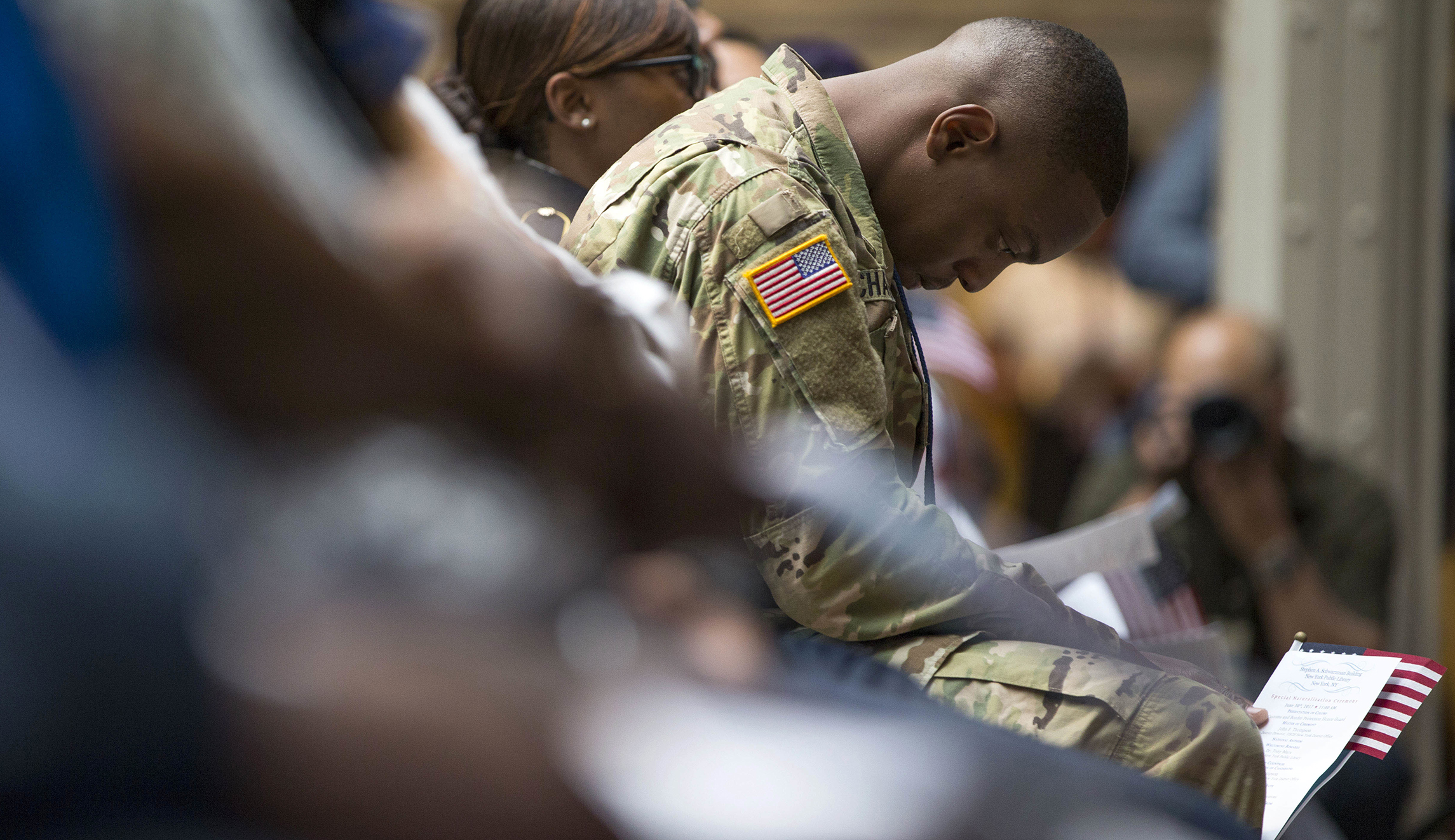
The Associated Press reported this week that the U.S. Army is “quietly discharging immigrant recruits.” It sounds quite awful, but the report may be more misleading than anything else.
The AP stated initially that the Army “has moved in recent weeks to discharge immigrant recruits and reservists who enlisted through a program that promised them a path to citizenship. Some of these service members say they weren’t told why they were being discharged. Others say the Army told them they’d been labeled as security risks because they have relatives abroad or because their background checks were pending.”
The obvious takeaway is that the president and his immigration hardliners have gone so far as to target even immigrants who’ve joined the U.S. armed forces via the Military Accessions Vital to the National Interest program, or MAVNI.
The truth of the matter doesn’t appear to be that cut and dried, and the AP report leaves out a good deal of necessary context.
First, it’s a full seven paragraphs before the reader is informed that the article is almost entirely about applicants who’ve only enlisted, and never even started basic training. It’s a bit of a stretch to use the word “discharged” for candidates who never made it past the starting line. You can’t be fired from a job for which you were never hired.
Second, it’s unclear just how many MAVNI applicants have been given the boot. The AP claims there are at least 40 cases, and at least one of them was in the program long enough to reach the rank of private second class, but considering that more than 10,000 noncitizens joined or signed contracts between 2009 and 2017, the number 40 suggests this may yet not be a plot to target immigrant recruits.
Third, there’s the fact that the MAVNI program was effectively shut down in 2016 over security concerns. All new recruitment was halted, which put a select group of applicants in a curious “bureaucratic limbo,” according to Military.com’s Richard Sisk.
“The beginning of the end for MAVNI came in the form of a September 2016 memo to the service secretaries from Peter Levine, then the acting under secretary for personnel and readiness,” Sisk reported in April.
Along with halting new recruitment, the program administrators also updated its background check criteria, making security much tougher for the more than 300 applicants stuck in limbo.
“Pentagon spokespeople said the program was effectively allowed to end last October [2017], when tighter screening procedures were put in place for MAVNI recruits who had already signed up,” Sisk reported.
MAVNI applicants have roughly 1,095 days to get their background checks completed before the agreement expires. If the clock runs out, or if they fail the enhanced background checks, their packet is rejected.
As to whether the 40 referenced by the AP fall into the expiration category or the failed background check category, the report doesn’t say.
This really is the biggest problem. As readers, we’re told something is wrong, but we’re never really given the full context. We’re not told whether this is a new policy implemented by the current administration or whether the rejections are the consequence of the 2016 MAVNI security enhancements. For what it’s worth, a Pentagon spokesperson said Friday that the AP has “mischaracterized” its handling of the MAVNI recruits, adding further that there has been “no change in policy.”
There is this Washington Post report from June 2017, which claims the Pentagon was “considering a plan to cancel enlistment contracts for 1,000 foreign-born recruits without legal immigration status, knowingly exposing them to deportation.” But the AP can’t lean on the Post’s reporting to excuse its own muddling coverage.
Neither the AP nor a spokesperson for the U.S. Army responded to the Washington Examiner’s requests for comment.
