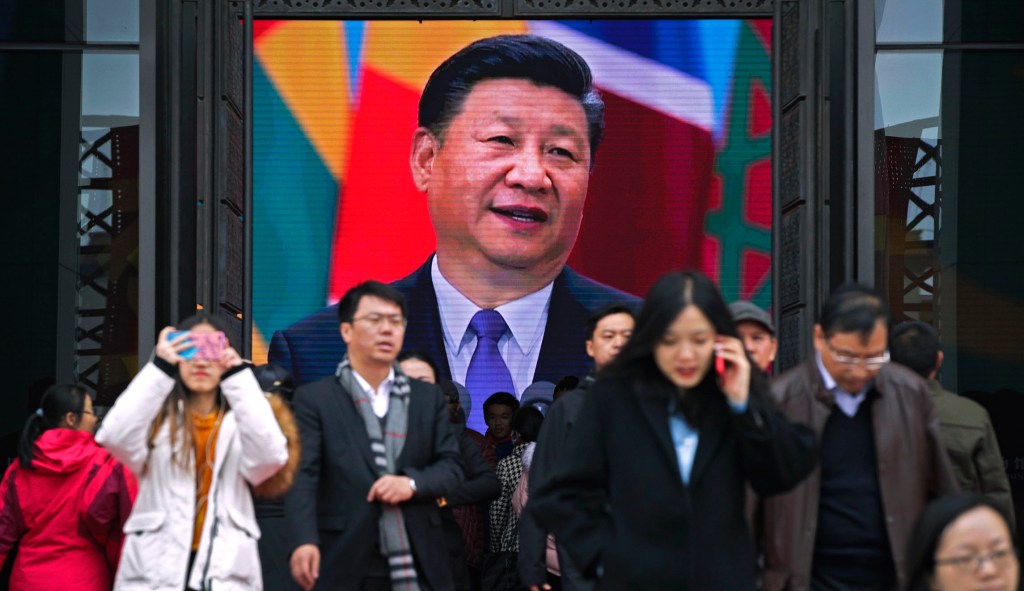
Via the New York Times, a dream from China’s dystopia

Published November 20, 2018 5:04pm ET


Few notions are as utterly ludicrous as the suggestion that a Chinese 18-year-old now has better life chances than an American 18-year-old. The opposite is true in terms of freedom, economic potential, and the pursuit of happiness.

But that’s exactly what Javier Hernandez and Quoctrung Bui claimed in the New York Times on Monday. The writers posit that “There are two 18-year-olds, one in China, the other in the Untied States, both poor and short on prospects. You have to pick the one with the better chance at upward mobility. Which would you choose?”

The American? Not so, says the Times. In fact, to pick the American is to be stupid. Because “China has risen so quickly that your chances of improving your station in life there vastly exceed those in the United States.”

Yes, you read that right. The New York Times apparently believes that one’s life chances are now better in a post-communist authoritarian state than they are in the world’s democratic powerhouse. And not just by a little bit — “vastly better.”

Let’s be clear, this is a truly insane assertion. But seeing as the Times is an otherwise auspicious publication with a well-educated readership, its editors know that the Hernandez and Bui’s intellectual detritus must be rendered into a kind of guano delicacy. So the article is pumped full of misleading data sets, helpfully provided by the not-so objectively sounding “World Inequality Database.” A little digging feeds into the objectivity concern — socialist number-manipulator, Thomas Piketty, is on the group’s executive committee.

Piketty’s silent guiding influence speaks to the central economic problem with the article: its fetish-focus on income inequality, and not on individual interests. Hernandez and Bui note that per capita GDP in the US is five times higher than in China, but add that “by some measures Chinese society has about the same level of inequality as the United States.” And as noted, the authors believe that the 18-year-old in China has life chances that “vastly exceed those in the United States.”

There are a few massive problems with this contention. First off, people do remain manifestly poorer in China than in the U.S. The Times attempts to hide this reality behind income percentiles in the respective US and Chinese populations, but there’s a big difference between the average U.S. wage and quality of life and the average Chinese wage and quality of life.

Distancing themselves from that reality, Hernandez and Bui embrace that most defining of socialist ills: the belief, as Margaret Thatcher eloquently explained, that as long as the gap between the rich and poor is smaller, it’s okay if everyone suffers more.

Yes, the Times offers a passing remark that “the poorest Chinese are far poorer [that the poorest Americans], with nearly 500 million people, or about 40 percent of the population, living on less than $5.50 a day,” a level of poverty that is essentially unheard of in the U.S. But their underlying suggestion is that the young Chinese lower-middle class are better off than their American counterparts. And that is unambiguously untrue.

Moreover, as the Chinese rural poor become more aware of the divorce between their medieval-style serfdom and the relative advantages of urban life, China’s government will face significant social upheaval. That may be one reason the government is cracking down on all dissent, hard, walling off nearly every useful, true, and informative part of the Internet from its citizens, and stoking nationalistic fervor with relentless propaganda. In the Trump era, it is China, not the U.S., that has become increasingly hostile toward foreign residents, and its new Orwellian “social credit” system is going further than ever before in limiting the rights of the Chinese people.

As Matthew Continetti notes, the article is absolutely uninterested in human freedom as a marker for life “prospects,” “upward mobility,” and the choice of where to live. But whereas the Times seems to think freedom is irrelevant to life chances, I suspect most humans would prefer the choice of living where they can pursue their own economic, political, social passions, and travel interests.

Hernandez and Bui also seem to be utterly ignorant of the fact that improved living standards in China are born not of central planning, but of an export-model built on low-wage labor and expanding global capitalism. The authors assert that “China used to make up much of the world’s poor. Now it makes up much of the world’s middle class.” That is true, but it’s only because global wealth has skyrocketed over the past thirty years, and Xi Jinping’s predecessors wisely opened up their nation to reap the benefits of global trade and capitalism.

The article concludes with a homage to Xi’s dystopia. A happy lady (I’m happy for her but not for her views), Xu Liya declares that China is on the right track because “poor people have the resources to compete with rich people, too … It feels like there are no limits to how far you can go [in modern China].”

I’m sorry, but that’s patently untrue. The U.S. is far from perfect, but the average 18-year-old American has far better life chances than their Chinese counterpart. And especially so if that counterpart is a Uighur, a Christian, a homosexual, or just one of 1.4 billion individuals who doesn’t like following Xi’s orders.