

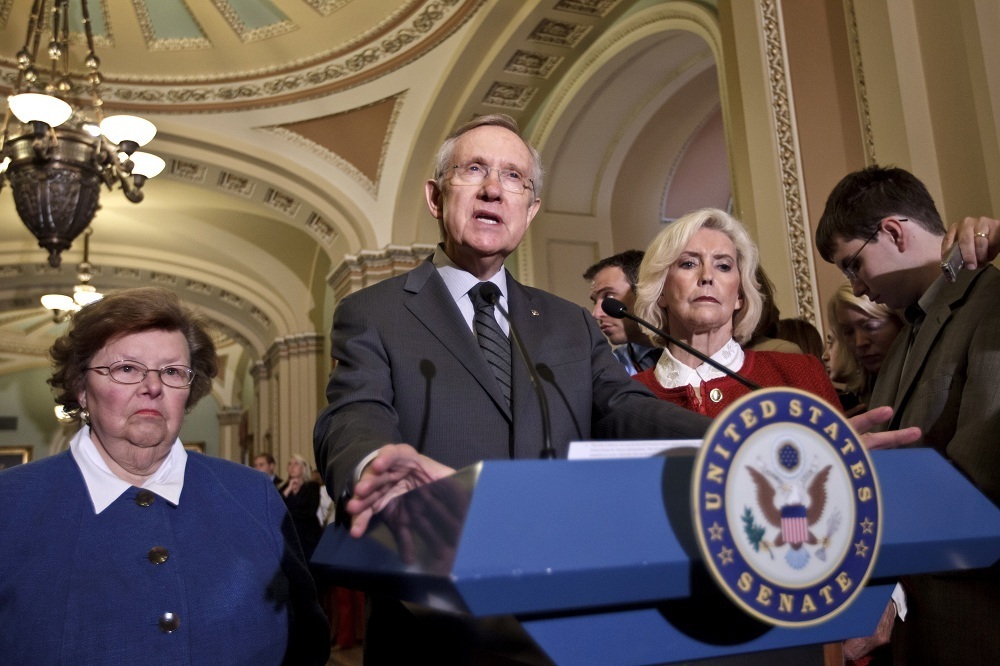
Amid a barrage of Democratic accusations that the Republican Party is engaged in a “war on women,” Senate Republicans on Tuesday blocked legislation intended to ensure equal pay for men and women who perform the same work.
The Paycheck Fairness Act fell eight votes short of the 60 needed to advance it to the Senate floor for debate. Fifty-two Democrats voted for the bill, while all 47 Republicans voted against it.
Recommended Stories


Democrats said prior to the vote that they hoped to a few Republican moderates would support the bill, but none crossed party lines.
Republicans sought to offer an alternative to the Democratic bill, but they avoided publicly discussing the legislation or even joining the floor debate, a sign that the party recognizes the damage the issue could inflict on its candidates among women voters whose support is considered critical in the November elections.
Even presumptive Republican presidential nominee Mitt Romney was largely silent on the issue, despite efforts by Senate Democrats to drag him into the debate in hopes of scoring political points for President Obama.
Senate Majority Leader Harry Reid, D-Nev., said Romney “may oppose it, but he’s afraid to say anything about it.” Reid called on Romney to “show some leadership … and tell his fellow Republicans that opposing fair pay for all Americans is shameful.”
Democratic National Committee Chairwoman Debbie Wasserman Schultz said Romney’s silence on the pay equity bill raises questions about his commitment to equal rights for women.
“What exactly is it about equal pay for equal work that makes Mitt Romney and congressional Republicans so uncomfortable?” Schultz said after the vote. “For weeks upon weeks, we’ve seen Romney refuse to stand up and show real leadership on the issue of pay equity.”
Polls show Obama leading Romney among women, though a recent Gallup Poll analysis suggests Obama’s lead is due to a long-term shift by women toward the Democratic Party and is not necessarily proof that women are being swayed by political debates over contraceptive funding, pay equity or other women’s issues.
Republicans argued the Paycheck Fairness bill would hurt small businesses and other employers by overwhelming them with new, cumbersome reporting requirements and by opening them up to the threat of discrimination lawsuits. Many business groups opposed the bill.
The Democratic bill would have allowed the federal government to collect wage information from private companies, and it would have required employers to justify differences in wages between men and women with the same job. It would also permit victims of pay discrimination to seek punitive damages.
“We are sorry this vote occurred strictly on party lines,” Sen. Barbara Mikulski, D-Md., said.
Sen. Barbara Boxer, D-Calif., asked Reid when he would bring the bill up again.
“For goodness sakes, how can you have a party that votes against equal pay for equal work?” Boxer said.
Among the GOP alternatives on which Reid would not allow votes was a bill from freshman Sen. Marco Rubio, R-Fla., that would allow employers to give performance-based bonuses to union workers with capped salaries.
Democrats said they opposed the measure because it would permit wage discrimination.
“It may lead to favorable treatment for some employees for reasons that might have nothing to do with the workplace,” Senate Majority Whip Richard Durbin, D-Ill., said.
