

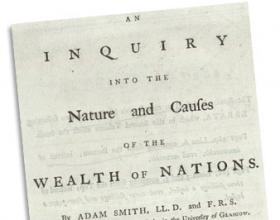
It is only a slight exaggeration to say that most recent college graduates learned everything they know about capitalism from Barbara Ehrenreich. Ehrenreich’s 2001 book Nickel and Dimed was compulsory summer reading for entering freshmen throughout most of the past decade at countless campuses across the country, including Smith, Rutgers, the State University of New York-Brockport, Slippery Rock University of Pennsylvania, the University of North Carolina-Chapel Hill, Appalachian State University, Illinois Wesleyan, Northern Arizona University, and California State University-Northridge. At none of those campuses were students at any level, from freshmen to graduating seniors, required to read a single word written by Adam Smith, whose Wealth of Nations (1776) is considered the seminal philosophical justification for a Western economic system that relies on private property and private investment and allows the market, not governments, to set wages and prices, in the process generating prosperity from the pursuit of self-interest. Nor were those students—and the same can be said for their successors enrolled in college today—required to read any of the seminal philosophical critics of capitalism, such as Karl Marx or Ferdinand Tönnies, who famously worried that social systems based on Gemeinschaft (traditional bonds of family and neighborhood) were being replaced by those based on Gesellschaft (impersonal monetary and contractual relations).
Recommended Stories


Instead of works by leading 18th- and 19th-century thinkers, college students got the adventures of Ehrenreich, a self-proclaimed socialist, dabbling in minimum-wage blue-collar employment such as waitressing, cleaning houses, and clerking for Walmart. Her modus operandi was to put in a few weeks on the job, quit in a huff over such indignities as having to scrub toilets or be nice to customers, and then complain about employee drug-testing at Walmart and the impossibility of surviving on $7 an hour (impossible for Ehrenreich, that is, since she lived by herself in relatively costly motel rooms instead of with family like most of the real-life working poor). Instead of wondering whether some people stay poor and live in poverty because they make lousy lifestyle choices such as dropping out of high school and bearing children out of wedlock, Ehrenreich made the zero-sum argument that people are poor because the rich systematically steal from them, for example by buying up all convenient residential land for “condos, McMansions, golf courses, or whatever they like,” thereby forcing those at the bottom of the ladder into shabby trailer parks from which they commute to their “junk” jobs.
Nickel and Dimed has pretty much run its course as required freshman reading, having been supplanted by Eric Schlosser’s war against junk food and Elizabeth Kolbert’s campaign to have the federal government force people to clamp down on carbon emissions. The point is that, for nearly a decade, professors and administrators at institutions of higher learning across America who do not consider Adam Smith to be essential reading for their students made Barbara Ehrenreich mandatory. This is not just an indictment of the anti-intellectualism of an academic system that would rather expose its students to a piece of flippant and ephemeral journalism than to one of the classics of the West. It is also a revelation of the pervasive ideological imbalance on campuses. Ehrenreich’s tract passed for an uncontroversial requirement; any effort to introduce college students to a fair—not boosterish, simply fair—evaluation of capitalism with all its virtues and drawbacks would likely provoke a faculty revolt.
What to do? College students and their elders certainly have a healthy level of interest in market economics. Friedrich Hayek’s Road to Serfdom (1944), arguing that government control over the economy inevitably leads to tyranny, has sold more than 400,000 copies in recent years. The results of this November’s elections indicate that a resounding majority of Americans reject the massively interventionist and economically suicidal policies of the Obama administration and a Democratic-dominated Congress. Yet market-friendly economists and their allies among historians, political theorists, and other scholars who believe that capitalism has not received a fair hearing in college classrooms are deeply divided about how to proceed, given the reality of the ideological proclivities that prevail in academia. Reform the curriculum for economics majors (one of the most popular majors on many campuses) so that the history of economic thought is a part of the instruction? Try to reach a larger slice of the student population with stand-alone seminars and other courses that might serve as counterweights to the usual anticapitalist propaganda? Make economics part of the interdisciplinary freshman seminars offered at many liberal-arts colleges? Bring outside speakers to campus? Mentor promising students? Sponsor clubs and discussion groups in order to air libertarian and conservative economic ideas? Fund internships and visiting fellowships in order to expose students to classical liberal scholars whom they might not meet on their statist-liberal campuses? All of the above? Or is it unrealistic to think that overwhelmingly liberal faculty members and college administrators will even allow such enterprises onto campuses?
That the prevailing political culture of American academia leans heavily toward pro-regulatory, big-government liberalism if not outright leftism—and hence toward institutional hostility to capitalism—is a given. Decades of research support this proposition, ranging from the studies of professorial political alignment published by Seymour Martin Lipset during the 1970s, 1980s, and 1990s to reports in Inside Higher Ed and the Daily Princetonian that professors and other college employees overwhelmingly directed their contribution dollars in 2008 toward presidential candidate Barack Obama and his fellow Democrats (92.4 percent of donations of more than $200 went to Obama at Princeton alone). In 2003 Daniel B. Klein, then a libertarian economics professor at Santa Clara University (he is now at George Mason University), and Charlotta Stern of the Institute for Social Research at Stockholm University conducted a large-scale survey of the political parties for which American academics voted. They chose six social-science and humanities fields that, coincidentally, are the sorts of fields in which the ideas of Adam Smith might be expected to receive an airing: anthropology, economics, history, political and legal philosophy, political science, and sociology. Their results bore out what the journalists reported concerning the Obama campaign a few years later: Anthropologists voted for Democratic over Republican candidates by a 30.2 to 1 ratio, and sociologists favored Democrats over Republicans by a 28 to 1 ratio. Toward the bottom of the ladder were political scientists, who still supported Democrats over Republicans 6.7 to 1. Even economists, typically regarded as conservatives among college faculty for their presumably hard-headed numbers-crunching, voted Democratic over Republican by a 3 to 1 ratio, with younger faculty members tilting more liberal than their older colleagues. “The social sciences and humanities are dominated by Democrats,” Klein and Stern wrote. “There is little ideological diversity.”
Furthermore, even if more academic economists were sympathetic to free-market ideas, most of them would have no place in their departments to teach them. Alone of the social sciences, economics is a discipline that has lost interest in its own intellectual history. At Yale, for example, undergraduates majoring in economics can choose among more than two dozen lecture courses and seminars during any given semester, ranging from the basics of micro- and macroeconomics to specialized classes bearing such titles as “Financial Markets,” “Trade and Development,” and “Economic Development of Japan.” In not one of those courses does it seem possible to read and discuss Adam Smith—or Karl Marx, Friedrich Hayek, Max Weber, Joseph Schumpeter, John Maynard Keynes, Ludwig von Mises, Ronald Coase, and other seminal thinkers whose theories shaped the academic discipline of economics and economics-focused political theory.
That was not always the case, according to Bruce Caldwell, a research professor of economics at Duke University whose scholarship concerns the works of Hayek. “The discipline [of economics] began during the 1950s to view itself as very much a scientific discipline,” he said in an interview. “This was something that Hayek fought against. He fought against the positivistic tendency to treat economics like engineering, for example. But now, there’s a self perception by economists of our discipline—that we are scientists and that in economics, as in other sciences, there is a gradual accumulation of truth and steady progress toward greater knowledge. So most economists believe that we don’t need a history of our discipline, which would only show past mistakes. In many economics departments there might be someone teaching the history of economics, but that person is probably an older person, and when those people retire, they’re not replaced. It’s very different from the other social sciences, where, in sociology, for example, of course you read Marx and Durkheim and the rest.”
That leaves most of today’s undergraduates with almost no classroom forum in which to learn about the philosophical and historical substrate on which Western capitalism rests. At best, they might sign up for a class such as communitarian theorist Michael Sandel’s immensely popular “Justice” course at Harvard. There Sandel gives a generally respectful, if oversimplified, hearing to libertarian arguments favoring free markets (that they facilitate the production of goods and services that people want) but ultimately questions whether it is fair for society to lavish greater rewards on people who by sheer luck of the genetic draw happen to be smarter or more talented than others, with the implicit suggestion that the government ought to level the playing field. At worst, those students get Barbara Ehrenreich or their own Marxism-besotted English professors pontificating about ruling-class hegemony and multinational corporations.
“Freshmen are energetic and motivated, but they come in with notable deficiencies in their background,” said William N. Butos, an economics professor at Trinity College in Connecticut. “I find that the students who had ‘economics’ at the high school level require the most deprogramming. What they come with is a kind of New York Times view of the world in which the market is supposed to be subject to massive and persistent failures. They have no analytical framework with which to draw those kinds of conclusions. They are simply mimicking what they’ve read elsewhere.”
As a result—as a 1999 survey conducted by the Council for Economic Education indicated—most people, including students, poorly comprehend even the most elementary and agreed-upon principles of economics. Fewer than half of American students, for example, understood that when interest rates go up, so do savings, and only about one-third recognized that the statement “money holds its value well in times of inflation” is incorrect. Fewer than half realized that when the government sets price ceilings, such as rent control for housing, supply falls.
It is not that college students are necessarily antibusiness. Jerry Z. Muller, a professor of modern European history at the Catholic University of America who has written several books about capitalism, conducted a survey of the future employment plans of the 15 members of the Dartmouth class of 2010 who had majored in history. He found that 5 out of the 15 intended to work in finance and a sixth had a job with another business, the St. Louis Rams (the rest intended to teach, attend law school, do medical research, and volunteer). They’re not “Leninist cadres,” said Muller, speaking at a day-long conference on October 6 in New York sponsored by the Manhattan Institute’s Center for the American University (Klein and Butos were also participants). Yet, as the Council for Economic Education discovered in its survey, most are grossly uninformed or misinformed about how the market system works, or why its proponents believe that it is superior to other economic arrangements in delivering prosperity, raising standards of living, and honoring personal freedom.
And the problem of how to offer those students a more nuanced perspective on capitalism remains. The history of trying to institute alternatives to conventional progressive-to-leftist economic and political thinking on college campuses is a history of genuine successes (the James Madison Program in American Ideals and Institutions at Princeton, the Center for the History of Political Economy directed by Caldwell at Duke, the Political Theory Project at Brown dedicated to “market-based approaches to social problems” and headed by John Tomasi, an associate professor of political science) interspersed with some mixed results and spectacular failures. The most disheartening of the failures was the $20 million gift in 1991 to Yale, one of the largest in the university’s history, by Texas billionaire Lee M. Bass, a Yale alum, for the funding of traditional courses in Western civilization. Yale returned the gift in 1995 amid vociferous complaints by faculty members that Bass intended to exert too much control over the content of the courses and who was to teach them.
In 2006 Robert Paquette, a history professor at Hamilton College in Clinton, N.Y., tried to set up a campus program, to be called the “Alexander Hamilton Center for the Study of Western Civilization,” that would offer lectures, colloquia, conferences, fellowships, and internships, all focusing on such historical, philosophical, and political themes as property rights, slavery, and the meaning of freedom. Funding would be supplied by a $3.6 million grant from a longtime Hamilton trustee, Carl Menges, and smaller gifts from institutional donors. The center won the signed approval of Hamilton’s president, and all seemed to go well—until Hamilton’s faculty voted by a margin of more than 80 percent to demand that the college rescind its support. (Paquette had already made campus enemies by his outspoken criticism of left-wing adventures on the Hamilton campus, such as a later-canceled campus speaking engagement in 2005 for Ward Churchill, notorious for writing that the 9/11 victims had deserved their fate.) The project collapsed when Paquette refused to agree to a new charter that would have given the Hamilton faculty control over the center’s programming and research, and Menges resigned from the board of trustees. Paquette, with Menges’s financial backing, managed to set up his program in late 2007, but only as an autonomous “Alexander Hamilton Institute” on the other side of Clinton that has no official connection to the college.
Since 1999 John Allison, the former chief executive of BB&T, a leading bank headquartered in Winston-Salem, North Carolina, has been funding, through BB&T’s charitable affiliate, courses and programs on the ethical foundations of capitalism at about 60 colleges and universities public and private in the South and Southeast (recipients have included prestigious Duke University as well as many lesser-known institutions). The grants have varied in size and the programs in ambition. Clemson University’s College of Business and Behavioral Science has received nearly $5 million since 2005 to fund an Institute for the Study of Capitalism that sponsors courses, research, conferences, fellowships, summer camps for high school and college students, and summer institutes for high school teachers. At other campuses grants from Allison have been more modest, ranging from $500,000 to $1 million to pay for more modest centers or single courses to be offered over a period of years.
Problems have arisen because a condition of some Allison grants is that the recipient college assign Ayn Rand’s 1957 novel Atlas Shrugged as part of required reading for the funded course. Allison discovered Rand as an undergraduate business major at the University of North Carolina during the 1960s, and Atlas Shrugged, with its celebration of businessmen and businesswomen as heroic individualists who confer benefits on society by pursuing “selfishness” (Rand’s word), is his favorite book. Atlas Shrugged, while a perennial bestseller and an important artifact of 20th-century culture, is not exactly great literature (stilted dialogue and cardboard characters have ranked among the defects pointed out by critics), and it is in War and Peace territory at more than 1,100 pages, including a 70-page monologue by the novel’s libertarian hero, John Galt.
Even staunch defenders of free-market capitalism might legitimately object to having students use up precious homework time plowing through Atlas Shrugged when they could be reading more Alexis de Tocqueville or Frédéric Bastiat. And unsurprisingly, the Atlas Shrugged requirement that Allison has imposed on some programs has turned into a lightning rod for liberal professors aghast at the idea that some part of a college curriculum might include a sympathetic portrayal of capitalists, or indeed any curriculum over which the faculty senate might not have the final say. In 2006 the faculty at Meredith College in Raleigh, North Carolina, voted overwhelmingly to turn down a $420,000 grant from BB&T for an honors program that was to include a course to be titled “Global Capitalism and Ethical Values” and would have made Atlas Shrugged and The Road to Serfdom required reading. Since then, the American Association of University Professors has been on a campaign, through articles for its print and online magazine, Academe, to shame other institutions of higher learning into turning down Allison money on the ground of inappropriate outside control.
Such stories serve as warnings of the perils awaiting even the best-intentioned and best-funded efforts to create an alternative center of gravity on a progressive campus. Even long-established conservative centers can get into trouble, as did Stanford’s 51-year-old Hoover Institution, which faced a massive, if ultimately unsuccessful, protest by faculty and students over its hiring of Donald Rumsfeld, secretary of defense under George W. Bush, as a visiting fellow in 2007. Furthermore, the programs can be dauntingly expensive. The annual budget for Princeton’s James Madison Program is about $1.5 million, paying for 13 visiting scholars (some of whom teach courses at -Princeton) as well as conferences, lectures by outside scholars, and discussion sessions for undergraduates. John -Tomasi’s more modest venture at Brown spends about $500,000 a year, and Caldwell’s economic history project at Duke has an annual budget of $175,000. “I think that the course offerings at Brown are exemplary,” Muller wrote in an email. “But because they are taught by post-docs brought in especially for the purpose, it would be difficult to replicate at a smaller and less wealthy institution like CUA.”
An even more intractable problem is what might be called ideological demographics: Where do you find enough academics committed to free markets and classical liberalism to do justice to courses on capitalism? Earlier this year the New York Times reported on a paper published by two sociologists, Neil Gross of the University of British Columbia and Ethan Fosse, a graduate student at Harvard, concluding that the reason so few political conservatives are college professors isn’t so much that they face discrimination by their teachers and tenure committees as that academia is typecast as a liberal career—just as nursing is typecast as a women’s career, with the result that only 6 percent of nurses are men. “These types of occupational reputations affect people’s career aspirations,” Gross told the Times. Helped along by the radical leftist political movements that swept over campuses during the late 1960s, liberalism and academia have become entwined in an ideational double helix, with liberals and professors sharing and reinforcing such characteristics noted by Gross and Fosse as advanced degrees, tolerance for controversial social ideas, nonconservative to nonexistent religious beliefs, and disparities between education and income. Their findings reinforced Daniel Klein’s data concerning the voting patterns of social scientists. Klein and Stern wrote that in making hiring decisions, “the majority [of faculty] will tend to support candidates like them in the matter of fundamental beliefs, values, and commitments.”
Those sorts of findings, coupled with personal experience, have led some otherwise market-sympathetic professors to cynicism about the realistic possibility of changing either campus culture or the ideological and political views of students, which have likely been already shaped by their Boomer and Gen X parents or their generally liberal high school teachers. “It’s easy to get a course approved,” said Jeffrey Miron, director of undergraduate studies in Harvard’s economics department, at the Manhattan Institute conference. “All I have to do is go to my department chair. But a course can be a two-way sword. A capitalism course can be used to create an anticapitalism course, depending on who teaches it. Interdisciplinary courses most of the time are a Trojan horse for pushing leftist views. They’re mushy, and they’re frequently bad. Kids and their parents sacrifice to get into schools that have exactly the curricula that we’re critiquing here. They think that a left-leaning model is what’s good for the economy—and so do their parents, who went to the same schools and got good jobs and have careers. They read the course catalogue, and they read the op-ed page, and they say, ‘Where’s the market failure in this educational model?’ ”
Miron’s solution to the problem of teaching capitalism is minimalist but apparently effective, at least in his own discipline: Design an elective course in which you forthrightly offer your own antistatist views as a counterweight to those of the rest of the faculty—in other words, play the token libertarian, because, if Daniel Klein is right, that’s what you are. Miron titles his own course “A Libertarian Perspective on Economic and Social Policy.” It is a kind of anti-Michael Sandel class that covers a range of hot-button political and ideological issues—“drug prohibition, gun control, public education, abortion rights, gay marriage, income redistribution, and campaign finance regulation,” according to the course description—from the perspective of advocacy of minimal government interference. In an email Miron said that he usually has about 200 Harvard undergraduates enrolled in his course every year who come in with “a variety of political views. A few change their minds, but not all by any means!”
Still, many professors who have taken a more irenic approach to teaching about capitalism—eschewing the overtly politicized approach that might have sunk Lee Bass’s project at Yale and raised questions about Allison’s Ayn Rand courses, and also avoiding the personal friction that surrounded the founding of the Hamilton Institute—have reported successes. Muller, for example, teaches a well-subscribed class on capitalism at the Catholic University of America that examines the theories of Smith and Hayek—but also the theories of Marx, Tönnies, and other critics of the market system. Muller’s course, like Miron’s at Harvard, is the product of his own intellectual passions that happen to fit well with offering a counterweight to the negative perspective on free-market economics that is standard on most campuses. But Robert George, the -Princeton professor of politics who set up the James Madison program in 2000 after years of pleading for funding from conservative foundations leery of giving after the Bass fiasco, argues that even more ambitious programs based on outside financing can succeed if they are proposed with sufficient diplomacy and by making it clear that the aim is not to fight a culture war. “There are a thousand members, roughly, of the Princeton faculty,” George told the Manhattan Institute’s conference. “I don’t need 500 who agree with me. I don’t even need 50, I need 15. If we’ve got 15 people who are willing to seriously engage the established campus orthodoxy, it will transform the climate.”
George said that his strategy for getting dissenting voices heard was to play to the very tolerance and open-mindedness upon which liberal department chairs and administrators pride themselves—to call their bluff, as it were, so that Barbara Ehrenreich and her ideological allies don’t have the last word on capitalism. “There are many honorable liberals who are in fact open to students’ hearing competing points of view,” said George. “Honorable people. Find them. You can do business with them. They’re open to the argument. Often they just haven’t heard it.”
Charlotte Allen is a contributing editor to the Manhattan Institute’s Minding the Campus website.
