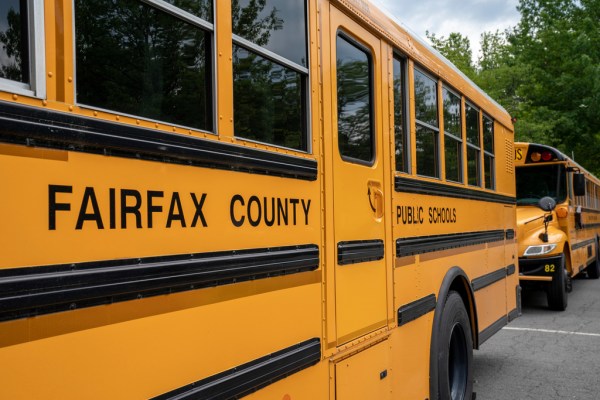
Fairfax County Public Schools Superintendent Jack Dale recently announced impressive improvements in test scores among special education students and those with limited English proficiency.
Nobody on the Fairfax County School Board thought to ask how he managed to produce almost miraculous pass rates among student subgroups that have historically been the hardest to improve. Instead, the board used the higher scores to justify extending Dale’s lucrative contract an additional four years.
But when members of FCPS Watch did what the School Board should have done, one statistic popped out: Since 2006, the first year the county was allowed to use an alternative to the Standards of Learning, more than 8,000 Virginia Grade Level Alternative Assessment tests were administered — an increase of 1,200 percent.
“That’s impossible, now isn’t it?” asked Janet Otersen, whose daughter took the VGLA for the first time this spring. “If there are fewer immigrants and [limited-English] students are progressing to the next level, the pool of students eligible to take the VGLA should be shrinking dramatically.”
Put simply, the higher Standards of Learning scores Dale claimed were achieved by excluding thousands of poor-performing students and testing them separately. It also means Dale and FCPS officials are trying to pull a fast one on Fairfax County parents and taxpayers.
Other stats didn’t look right, either. Dale told the Virginia Department of Education that 93 percent of all FCPS students passed a mandated English test this year, up a respectable six percentage points from three years ago.
But the passing scores for students with learning disabilities and limited English proficiency soared 18 and 20 percent, respectively. “So they’re telling us that kids who are already struggling are the superstars, academically outperforming regular students?” Otersen asked in disbelief.
According to the state, the VGLA is given to students in grades three through eight who, even with accommodations, “cannot demonstrate individual achievement on the Virginia SOL.” It is supposed to measure the same grade-level skills — just in a different format.
After demanding to see her daughter’s VGLA portfolio, Otersen was shocked to see whole sentences erased and rewritten, as well as worksheets dated after three teachers had already signed an affidavit certifying her daughter’s independent work.
Otersen, a mother of five, was suspicious that at-risk students were being steered to the VGLA, so she requested the VGLA database from Richmond. “It is positively sickening. Pretty much 95 to 100 percent pass rates across the board,” she told The Examiner. “It is all smoke and mirrors. I find it disgusting and a slap in the face to what No Child Left Behind stands for.”
A 2007 study by Virginia Commonwealth University found that the “depth of knowledge” required by the VGLA was 23 percent lower than for the same grade-level SOLs in math and up to 50 percent lower in English. Without mastering any new skills, a child’s scores will jump just by switching to the less rigorous VGLA.
A subsequent audit found that almost a third of the approximately 8,000 student portfolios had been graded incorrectly by FCPS teachers pulled out of the classroom to score them, with a high probability that most of the mistakes were made in the students’ favor.
The dramatic increase in VGLA participation is in addition to Fairfax County’s high dropout rate, which the Virginia School Report Card listed as 22.1 percent for Hispanics and nearly a third of students learning English as a second language.
Dale, whose $266,292 contract includes a free car, free health insurance and a gold-plated retirement plan, doesn’t need to worry about the future. But thousands of FCPS students, who will eventually learn that they were cheated out of the rigorous education they deserved, most certainly will.
Barbara F. Hollingsworth is The Examiner’s local opinion editor.