

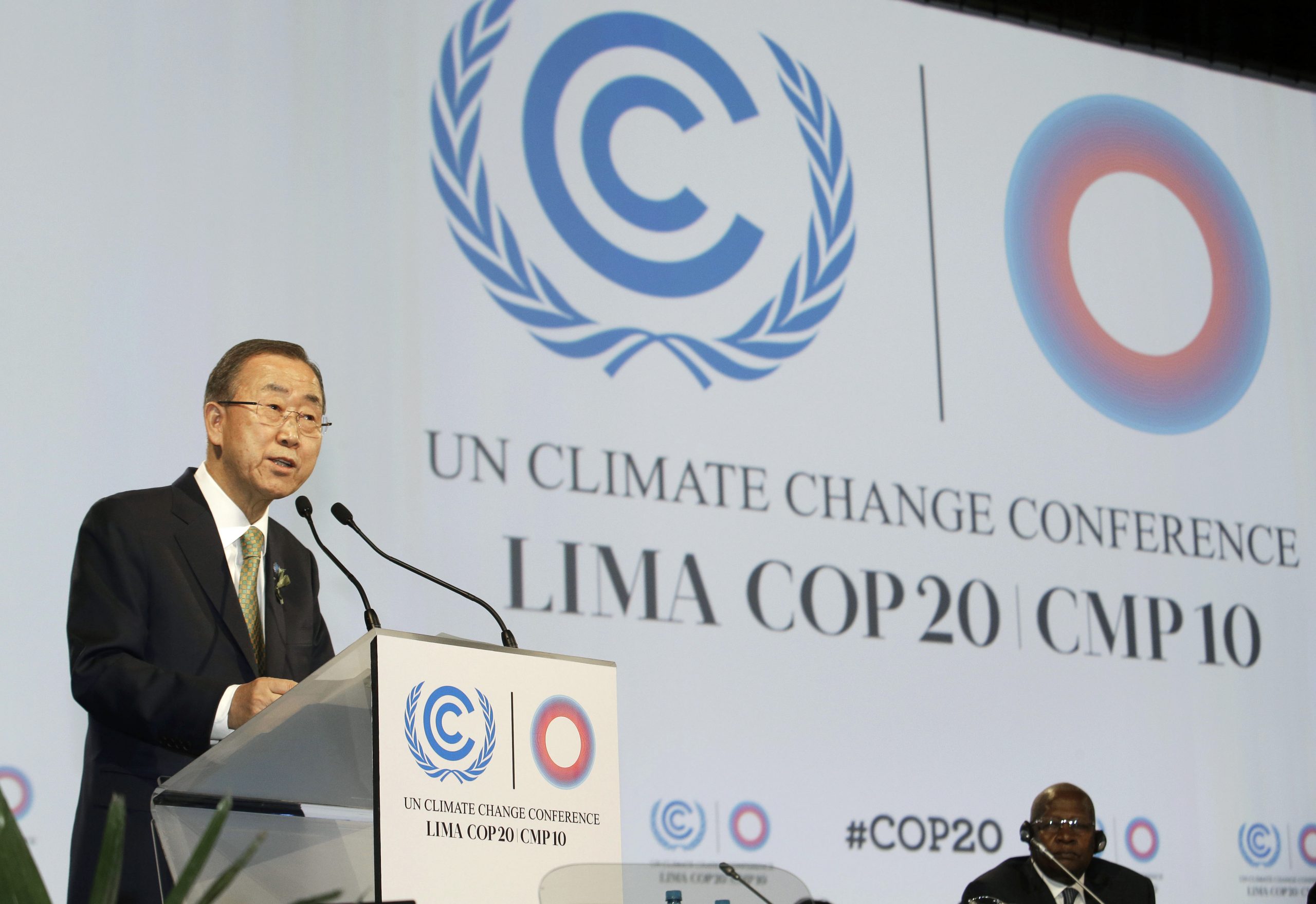
The United Nations is facing growing criticism that negotiations aren’t progressing fast enough to reach a global deal on climate change in Paris this December.
Stay informed.Stay ahead.
Join Washington Examiner for unlimited access to the news, analysis, and commentary that matter most.
Already a member? Log in
The U.N. concluded its latest round of climate talks on Friday in Bonn, Germany. At the five-day meeting, leaders were meant to agree on the preliminary text of a climate change agreement leaders are expected to sign later this year in Paris. But aid activists and others say that wasn’t long enough to settle disagreements that could ultimately scuttle the deal.
The groups say there are serious hold-ups over a funding mechanism that is crucial for a final deal to move forward in Paris. The climate funding would secure billions of dollars a year in commitments to be used to help developing countries adapt to increasing sea-levels and coastal flooding.
Harjeet Singh, climate policy manager at ActionAid, said the “U.S. and [the European Union] took baby steps towards agreeing to deal with climate damages for vulnerable countries, but insisted on leaving this out of the core agreement. Its exclusion will likely cripple a deal in Paris.”
The White House said Friday that it was committed to reaching a deal in Paris by December.
Two hundred nations assembled at the meeting in Bonn to begin winnowing down an 83-page draft document that will become the basis of that deal.
The draft deal frames actions nations must take to begin curbing emissions and reduce the effects of global warming by mid-century, and puts up tens of billions of dollars to help poorer countries adapt to the effects of global warming.
President Obama is working steadily with the international community to ensure a deal in Paris is reached as part of his climate change agenda. He recently returned from Alaska as part of a tour to raise awareness about climate change and the effects it is having on the Arctic. He began the tour by meeting with foreign dignitaries to rally support for success in Paris.
“I’ve come here today, as the leader of the world’s largest economy and its second largest emitter, to say that the United States recognizes our role in creating this problem, and we embrace our responsibility to help solve it,” the president told foreign ministers and foreign dignitaries in Alaska Aug. 31. “And I believe we can solve it [but we] “have to do it together,” he said. That’s why “this year, in Paris, has to be the year that the world finally reaches an agreement to protect the one planet that we’ve got while we still can.”
But while the president was jetting to and from the Arctic, the nitty-gritty of reaching a climate deal was moving “painstakingly” slow in Bonn, where activists said more compromise would be needed to secure enough funding to make the deal worthwhile. The goal is to secure $100 billion a year by 2020 for a green action fund, more than doubling prior commitments under previous U.N. goals.
In order “to get a deal worth the effort, … [the U.N. and the leading economies] must speed up the process between now and the next session in October,” said Mohamed Adow with the group Christian Aid, who was in Bonn advocating for the funding.
The next meeting in October is expected to be the last interim step before Paris, where these matters need to be settled before moving to final negotiations on Nov. 30. Ministerial meetings between the countries will be ongoing ahead of the October session.
“Making use of the ministerial meetings … next week and in September will be critical in working out the crunch issue of the needed climate finance and adopting a system for increasing action beyond Paris,” said Adow. “Now is the time for countries to reach out to each other in a spirit of compromise to resolve these issues and move towards a successful Paris agreement.”
But a senior United Nations official disagreed with assessments that the pace of negotiations was somehow too slow, too fast, or too “whatever.” U.N. climate chief Christiana Figueres said Friday that the only issue that should be seen as important is the direction of the negotiations.
“Every single country remains committed to the ultimate destination” of reaching a deal in Paris, Figueres said. “You could argue not fast enough, too fast, perfect pace, whatever. It is really not that important about the pace.”
“The question is: Do we remain moving in the direction of progress? Most definitely. And does everyone agree to the final destination? Most definitely,” Figueres said.
She added that when it came to negotiations over climate funding, or the developing countries, the questions about the “pace” of negotiations are “irrelevant.”
Greenpeace climate campaigner Li Shuo told Agence France Press that what people fear is a “lowest-common-denominator situation, which is nobody would agree with anybody and then everybody just agree on the least ambitious option.”
“The question is not whether or not we will have a deal. But I think the quality of the deal is in question,” Li Shuo told AFP.
Reuters reports that even U.N. Secretary-General Ban Ki-moon had in recent weeks been critical of the negotiations, saying they were progressing at a “snail’s pace.”
Ahmed Djoghlaf, co-chair for the Bonn meeting, responded to the claims, saying Ban’s office is high atop the U.N. building in New York, where “you don’t see what is going on in the basement.” He told reporters at a press conference, “We are making progress. … We will be on time in Paris.”
President Obama and Saudi King Salman at the White House on Friday emphasized their commitment to reaching an agreement in Paris.
“The two leaders discussed the challenge of global climate change and agreed to work together to achieve a successful outcome at the Paris negotiations in December,” a joint statement from Obama and the king read.
President Obama also dispatched his senior climate change adviser, Brian Deese, to meet with Indian and Chinese officials in New Delhi and Beijing next week to discuss both countries’ commitment to a December deal.
“He will meet with senior officials in both countries, including Foreign Secretary Subrahmanyam Jaishankar in India and Executive Vice Premier Zhang Gaoli in China, to consult on key international climate change issues,” the White House said. “In both countries, he will underscore the United States’ commitment to strong domestic action on climate change and the value of strong bilateral partnerships to help secure an ambitious outcome at the Paris climate conference.”
