
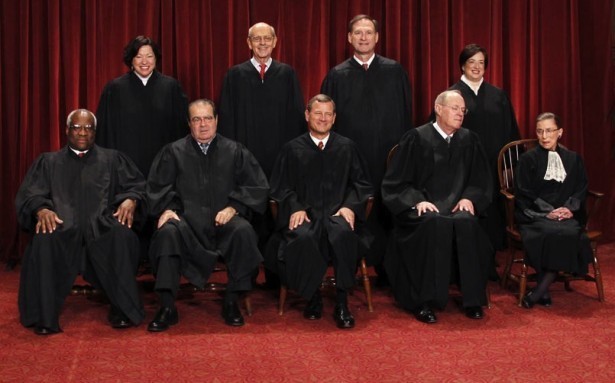
It is difficult and risky to guess how an individual Supreme Court justice will rule in any particular case. But all of the justices who will hear Obamacare cases next week have histories that give some indication of where they are likely to stand when the decision comes down.
Here is a look at all nine justices and reasons to think they might go one way or the other.
Solid Pro-Obamacare Votes
Justices Stephen Breyer and Ruth Ginsburg – Breyer and Ginsburg have sided with the government in every Commerce Clause and Necessary and Proper Clause case before the Court (Comstock, Raich, Morrison, Lopez – see accompanying case descriptions). No one expects them to change course now.
Justices Sonia Sotomayor and Elena Kagan – Both of these Justices were nominated to the Court by Obama. Kagan even served as Obama’s Solicitor General at the time when the Department of Justice was formulating its initial defense of Obamacare. It would be shocking if either Justice chose to throw out the signature domestic accomplishment of the president that put them on the bench.
Solid Anti-Obamacare Votes
Justice Clarence Thomas – Thomas has consistently sided against expansive federal government power in every Commerce Clause and Necessary and Proper Clause case before the Court (Comstock, Raich, Morrison, Lopez). He will most likely stick to his guns and vote again for limiting congressional power.
Justice Antonin Scalia – Scalia’s record on Commerce and Necessary and Proper Clause cases is almost as spotless as Thomas’, but he did side with the government in Raich. However, his concurring opinion stressed, “[A]lthough Congress’s authority to regulate intrastate activity that substantially affects interstate commerce is broad, it does not permit the Court to ‘pile inference upon inference’ in order to establish that noneconomic activity has a substantial effect on interstate commerce.” The government’s defense of the individual mandate is just the kind of “inference upon inference” piling that Scalia warned about. He should be considered a solid anti-Obamacare vote.
Justice Sam Alito – Alito has been on the bench for only one major government power case, Comstock, and he did side with the government. But his concurring opinion specifically warned, “The Necessary and Proper Clause does not give Congress carte blanche.” The Obama administration has failed at every stage of argument to explain why upholding the mandate would not give Congress carte blanche. Alito will probably side with the Obamacare’s challengers.
The swing votes
Justice Anthony Kennedy – Kennedy has a mixed record on Commerce and Necessary and Proper Clause cases. He sided against broad government power in Morrison and Lopez, but sided with the government in Comstock and Raich. But his concurrence in Comstock suggests he does not believe the Necessary and Proper Clause would encompass the individual mandate. Justifying Congress’ power to further detain inmates already in federal prisons, Kennedy wrote, “This is a discrete and narrow exercise of authority over a small class of persons already subject to the federal power.” Kennedy probably leans against Obamacare.
Chief Justice John Roberts – Many liberals believe Roberts is “gettable” because he did not write a concurring opinion differentiating himself from Breyer’s majority opinion in Comstock like Kennedy and Alito did. Roberts has also previously voiced interest in producing narrow opinions that keep the Court from looking partisan and driven by ideology. However, that impulse has not stopped him from signing on to major rollbacks of government power like the Citizens United v. FEC decision, which struck down Congressional regulation of political speech. If Kennedy joins with Alito, Scalia, and Thomas, it is especially difficult to see Roberts contributing the only conservative vote upholding Obamacare.
