

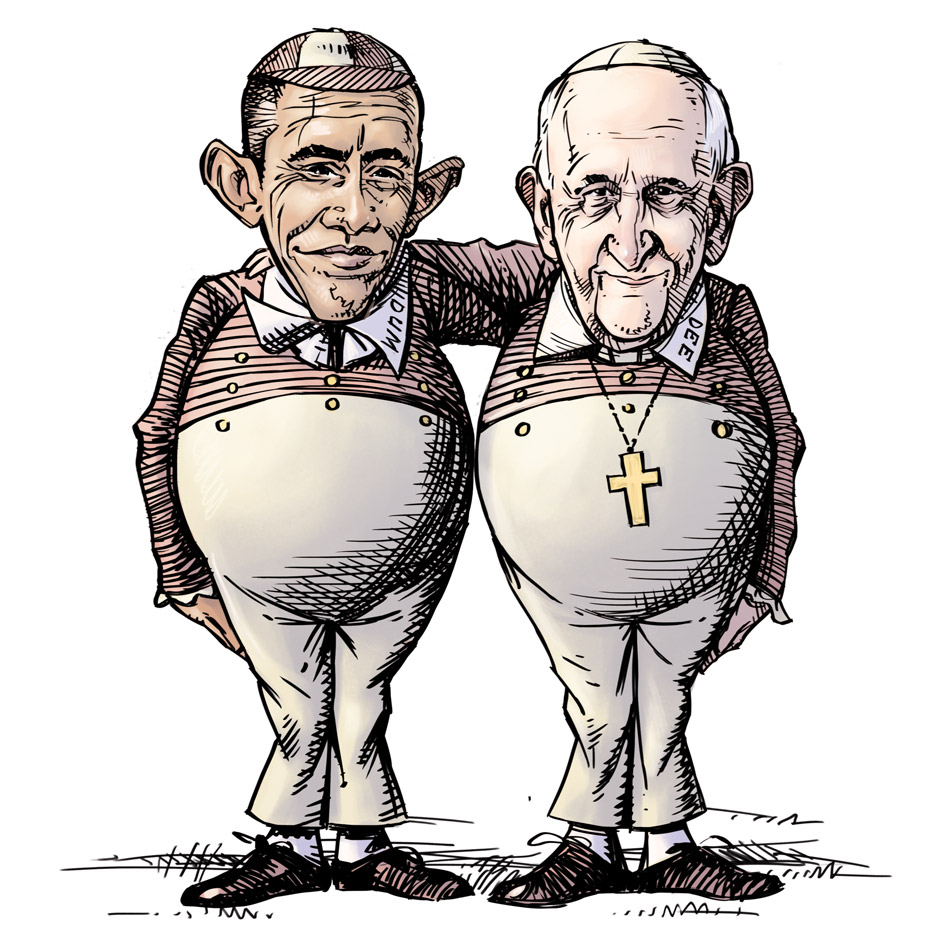
Pope Francis’s synod on the family adjourned on Sunday, October 25, after an acrimonious three weeks. This assembly of bishops, like a similar one last year, was convened because the pope is interested in changing Catholic teaching on divorce, remarriage, and, to a lesser extent, homosexuality.
How so? The pope’s favorite theologian seems to be the German cardinal Walter Kasper, who has long argued that, pace the explicit words of Jesus Christ, marriage is a dissoluble institution. Kasper believes that the Catholic church should recognize divorce and subsequent remarriages—readmitting such Catholics to holy communion—and that it ought to be more “open” to homosexual couples, too. (The exact details of what this openness entails are never concretely defined.)
Stay informed.Stay ahead.
Join Washington Examiner for unlimited access to the news, analysis, and commentary that matter most.
Already a member? Log in
Because Francis is a Jesuit, he presented the two synods as beautiful opportunities to dialogue—Jesuits love this verb—on Cardinal Kasper’s propositions. But make no mistake: The synods were not a dialogue. They were a fight between a small group of clerics that wants to revolutionize the doctrines of the church and a larger group that wants to preserve them.
At the conclusion of the fight, both the traditionalists and progressives claimed victory. Both were wrong.
To give a sense of the quality of the “dialogue” at the synod, consider a few highlights:
* The day before the synod convened, Monsignor Krzysztof Charamsa, a Vatican priest assigned to the Congregation for the Doctrine of the Faith, was ousted because it was revealed that he was (1) gay; (2) with a long-term boyfriend; and (3) planning a public protest outside the synod against the church’s “homophobia” (his word).
* Going into the synod, the pope established new bureaucratic procedures that did away with the traditional democratic processes and granted power to small groups of appointed bishops. To wit: The priests charged with drafting the synod working documents were appointed by Francis rather than elected by their peers. At the close of a synod, this drafting committee presents a final document. Traditionally, the assembly then votes on each paragraph, in order to exercise strict control over what is being said. The pope’s new rules would allow only a single up-or-down vote on the final document.
– These “reforms” looked so much like rigging that on the first day of the synod a group of 13 senior clergymen sent a letter of protest to Francis.
– In response, Francis chastised critics for giving in to “the hermeneutic of conspiracy,” which, he claimed, “is sociologically weak and spiritually unhelpful.”
– Speaking of conspiracies, shortly thereafter supporters of Francis began alleging that Monsignor Charamsa’s ousting had been part of a conservative plot “to create problems for the Synod and for Francis.”
– After that, a Vatican reporter obtained the text of the protest letter that had been sent to Francis. Four of the signers issued statements designed to suggest they had not been party to the communiqué. Subsequent reporting revealed that these demurrals were themselves misleading—all 13 men had indeed signed the rebuke.
– In a speech a few days later Francis said that going forward the Catholic church would become a “synodal church.” It wasn’t clear what that term meant—the Holy Father talked a lot about “listening.” But he closed these remarks emphasizing obedience, reminding the assembled participants that “the synodal process culminates in listening to the Bishop of Rome, who is called upon to pronounce as ‘pastor and teacher of all Christians.’ ” Translation: This will proceed as a dialogue unless you don’t give me what I want. In which case remember: I’m in charge.
It was reminiscent of a moment in 2009 when a newly elected President Obama met with congressional Republicans to build consensus on his stimulus proposal. Rep. Eric Cantor began to criticize certain aspects of the plan, but Obama cut him off, explaining, “Eric, I won.”
It’s normally a mistake to view the workings of the Catholic church through the lens we use to evaluate domestic American politics. But in this case, the lens fits: Throughout the synod, Francis behaved like an ideologically ambitious president at war with an oppositional Congress. He was the Roman church’s Obama.
Obama claimed to run “the most transparent administration in history.” Francis insisted that his procedural changes would make the synod more transparent and responsive. Obama campaigned as a pragmatic centrist, but turned out to have robust and radical ideological ambitions. Francis began his pontificate talking blandly about “service,” only to push the most theologically radical agenda in (at least) half a century. Obama, who promised to unite a purple America, became the most divisive president in modern history. Francis, who began his papacy promising “humility,” has become the most divisive pope in living memory. When it became clear at the synod that the majority of the bishops and cardinals would not approve the pope’s favored outcomes, the Vatican floated the idea of simply devolving authority over these questions to local councils of bishops.
Even Francis’s defenders noted the commonality: “Francis has the same problem that Obama had,” the Rev. Thomas J. Reese told the Washington Post. “He promised the world, but Congress wouldn’t let him deliver. If nothing much comes of this synod, I think people will give the pope a pass and blame the bishops for stopping change.” At this point, all we’re missing to make the analogy complete is a Jesuit priest from Georgetown explaining that, for the first time in his life, he’s proud of his church.
Which brings us to the competing claims of victory. Traditionalist Catholics view the outcome of the synod as a win. The letter from the 13 bishops and cardinals did indeed change the trajectory of the meeting, causing Francis to reinstate voting: When the synod compiled its final document, it was approved paragraph-by-paragraph, rather than by a single up-or-down vote. And when all the votes were counted, the Kasper gambit had been avoided. The final document did not recommend defacing Catholic doctrine on marriage.
But avoidance of calamity is not the same thing as a great victory. That it feels that way to the traditionalists tells you a bit about why the progressives think they won. Because on closer inspection, the relevant paragraphs in the final document that deal with divorce and remarriage—and which passed with very narrow majorities—weren’t quite as firm as they seemed. As National Review’s C. C. Pecknold put it, these paragraphs leave so much room that “Kasper’s battalions can be driven right through them.”
Cardinal Kasper himself agreed, saying, “I’m satisfied; the door has been opened to the possibility of the divorced and remarried being granted communion. There has been somewhat of an opening, but the consequences were not discussed. All of this is now in the pope’s hands, who will decide what has to be done.”
So if progressive Catholics didn’t get exactly what they wanted from the synod, they did get a good, hard look at a possible future. The synod document isn’t binding. It is merely a suggestion to the Holy Father. The pope can affirm it, ignore it, or contradict it as he sees fit. As for the pope’s mindset? Well. At the close of the synod, Francis gave a homily in which he excoriated the bishops who had voted against his preferred changes. The synod process had, he said, “laid bare the closed hearts which frequently hide even behind the church’s teachings and good intentions, in order to sit in the chair of Moses and judge, sometimes with superiority and superficiality, difficult cases and wounded families.”
He continued: “The synod experience also made us better realize that the true defenders of doctrine are not those who uphold its letter, but its spirit; not ideas but people; not formulas but the free availability of God’s love and forgiveness.” Once you got past the shock of hearing a pope say that “ideas” are less important to Catholic doctrine than “people,” you half expected Francis to declare that while the corrupt, sclerotic synod may resist change, he still has a ring and a pen.
The net effect of the Obama administration has been to open for discussion ideas that were once inconceivable. Eight years ago, who would have thought that a president could unilaterally grant amnesty to five million illegal immigrants—or sign a long-term nuclear treaty with Iran—without congressional approval? Who would have thought a bakery could be sued for refusing to bake a cake for a gay wedding? Or that an avowed socialist would be a serious candidate for the Democratic presidential nomination? Obama changed the scope of the possible in American politics.
And Francis is doing the same. As Maggie Gallagher put it, “issues that have been considered closed for 2,000 years will likely remain open questions in Catholic life for the foreseeable future.” The result for Catholics, she says, “is likely to be a profound dislocation in the authority structures of the Catholic Church.” You could say much the same about post-Obama America.
Radicalism is radicalism, be it political or theological. And its effects are rarely happy.
Non-Catholics might not fully appreciate what’s at stake here, so it’s important to understand that the fight at the synod wasn’t really about whether or not people who divorce and remarry can receive the Eucharist. The church has its teachings about the condition one’s soul must be in to validly participate in communion. But as a practical matter, anyone who lines up at the altar will be served. Divorced and remarried? Gay? Shot a man in Reno just to watch him die? The only practical barrier to the Eucharist is your own conscience, because whatever the church teaches, priests don’t deny communion to people during the Mass. Even if you do 10 abortions a day for Planned Parenthood. Even if you’re Nancy Pelosi.
So when the pope and Cardinal Kasper fight to change doctrine, it isn’t because they want to change the practice of Catholicism. It isn’t about getting the Eucharist into the mouths of the divorced-and-remarried. That happens thousands—possibly millions—of times per week. No, it’s about getting the church to formally approve of divorce and remarriage.
Which is the thin end of the wedge for getting the church to formally approve of all sorts of other things. Because once doctrine has been untethered from the actual teachings of Jesus, you can do pretty much whatever you want. And for Francis, Kasper, and millions of militantly progressive Catholics, that’s where the real fun begins.
The problem is that it’s where the real conflict will begin, too. Which is why, despite what both sides claimed at the close of the synod, nobody left Rome a winner. As columnist Ross Douthat noted wryly last week, “Most of human history, Catholic and otherwise, suggests if what you want requires a civil war, you’ll get a civil war.”
Barack Obama wasn’t quite that ambitious. As for Pope Francis, we’ll see.
Jonathan V. Last is a senior writer at The Weekly Standard.
