

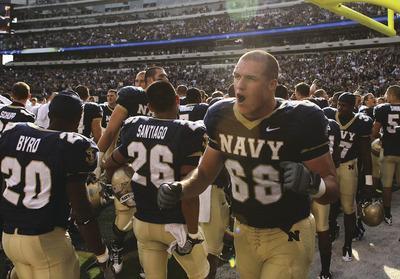
Navy offensive lineman has heavy course load Scribbling on a dry erase board, Navy assistant coach Ashley Ingram is running through plays the Midshipmen will use in their game against San Jose State. There is no time to waste. This fast-paced lunchtime session will last less than an hour.
Ingram is furiously spewing blocking terminology: oscar, geronimo, lobo, veer climb, slot hammer and foo-foo.
Stay informed.Stay ahead.
Join Washington Examiner for unlimited access to the news, analysis, and commentary that matter most.
Already a member? Log in
To the uninitiated, this meeting of Navy offensive linemen is as unintelligible as an academy course in nuclear energy conversion. But this is the easiest part of a Tuesday in November for senior guard John Dowd, a mechanical engineering major with a 3.91 grade-point average who was a finalist for the William V. Campbell Trophy, which recognizes the nation’s top football scholar-athlete.
| Dowd’s classes |
| Descriptions for two of the courses John Dowd is taking this semester: |
| Heat Transfer » The study of thermal radiation, steady and transient conduction, laminar and turbulent convection, internal and external flow, boundary layers and empirical correlations. Applicants address fins, nuclear reactor cooling, heat exchangers and interactive computing. |
| Mechanical Engineering Design » Topics include the engineering design process, project management, codes and standards, engineering ethics and computer-aided design. Students form design teams, select a capstone design project and progress through the proposal and preliminary design stages of the project. |
In the structured life of Dowd, who is from Staten Island, N.Y., there is little down time. Meetings, practices, games and other football activities can take up to 25 hours a week, and even more when the Mids play a road game. Academic requirements can take an additional 40-45 hours.
When asked whether he typically has schoolwork left after practice, Dowd just laughs. On a good night, he can get it done in two to three hours.
“Hopefully it tapers off next semester. That’s what they’ve told me,” Dowd says. “I don’t really believe them.”
At Bancroft Hall, the massive dormitory that houses all 4,400 of the midshipmen, Dowd and his two roommates rise at 6:30 a.m. reveille. If Dowd needs specialized physical treatment — often the case late in the year — he is up at 5:45 a.m. and reports to the football facility, Ricketts Hall. If not, he goes to morning meal formation. Breakfast is served at 7:10 a.m.
At 7:55 a.m., Dowd’s school day begins humorously. Lt. Cmdr. Ethan Lust, instructor of Mechanical Engineering Design, sends students off to their lab with a movie-inspired command: “Dodgeball,” he says with thumbs raised.
Describing the two-semester “capstone” project that he and his two partners have undertaken is best left to Dowd.
“To develop a system to detect directed-energy weapons to use against composites,” Dowd says as he solders electrical wires and gauge string to a fiberglass plate, preparing it for the moment of truth — a 100-watt laser blast.
The laser test, which happened the following week, produces the results Dowd expected.
“My concept doesn’t work,” Dowd says. “It was pretty awful.”
But it was a due-diligence step in the research process. Dowd is anxious to move on to a test with fiber-optic materials that holds more promise.
At 10 a.m., Dowd’s Introductory Economics class begins. It’s the least demanding of the courses he is taking this fall. Maj. Khalilah Thomas leads the discussion, engaging all 10 students as she drills them on the consumer price index, the real wage rate and financial markets.
After class, Dowd eats with the football team in King Hall, a T-shaped dining facility that looks straight out of a 1960s prison movie set, monstrous enough to seat all of the midshipmen.
As football players eat lunch, the rest of the Brigade assembles for noon meal formation. In perhaps the most impressive and moving routine of the day, midshipmen march up the steps of Bancroft Hall to the sound of bagpipes. By the time they herd downstairs into King Hall, the football players have finished eating and are on their way to Ricketts Hall for position-specific meetings.
Afterward, Dowd has a Navy Law class at 1:30 p.m. While his schedule is full on Tuesdays and Thursdays, the day is not as challenging as his Monday-Wednesday-Friday regimen, which includes courses in Heat Transfer and Solid Mechanics.
Dowd doesn’t simply show up for football practice. He needs to get “put together,” as he says. With a labrum tear in his hip and an assortment of other ailments, Dowd needs considerable treatment before heading to Rip Miller Field.
Dowd needed even more prep time after he broke a bone in his right wrist in a September loss at South Carolina. For the following five weeks, Dowd’s hand was immobilized in a cast, with his fingers exposed to be able to type on a keyboard. For practice and games, Dowd’s hand was encased in a boxing glove and wrapped.
By necessity, Navy practices are fast-paced. Coach Ken Niumatalolo knows the limits of what he can demand.
“When they come here, we don’t want to waste their time,” Niumatalolo said. “Our practices are pretty short, pretty concise, organized and detailed.”
Just like the academy life of Dowd.
