

My earliest memory of running—of making an effort to run as fast as I could—comes from first grade. There were a lot of footraces at school that year. They were short distance sprints across the blacktop and back. Maybe 75 yards. As often as not, I won. My only real competition was John Scotto, a kind, quiet kid whose family owned a local pizza chain. Where John was short and quick-legged, I was long and thin. He could beat me for 50 yards; after that I’d outstride him. I was fast.
Recommended Stories


As I got older, I came to understand that while I was fast, I wasn’t actually fast. In high school I ran track and was captain of the cross-country team, but my times were middling. I’d clock in at just under 19 minutes for the 5,000-meter cross-country course, which blew the doors off no one. In spring track I ran a sub-five-minute mile exactly once, and it almost killed me. As with John Scotto, I realized I needed longer distances.
One of the interesting aspects of distance running is that it’s not a purely physical activity. In cross-country, for example, runners don’t gradually become faster as they improve their cardiovascular systems: You don’t cut 10 seconds one week and then 12 seconds the next. Instead, runners tend to stay stuck on plateaus around a certain time. Then they’ll make an evolutionary leap, dropping, say, a minute from their time all at once. And this becomes their new plateau.
It is, literally, mind over body. It’s not as if your heart and lungs suddenly become capable of running 5,000 meters 60 seconds faster. Rather, it’s that your mind suddenly understands that you can go faster and then allows your body to do it.
The same leaps happen with distances. An example: Thirteen years ago I was training for a marathon. One day I ran an 18-mile workout, the farthest I’d ever gone in one session. Toward the end my body began what seemed like a physical breakdown. I got wobbly and light-headed. My pace slowed dramatically. I felt like I was walking through molasses.
As I hit the 17-mile mark, I heard footsteps behind me. Hoping not to be passed by other runners in the last mile—nothing is more demoralizing—I glanced over my shoulder to determine whether or not I could hold them off.
What I saw was not another runner, but a gentleman, about the age of 70, strolling hand-in-hand with his wife. And they were gaining on me.
I managed to finish my run—by that point more like the shamble of a gravely wounded buffalo—without the couple passing me. Afterwards, I collapsed.
Two weeks later I did another 18 miles and ran like a gazelle. As I finished, my legs felt as though they had springs in them, and I was tempted to tack on a few extra miles. The only part of my body that had gotten in better shape was the stuff between my ears.
The mind does funny things while you run. For more than 20 years I ran without any distractions. No headphones, no Walkman. I enjoyed being alone with my thoughts. If I was in a good mood and having a pleasant day, I’d go for a run to savor it. If I was cranky or aggravated, I’d run to clear my head. Running in silence for an hour or two is a remarkable way to be present in your own life.
Yet age has robbed me of the patience for such things. These days, I find running indoors intolerable without a movie to watch. (You can’t fully appreciate how slow Star Trek: The Motion Picture is until you’ve watched it on a treadmill.) And I loathe running outdoors without an audiobook. (I tend to favor Tom Clancy and Lee Child, but the most enjoyable run I’ve had in recent memory came doing five miles on a beach, at sunset, listening to War and Peace.)
The other thing age has robbed me of is speed. I’m not just slow, I’m slow. But as I’ve lost pace, I’ve noticed another odd transformation in my head. Back when I was fast, it never occurred to me to take any pride in running. It was simply part of my life. The payoff was the joy of the run.
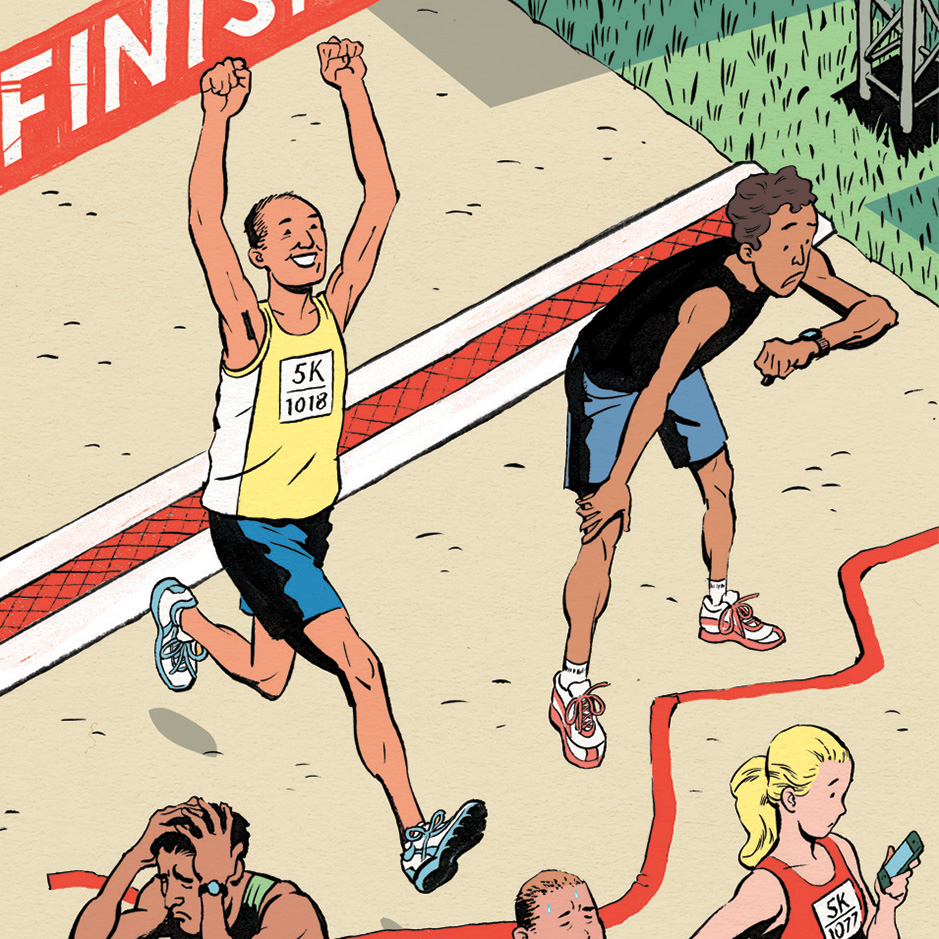
The other day, on a lark, I ran a 5K. It was my first race in more than a decade. If you had given my 17-year-old self a look at my finishing time, he would have assumed that I’d lost a leg. But it was faster than I had expected. And for the first time in my life, I was proud of myself for a run.
