

One general rule of thumb in polling is that even in the early stages of a campaign a universally known candidate’s poll numbers pretty closely approximate what that candidate would get in a general election — and if that candidate is polling under 50 percent, she or he is likely to lose. That may not always be true, and opinion about even a very well known candidate can change — as changing ratings of presidents demonstrate. (Although, come to think of it, Barack Obama’s job approval hasn’t changed appreciably during the more than two years of his second term.) It’s a rule of thumb particularly applicable to Hillary Clinton, who is almost surely the most widely and deeply known candidate running in a presidential year with no incumbent running since Richard Nixon in 1968.
So how’s she doing?
Recommended Stories


Well, in national pollings as measured against six Republicans (Bush, Christie, Cruz, Paul, Rubio and Walker), she is averaging 47 percent in the realclearpolitics.com averages of recent polls. That’s below the 50 percent usually required to win in a two-candidate race, but not far below. Certainly within striking distance. And intuitively it seems plausible in what has been a politically polarized country, in which no Democratic or Republican nominee has gotten less than 46 percent of the vote or more than 53 percent in any general election in this century — or since 1984, if you allocate the Perot vote to Perot voters’ second choice candidates in 1992 and 1996.
But presidential elections are not won by popular vote, as we all learned in 2000, and what really matters is how many electoral votes a candidate wins. And in twenty-first century contests, only a minority of states have been seriously contested. So how is Hillary Clinton doing in target states?
Not as well as in national polls. Altogether 16 polls pitting Clinton against multiple Republicans have been reported since July 16 in 14 states, almost all of them target states (Illinois, Michigan and Minnesota being the exceptions). In all but two of the 16 polls Clinton has been running well behind Barack Obama’s 2012 percentage in that state —farther behind the 4 percent she’s been running behind him in recent national polls (her 47 percent average compared to Obama’s 51 percent of the popular vote).
The following table shows for each of the states in which these polls were conducted, arrayed according to Obama 2012 percentage, the pollster conducting the survey, the Republicans against whom Clinton was matched, the average Clinton percentage, the Obama 2012 percentage and the difference between the two percentages.
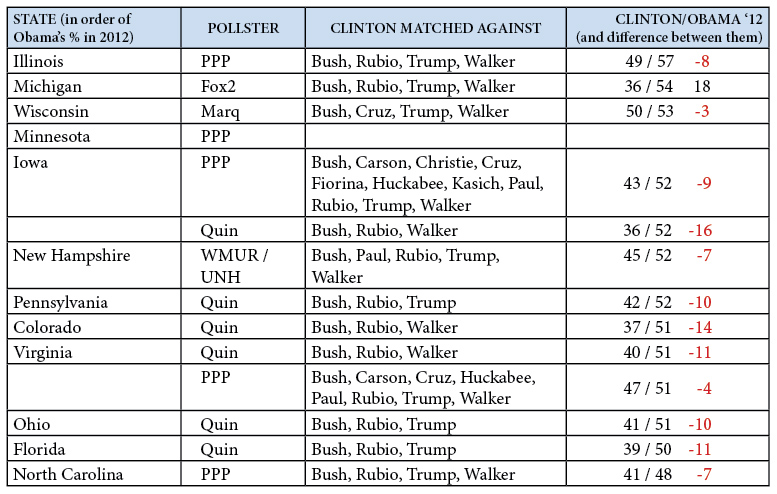
There are many ways you can analyze these numbers, comparing Clinton’s performance against various candidates, measuring the discrepancy between polls with Trump and without, noting the dates the surveys were taken and so forth. I just want to focus on the Clinton numbers. In only three of these 16 polls does she average over 45 percent — a percentage of the vote lower than that received by any major party candidate in the last four elections. One of those is in Illinois, which everyone considers safe Democratic; the other two are in Virginia (where the average of the two polls puts her below 45 percent) and in Wisconsin. Some of these polls look like outliers, notably those in Michigan and Wisconsin, whose Obama 2012 percentages were only 1 percent different but whose Clinton poll numbers differ by 14 percent.
The bottom line is that in these states with 170 electoral votes, all but one of which (North Carolina) went for Barack Obama in 2012, Hillary Clinton looks well positioned to win two states with 30 electoral votes (Illinois and Wisconsin) and poorly positioned to win in 12 states with 140 electoral votes. If Obama had not carried 11 of those states, he would have received 207 rather than 332 electoral votes. All of which is not good news for Hillary Clinton’s campaign.
