Trump National Security Strategy puts ending Russia-Ukraine war as ‘core interest’

President Donald Trump‘s administration argues in its new National Security Strategy that ending the Russia-Ukraine war is a “core interest” for the United States, but it has been faced with European leaders who have “unrealistic expectations” for how it could end.

According to the document, which outlines the core principles of Trump’s “America First” foreign policy, it is in a “core” U.S. interest to “negotiate an expeditious cessation of hostilities in Ukraine,” and doing so would “stabilize European economies, prevent unintended escalation or expansion of the war, and reestablish strategic stability with Russia, as well as to enable the post-hostilities reconstruction of Ukraine to enable its survival as a viable state.”

The Trump administration came into office in January with the goal of ending the war and the near boundless U.S. military support that Ukraine enjoyed under the former administration.

Trump’s election last year represented a monumental shift for Ukraine in terms of the support it enjoyed from America under the previous administration. He campaigned on ending U.S. military support for Ukraine and finding a peaceful resolution to a war that is now nearing the fourth anniversary of Russia’s full-scale invasion.

Their effort to end the war diplomatically put themselves “at odds with European officials who hold unrealistic expectations for the war perched in unstable minority governments,” according to the NSS.

U.S. officials began their latest aggressive diplomatic push to end the war shortly before Thanksgiving.

There was a flurry of meetings between the U.S. negotiating team — Steve Witkoff, a real estate agent turned presidential envoy; Jared Kushner, the president’s son-in-law who served as a foreign policy adviser during Trump’s first term; and Secretary of State Marco Rubio — and the Russian and Ukrainian delegations in recent weeks.

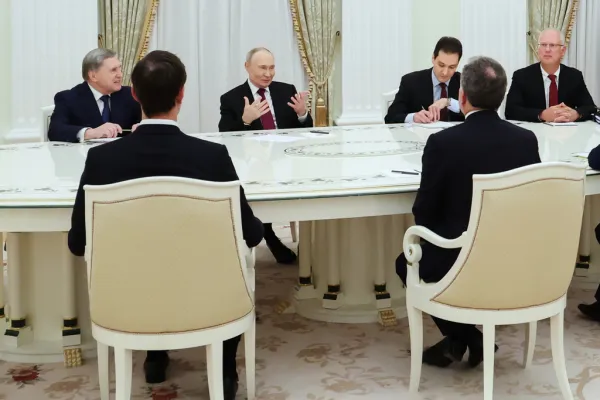
Witkoff meets with Putin at Kremlin.
Russian President Vladimir Putin, second from left, Russian presidential foreign policy adviser Yuri Ushakov, left, and Russian Direct Investment Fund CEO and special presidential representative for investment and economic cooperation with foreign countries Kirill Dmitriev, right, attend the talks with U.S. special envoy Steve Witkoff, right with back to camera, and Jared Kushner, President Donald Trump’s son-in-law, left with back to camera, on Tuesday, Dec. 2, 2025, at the Senate Palace of the Kremlin in Moscow. (Alexander Kazakov, Sputnik, Kremlin Pool Photo via AP)

A leaked proposal attributed to the United States was widely denounced by Ukraine and its allies for the perception that it forced a number of Ukrainian concessions that they have long argued were nonstarters for them.

Moscow has continued to make significant demands of Ukraine in any proposal to end the war including the redrawing of borders, which includes giving Russia the territory it currently occupies and additional territory it has been trying to conquer militarily but has not been able to, putting a cap on the future size of the Ukrainian military, and it wants Ukraine to give up its desire to enter the NATO alliance.

Despite the recent push, Rubio gave a bleak assessment of where the negotiations stand earlier this week.

“We have tried to bring both sides together and see what proposals we could come up with that both sides could live with,” he said on Fox News. “We’re going to do everything we can to make it work. We’re still not close enough. But that could change. I hope it changes.”

Rubio noted that Russian President Vladimir Putin is the sole decision-maker in Moscow when it comes to such an agreement, and gaining his support for a deal poses a difficult challenge.

Yury Ushakov, a foreign policy adviser to the Russian president, said immediately following the nearly five-hour meeting Putin had earlier this week with Witkoff and Kushner that “a compromise solution hasn’t been found yet.”

When the war began, most experts believed Russian forces would be able to topple the Ukrainian government in Kyiv in a matter of days or weeks. They only occupy about one-fifth of the country, less than they held during the initial weeks of the war when they were trying to conquer the capital.

Russia has accepted direct or indirect military assistance from Tehran, Pyongyang, and Beijing in trying to defeat a much smaller army that it was supposed to easily overpower. Despite more than 1 million killed or wounded Russian soldiers, Putin has shown no interest in ending the war and believes he can outlast European support for the beleaguered nation fighting against a much larger military.

European countries began significantly increasing their defense spending to ensure they are prepared for any possible future Russian aggression.

The Trump administration then capitalized on the wave of increased spending, getting the NATO alliance to increase the defense spending minimum from 2% GDP to 5%. All NATO members except Spain agreed to the proposal.

“The days of the United States propping up the entire world order like Atlas are over,” according to the NSS. “We count among our many allies and partners dozens of wealthy, sophisticated nations that must assume primary responsibility for their regions and contribute far more to our collective defense. President Trump has set a new global standard with the Hague Commitment, which pledges NATO countries to spend 5 percent of GDP on defense and which our NATO allies have endorsed and must now meet.”

US POWERLESS AGAINST PUTIN OBSTINANCE AS PEACE DEAL HOPES WANE ONCE AGAIN

Both Sweden and Finland joined the alliance since the war began, effectively doubling the amount of NATO territory that Russia borders. Kremlin officials have cited NATO expansion as one of the reasons the war began.

According to the Trump NSS, the U.S. should prioritize “ending the perception, and preventing the reality of NATO as a perpetually expanding alliance,” but it does not specify details about who holds that perception, why they hold it, and how to end it.

Related Content