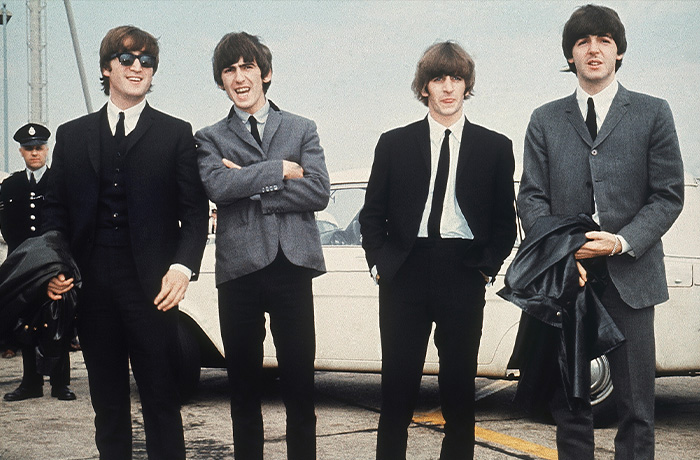
And so this is Christmas, and for those of us who’ve spent decades hunting down every scratchy demo, rehearsal, studio outtake, telecast, or concert the Beatles and solo Beatles ever laid down, it’s a special one. The season heralds the release of Anthology 4, a new album and documentary of Beatles rarities and oddities.
Nobody is immune to the cultural effect of the Beatles, but to a certain segment of their fans, a new Anthology release is nothing less than a seismic event. We are the true believers who prowled the second-story walkups in Greenwich Village in the 1990s, the golden era when unauthorized recordings, previously the preoccupation of a few stoners with sticky fingers and mimeograph machines, exploded onto the market, sheathed in gorgeous, full-color packaging, complete with booklets and liner notes. It was unreal: complete sessions, in sequence and pristine sound, for “I Saw Her Standing There” or “Strawberry Fields Forever.”

And when the authorities rolled up those shops, we trekked out to Secaucus, New Jersey, for Beatlefest conventions, where the high sign got you admitted to dealers’ rooms and you beheld, with astonished eyes, the source of it all: vast operations run by unsmiling men, catering to geeks pawing through trunks of DVDs and VHS tapes.

And when all that dried up, we rode eBay and other websites until the empire struck back: the “Great Clampdown” by EMI, the “Threetles,” and the John Lennon and George Harrison estates that closed the spigots, all but ended the gold rush. Diminished, the subculture survives. When a new rarity materializes, such as Paul McCartney’s demo for “A World Without Love,” which surfaced in 2013, the Beatles’ 1963 performance at the Stowe School, unearthed in 2023, or rough mixes of Wings’ London Town, discovered last year, it comes advertised via email.
The Great Clampdown facilitated the Beatles’ plunge into bootlegs. Across 1995 and 1996, in conjunction with a six-hour televised documentary, EMI released a trio of double albums, titled Anthology 1, Anthology 2, and Anthology 3, which trafficked the same content the bootleggers had. Better still, the surviving Beatles and George Martin, their producer, steered clear of material already in circulation.
The loyal pilgrims who had flocked to the Village and Secaucus and eBay now thrilled to such “new” gems as “You’ll Know What to Do,” a never-before-heard 1963 Harrison demo; the early takes of “Eight Days a Week” from 1965, with a radically different intro; and “Come Together – Take 1,” from 1969. But while it made for a fascinating listen, it was archivally… suspect. The Fabs took some liberties that didn’t sit well with the Talmudists. For example, the remixed version of “Penny Lane” on Anthology 3 presented, as the liner notes explained, “a unique combination of the many different takes” available. Vocal and instrumental performances from different days were assembled to suggest how the song might have sounded if certain musical avenues, abandoned at the sessions, had been pursued. Purists didn’t love that. Don’t give us portions of Takes 1, 3, and 10 woven together; give us Takes 1, 3, and 10!
Now comes the belated addition: Anthology 4, a restored version of the documentary, featuring an extra episode, and vinyl/CD sets of varying bulk, also available on streaming. The treasure trove consists of remastered versions of the first three sets and demos, outtakes, and rarities taken from the deluxe editions of such albums as Sgt. Pepper’s Lonely Hearts Club Band and The Beatles; the addition of “Now and Then,” the third and final single developed from 1970s-era Lennon demos; and 13 “new” studio outtakes never before circulated.
For casual or newer fans, the entire package may prove too obscure, too inside-baseball. Or it might well fuel the fandom, introduce the uninitiated into the alluring world, seldom escaped once entered, of (official) bootlegs and rarities.
To the initiated, however, the 13 “new” tracks are the main event. And what joy they bring, so reminiscent of that which we experienced 30 years ago!
As always, maximal insight comes from the Take 1s. Now we know how fully formed “In My Life” was, even before the addition of the sped-up piano solo. By contrast, we hear how much faster “I Need You” was originally meant to be, more Beatlemania than Help!-era. And, from Take 2, how much more like the Byrds John’s “Nowhere Man” was supposed to sound.
Takes 4 and 5 of “Tell Me Why,” a Lennon number from A Hard Day’s Night that he later dismissed, show Ringo Starr practicing the burlesque-style drum fill that heralds the song’s end. Likewise, the closing 90 seconds of the BBC rehearsal of “All You Need Is Love” finds Starr shifting time signatures to a more familiar 4:4. The band’s welcoming response almost makes for a new song entirely.
Most thrilling, however, are Takes 11 and 12 of “Baby You’re A Rich Man,” John’s up-tempo ballad for the Beatles’ tormented manager, Brian Epstein. The instrumental passage that starts the song sounds, here, like solo-Lennon’s “Watching The Wheels,” still a decade away. It’s eerie! And Lennon and McCartney’s ad-libs over the fade-out not only show different vocal phrasings from the final number but their exuberant chemistry, still aimed, before the bad vibes set in, as much at making each other laugh as at true craft.
And it is here, in the chatter between takes, that we are reminded of the band’s drift from the relative innocence of the early days, evidenced when Lennon calls out to the Beatles’ long-suffering roadie and aide-de-camp, Mal Evans.
LENNON: We’d like some Cokes, Mal.
MCCARTNEY: And if you’ve got some cannabis resin—
LENNON: Mal, some Cokes, some Cokes in here, Mal, Nell, Mal!
MCCARTNEY: Cannabis resin, too!
LENNON: Yeah, if you’ve got any cannabis, send it in.
MCCARTNEY: We’ve got that tape for the High Court [of Justice in London] tomorrow!
MAGAZINE: ON CHRISTMAS READING
Amid the original Anthology releases, Harrison was quoted as saying the group’s next archival release would be titled Scraping the Bottom of the Barrel. Fans have disagreed. The deluxe box for Revolver (1966), for example, released in 2022, contained demos for “Yellow Submarine” by Lennon that not only demolished the popular misconception that it was a McCartney song, but which were heartbreakingly sad and beautiful, with Lennon’s lilting, haunting voice heard over acoustic strumming: “In the town where I was born, no one cared, no one cared.”
Likewise, the 13 “new” tracks on Anthology 4 are revelatory, thrilling. But what is the future for the Beatles’ legacy business? You can read online the growing clamor for deluxe versions of Rubber Soul or With the Beatles. But where such releases are concerned, there lingers in the mind, especially that of the fanatic, the obsessed, an unwelcome sentiment, the very one Sgt. Pepper expressed as Side 2 approached its close: “It’s getting very near the end.”
James Rosen is chief Washington correspondent at Newsmax and author of the forthcoming Scalia: Supreme Court Years, 1986-2001, to be published in February.

