

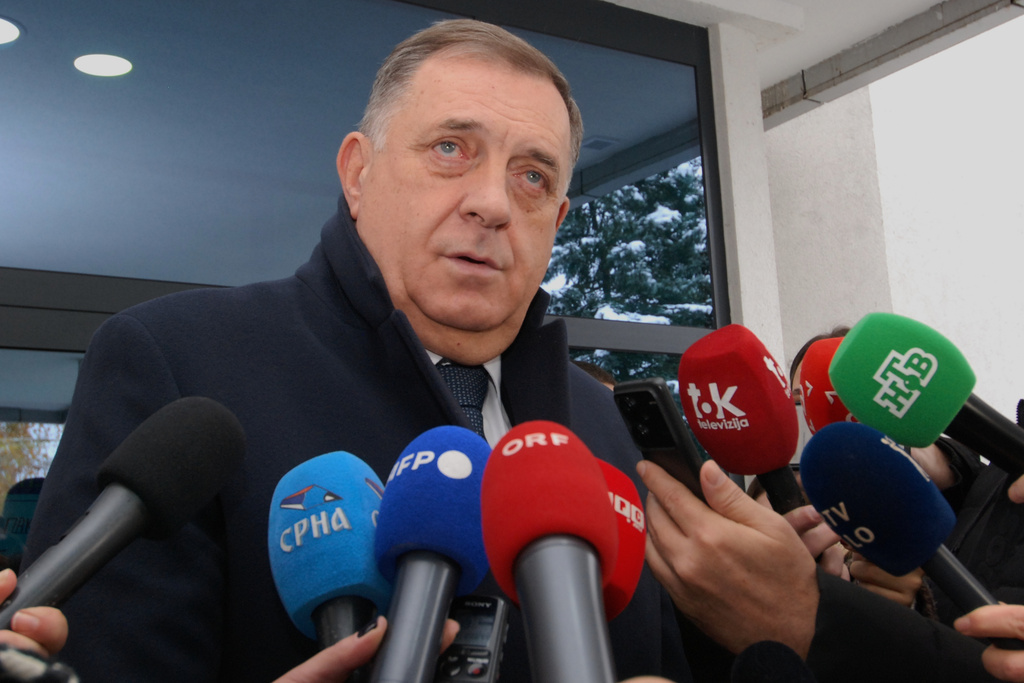
Bosnia and Herzegovina’s Serb ethnic republic, the Republika Srpska, held an election recently, and even though there is a new president, the boss remains the same: Milorad Dodik.
Dodik, who Bosnia’s High Representative and court system have determined ineligible to hold political office, left the presidency in favor of a hand-chosen successor. Bosnia should expect more of the same corruption, fragmentation, division, and ethnic friction that have stood in the way of the country’s development and stability for the last 30 years.
Stay informed.Stay ahead.
Join Washington Examiner for unlimited access to the news, analysis, and commentary that matter most.
Already a member? Log in
Dodik has built his recent political career on instigating conflict and discord between the RS and Bosnia’s state-level government. On multiple instances, Dodik has called for referendums supporting either RS secession or rejection of Bosnian state-level institutions. He has been the subject of multiple corruption investigations and has faced allegations of supporting criminal networks. Dodik also brags that he “regularly” meets with Russian President Vladimir Putin and has echoed Moscow’s line that its war in Ukraine is “highly justified.”
CAN TRUMP SAVE EUROPE FROM ITSELF?
The United States targeted Dodik and his family with sanctions. Their response: cultivating their existing patronage networks into a sanctions-evasion machine.
Despite this ongoing situation, President Donald Trump lifted sanctions on Dodik and 47 other Bosnian entities in October.
Around the same time, almost certainly in coordination, Dodik resigned his presidency, allowing new elections to be held, and regional officials repealed certain unconstitutional legislation. This remarkable seeming quid-pro-quo put an end to a months-long standoff between Dodik and higher Bosnian authorities about his no-longer-legal grasp on power.
The challenge, though, is that Bosnia’s problems don’t stop with Dodik. In addition to financial crimes, he and other Serb nationalists and RS officials have pushed an agenda of secessionism, division, and an alignment with Moscow. This presents both a regional security threat and a contagion risk for the bordering European Union.
Bosnia is a country still recovering from the mass murder and genocide of thousands. Since the splintering of Yugoslavia and the Bosnian War of the 1990s, a critical yet flawed peace agreement (the Dayton Accords) has kept Bosnia more or less intact. However, the threat of ethnic violence is never far away.
There could be a horrifying human toll should this instability again become ethnic conflict. Bosnia’s Serbs already play into broader Russian and Serbian agitation in the Western Balkans.
Though the RS’s recent elections were Dodik-free, they were marred by the same nationalism and agitation he champions as well as by low voter turnout and allegations of “massive vote rigging.” The result represents a continuation of the status quo. Dodik’s handpicked successor, Sinisa Karan, has taken his place.
In effect, the RS performed the Russian shuffle, in which Dmitry Medvedev warmed the president’s chair for Vladimir Putin from 2008 to 2012 to avoid Russia’s term limits. Dodik even campaigned on the promise that when electors voted for Karan, “they vote for me and the policies we have pursued so far.”
Going forward, without economic checks provided by U.S. sanctions, some Serb nationalists should be expected to intensify their hate-filled rhetoric, corruption, and destabilizing activity. They know that face a reduced risk of consequences for their actions. The United States must remain alert and ready to prove that that is not the case.
Perhaps Dodik himself put it most succinctly: “[The West] wanted to remove Dodik… and now they ended up with two Dodiks. They will be seeing that every day.”
EUROPE’S ‘DIGITAL SOVEREIGNTY’ IS AN ATTACK AGAINST US INNOVATORS
In lifting sanctions, the United States presumably aimed to reduce instability and tension in a region that is still a tinderbox — not to finance a puppet show. Though RS officials may be in technical compliance with the unofficial U.S. terms for sanctions relief, it will be interesting to see how the Trump administration reacts when they violate the spirit of this arrangement. As we have seen in trade negotiations with China, Trump has few qualms about reimposing harsh penalties when he feels gamesmanship is at work.
Let’s hope he refuses to play Dodik’s games.
Angela Howard is a research analyst at the Center on Economic and Financial Power at the Foundation for Defense of Democracies. For more insight, follow her on X at @angela__howard.