

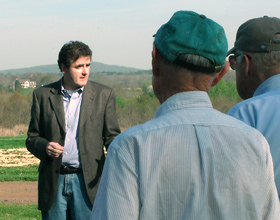
Langhorne, Pennsylvania
The wipeout of House Republicans from the Northeast reached Bucks County in 2006. The victim was Michael Fitzpatrick, defeated after a single term in the wave that gave Democrats control of the House and Senate. A money advantage, long experience in county politics, and personal popularity couldn’ta save him. He lost to Democrat Patrick Murphy, a newcomer to the district.
Stay informed.Stay ahead.
Join Washington Examiner for unlimited access to the news, analysis, and commentary that matter most.
Already a member? Log in
The campaign was brutal. Both President Bush and the Iraq war were deeply unpopular. “The intensity I ran against in 2006 was … irrational,” Fitzpatrick told me, struggling for the right word. At the top of the ticket, Republican senator Rick Santorum lost the district by 18 percentage points. The Republican candidate for governor, ex-Pittsburgh Steelers wide receiver Lynn Swann, lost by 20 points.
Fitzpatrick, unlike many defeated members of Congress, didn’t stay in Washington as a lobbyist. “I’m a Bucks County guy,” he says. He has six children, two in college. He returned to his law practice in Langhorne and didn’t consider running in 2008. He was being treated for colon cancer with chemotherapy and radiation. Murphy was reelected easily as the second wave of the Democratic juggernaut hit.
Now Fitzpatrick, 47, is running again. His cancer, he says, is cured, and he’s eager to be part of a Republican recovery in the Northeast. In one of the political surprises of 2010, Republicans have an excellent chance of winning as many as a dozen House seats in a region—New England, plus New York, New Jersey, and Pennsylvania—that was considered a dead zone for them for decades to come.
The conventional wisdom, after 2008, was that the Republican party was too conservative, too Southern-oriented, and too obsessed with social issues like abortion and gay rights to compete in the Northeast. Though this analysis was (and is) dubious, the election results in House races did suggest a barren future for Republicans.
After two disastrous election cycles, Republicans had lost 5 of their 12 House seats in Pennsylvania, 6 of 9 in New York, all 3 in Connecticut, both seats in New Hampshire, and 1 of 6 in New Jersey. They have zero House seats in New England. That’s a wipeout, for sure. Until this year—really until midsummer—a Republican resurgence was unthinkable.
It wasn’t until January that the Cook Political Report downgraded the Bucks County district from “Solid D” to “Likely D.” The reason, Cook said, is that Fitzpatrick “makes this district a new concern for Democrats.” Now it’s a critical concern. In August, Cook called the race a tossup. Noting that Murphy beat Fitzpatrick by just 1,518 votes in 2006—half a percentage point of the total vote—Cook declared, “It’s hard to see how four years in Washington gets [Murphy] in a much better position for a rematch in this kind of political environment.”
The change in the political climate has permeated the Northeast. President Obama’s job approval hasn’t nosedived, but his policies on health care and the economy are almost as poisonous for Democrats here as elsewhere. In a Rasmussen poll in September, Obama’s approval rating in New York was 61 percent favorable, 38 percent not. But by 56 percent to 42 percent, likely voters in New York favor repeal of Obamacare. In New Jersey and all of New England, the same phenomenon exists.
The expectation of a Republican comeback stems from two other factors. Most of the seats Republicans are poised to win have historically been held by Republicans or have at least been receptive. One example: the eastern Long Island district in New York, where Republicans have an advantage over Democrats in voter registration of 12,800 and their frequent ally, the state’s Conservative party, has more registered voters than in any other district.
The Republican challenger is businessman Randy Altschuler, 40, who defeated Richard Nixon’s grandson Chris Cox and lawyer George Demos in a grueling primary in the district. Altschuler is focused solely on the economy and jobs—issues that unite Republicans, conservative Democrats, and independents in the Northeast. Those issues are the second factor aiding Republicans. “My top priority is to create a pro-growth environment, lower taxes, and more jobs,” Altschuler says in a TV ad. “This should be our district,” he told me, “particularly in a year like this.”
It not only should be, but it must be if Republicans are to gain the 39 seats they need nationally to capture the House. With 10 or 12 pickups in the Northeast, a majority would be assured. In New York, Republicans are almost certain of winning 3 or 4 seats and may net as many as 7. More likely than not, they’ll win both New Hampshire seats. They have an even chance of gaining one seat in New Jersey and another in Connecticut.
But Pennsylvania is the biggest potential prize. Cook lists 5 seats held by Democrats as tossups and another as “leans D.” The election model of analyst Nate Silver gives Republicans a better than 50 percent chance of winning 6 Democratic seats. This includes a 69 percent chance of taking the Scranton seat represented since 1984 by Democratic warhorse Paul Kanjorski. Fitzpatrick has a 54 percent chance of ousting Murphy, according to Silver.
Pennsylvania has trended Democratic since 2000, but it has reacted more negatively to Obama and his agenda than the rest of the Northeast. The president’s approval is under water in Pennsylvania (51 percent negative to 47 percent positive in the Rasmussen poll). Repeal of his health care bill is favored by 56 percent to 38 percent.
The collapse of support for Obama is duplicated in Pennsylvania’s 8th District, which takes in all of Bucks County and a small chunk of northeast Philadelphia. The county, just north of Philadelphia, is urban in the south, suburban in the middle, and rural in the north. Fitzpatrick grew up in Levit-town, the gigantic postwar development of modestly priced houses, and still lives there.
In private polling, Obama’s approval in the district has flipped from 55 percent to 42 percent positive a year ago to 53 percent to 43 percent negative now. Last month, a private survey gave Fitzpatrick a 48 percent to 41 percent lead over Murphy.
Fitzpatrick is hardly coasting. As the incumbent, Murphy will raise and spend more, just as Fitzpatrick did in 2006 when he was running for reelection. Fitzpatrick has already raised more than $1 million and figures he needs $1 million more to run an effective campaign. “In this atmosphere, we’re not going to have to spend as much as the incumbent,” Fitzpatrick says.
In 2010, money matters less than issues, and that’s where Fitzpatrick—and Republicans in much of the Northeast—has an advantage. “Congressman Murphy would like to make [the election] about social issues,” Fitzpatrick, a pro-life Catholic, says. “But all the other issues have been trumped by the economy.”
Murphy voted for the liberal trinity of unpopular measures—economic stimulus, cap and trade, and health care. “We’re going to make him defend everything,” Fitzpatrick says. His plan to revive the economy and create jobs is standard Republican fare: “smaller, more efficient government, less spending, lower taxes, and setting the table for small businesses and manufacturers.”
The importance of Fitzpatrick’s candidacy is a given among Republican strategists, though he’s gotten little outside help so far. “It’d be difficult to get a majority without winning this district,” he says. Winning is hardly certain. But a betting man would back Fitzpatrick.
Fred Barnes is executive editor of The Weekly Standard.
