

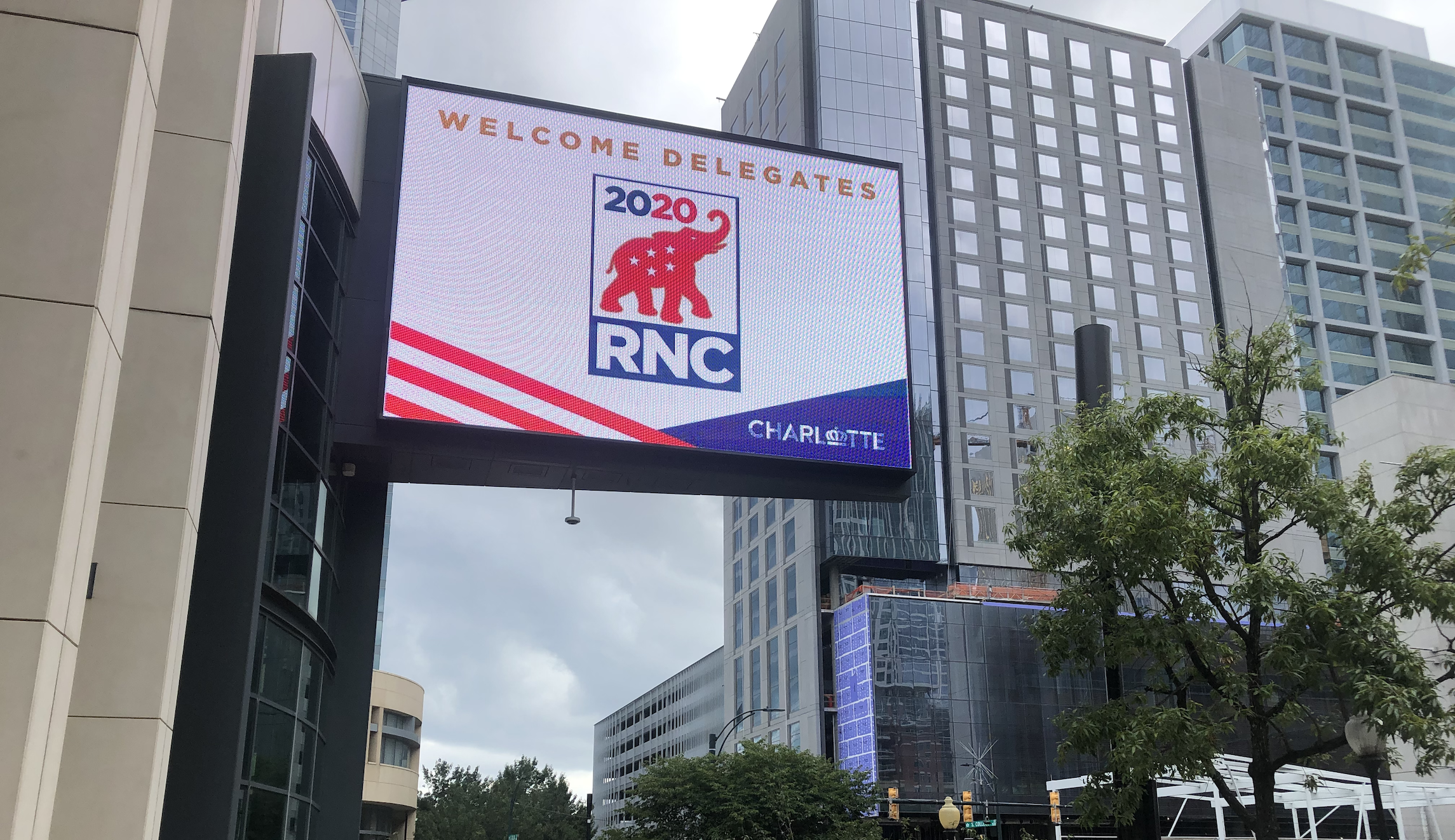
CHARLOTTE — They used to debate things. Immigration, abortion laws, public education, federal spending, tax reform.
Republicans used to have platform committee debates over these issues. No more.
Recommended Stories


George Bush started to neuter the process. Mitt Romney’s people did their best to make things as white-bread and uneventful as possible. But it took Donald Trump’s second term to kill the whole thing.
The Republican National Committee voted Sunday not to adopt a new platform, passing a resolution that instead stated “the Republican Party has and will continue to enthusiastically support the President’s America-first agenda.”
Republican officials cited coronavirus restrictions for the lack of a new platform. No new platform means the 2016 platform still stands. But it also suggests that Republican principles and policies are being replaced by fealty to one man: Donald Trump.
“A normal convention has 2,500 delegates,” Henry Barbour, the Republican national committeeman for Mississippi and longtime RNC powerbroker, told me Sunday morning. “This year, we have 500. This is not the time to rewrite it. It’s that simple. … I strongly believe, you know, trying to do the platform, even changing the rules with a really small group, opens you up to a lot of criticism.”
Most delegates were fine with this change.
“I’m disappointed, but I understand the necessity here — this is a very awkward time,” said Greg Cook, an Alabama delegate. “I think the party is doing a great job of adjusting to a very difficult situation.”
“I think the fact that in this unusual year, we’re not able to have the whole delegation come from each state makes it reasonable that we won’t recraft it with just a few people,” said Mary McCrossan, a Delaware delegate.
“I wish we could have” held a platform process, said Wyoming delegate and state Sen. Cheri Steinmetz, “but we’re all in the middle of a national emergency, and I think all Americans understand that.”
Was it possible to debate a new platform virtually?
“Maybe there was” a way, Steinmetz said, “but it was decided not to do it that way, and I’m OK with that. I mean, under the circumstances.”
Others were glad to go without a platform debate. “We do not want it monkeyed or toyed with,” said Terry Lathan, the chairman of Alabama’s Republican Party. “It doesn’t need to be.”
“If you look at the rules of the Republican National Committee,” said Bruce Hough, a Utah delegate, “our singular job is to hold a convention every four years and nominate a presidential candidate. That’s our job. Everything else is peripheral. … We really didn’t have that whole process this time. And I’m fine with it this time; we’ll have a chance to do that for 2024.”
One former platform committee member, speaking on condition of anonymity, told me, “I’m kinda glad we’re not doing that this time because we didn’t need that distraction. We could have the focus be the president. As a longtime Republican trying to fix the organization and push forth my values, I trust him.”
That trust in Trump and the party was a common theme in comments on the lack of a platform process. “I just trust the leadership, that they’re doing what’s best and making those decisions,” Steinmetz said. “That’s why we elected them.”
Morton Blackwell, the longtime conservative activist and gadfly of the party establishment, understood the argument against holding a new platform debate amid coronavirus limitations, but he also saw a big downside: The lack of participation by party activists reduces grassroots buy-in.
“The big disadvantage,” he said, is that in normal years, “the various elements of the Republican winning majority have their own strong interests in participating in the platform writing” and thus are invested in the party.
Pro-lifers, the NRA, immigration hawks, and other grassroots entities battled for their language in Republican platforms over the decades. This helped make these groups part of the party coalition.
Blackwell, who was a Goldwater delegate in 1964, also noted how the platforms in the 1960s through the 1980s helped bring Southern states, despite the dominance of the Democratic Party, to vote Republican on the national level. Instead of a new platform, the party passed a resolution stating there would be no platform and that the RNC supports Trump. Also on Sunday, the Trump campaign released a 49-point agenda.
RNC Platform Resolution: “RESOLVED, That the Republican Party has & will continue to enthusiastically support the President’s America-first agenda;
RESOVLVED, That the 2020 Republican National Convention will adjourn without adopting a new platform until the 2024 RNC…” pic.twitter.com/zWdqYhKrdp— JERRY DUNLEAVY (@JerryDunleavy) August 24, 2020
