
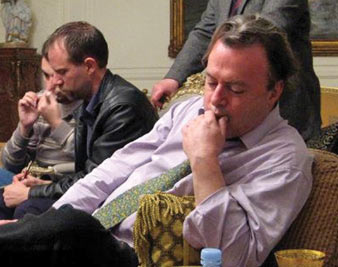
In February 2009, Christopher Hitchens got into a fight with fascists in Beirut. Visiting the country as part of a delegation of foreign journalists hosted by Lebanon’s pro-democracy March 14 movement, Hitchens was walking through the Hamra district with two colleagues when he saw a plaque commemorating a martyr from the Syrian Social Nationalist Party. The organization’s symbol is a variation on the swastika, the sight of which prompted Hitchens to pull out a pen and deface the placard. Suddenly a gang of SSNP thugs materialized and set upon Hitchens and the others, who were barely able to make their safe escape in a passing taxi.
“Had I really understood what I was doing on my little anti-swastika excursion,” Hitchens writes in his memoir, Hitch-22, “I would not have done it.” On the same street corner the SSNP had previously beaten a local journalist so badly that he was hospitalized for months. Worse, in May 2008 the SSNP had terrorized the neighborhood, killing some of its residents, when its ally Hezbollah attempted a coup d’état. Nonetheless, Hitchens’s considered second-thought beggars belief: He would have scribbled an expletive on that plaque even if the only writing utensil at hand had been his own fingernail. Indeed, one way to understand his career is as an anti-swastika world tour, which has now come to an end.
Real journalism.Trusted by millions.
Unlimited access to in-depth reporting, expert analysis, and the stories that shape our country.
Already a member? Log in