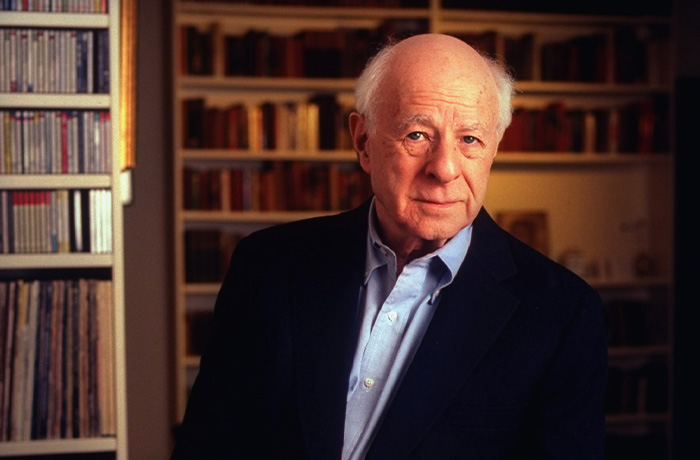
Norman Podhoretz, 1930-2025

“One of the longest journeys in the world is the journey from Brooklyn to Manhattan — or at least from certain neighborhoods in Brooklyn to certain parts of Manhattan.” Norman Podhoretz wrote those words in 1967, capturing in one wry sentence the improbable ascent that defined his life: from the rough streets of Brownsville to the commanding heights of American intellectual life, where he would reshape conservative thought and foreign policy debate for generations.

That journey began on Jan. 16, 1930, in a working-class immigrant household in Brooklyn’s Brownsville section. His parents had fled Galicia, bringing with them Yiddish and leftist sympathies — Podhoretz later quipped that he never met a Republican until high school. A public school teacher, spotting his potential beneath a thick Brooklyn accent, insisted on speech lessons that helped refine his delivery and open doors. Talent and determination propelled him forward. Scholarships took him to Columbia College, where he studied under Lionel Trilling, whose emphasis on moral complexity in literature left a lasting mark; to Cambridge University on a Fulbright and Kellett Fellowship, earning a second bachelor’s degree; and concurrently to the Jewish Theological Seminary, where he pursued Hebrew literature and earned a degree in Hebrew letters. After a stint in the U.S. Army, he emerged as a precocious literary critic, publishing sharp reviews in Partisan Review, the New Yorker, and elsewhere while still in his 20s.

By 1960, at the astonishing age of 30, Podhoretz was named editor-in-chief of Commentary, the monthly magazine published by the American Jewish Committee. What he inherited was a respected but somewhat parochial anti-Communist journal rooted in Cold War liberalism. What he forged over the next 35 years was something far more dynamic and contentious: first a vibrant forum for the cultural ferment of the early 1960s, publishing Norman Mailer, James Baldwin, Susan Sontag, Philip Roth, and Hannah Arendt; then, as the decade soured, a platform for unflinching critique of the New Left’s excesses.

Conservative author Norman Podhoretz (James Keyser/Getty Images)
Conservative author Norman Podhoretz. (James Keyser/Getty Images)

The pivot came gradually but decisively. Disillusioned by campus radicalism, the counterculture’s romanticization of violence, Black Power separatism, and mounting hostility toward Israel on the Left after the 1967 Six-Day War — hostility Podhoretz viewed as veiling a resurgence of antisemitism that had been taboo in postwar America — he steered Commentary rightward. He believed that the Left had abandoned its own principles in the face of totalitarianism. Alongside Irving Kristol, whom many credit as neoconservatism’s godfather, Podhoretz became its foreign policy firebrand. He argued relentlessly that America must confront totalitarian threats head-on, whether Soviet expansionism or, later, Islamist militancy. Commentary under his watch launched ideas and careers: Jeane Kirkpatrick’s seminal 1979 essay “Dictatorships and Double Standards,” which distinguished authoritarian from totalitarian regimes, helped shape President Ronald Reagan’s foreign policy doctrine; pieces by Daniel Patrick Moynihan fortified defenses against Soviet disinformation; contributors such as Midge Decter dissected feminist excesses with surgical precision.

Podhoretz’s own books amplified the magazine’s voice. His 1967 memoir Making It scandalized literary circles with its candid admission of ambition — for fame, money, and influence — earning savage reviews but cementing his reputation as a provocateur unafraid of ugly truths. Later works, such as Breaking Ranks: A Political Memoir (1979), chronicled his ideological defection. The Present Danger: Do We Have the Will to Reverse the Decline of American Power (1980) warned against détente with the Soviets. World War IV: The Long Struggle Against Islamofascism (2007) framed the post-9/11 struggle as a protracted ideological war demanding American resolve. He never shied from controversy, breaking lifelong friendships with Mailer, Lillian Hellman, and others as ideological lines hardened. Woody Allen immortalized the era’s tribal warfare in Annie Hall, joking that Commentary and Dissent had merged into “Dysentery.”

Through it all, Podhoretz positioned Commentary as neoconservatism’s flagship, insisting that America, for all its flaws, remained a force for good — a beacon worth defending aggressively abroad and whose values were worth upholding at home. His influence reached the White House: Reagan admired him, and President George W. Bush awarded him the Presidential Medal of Freedom in 2004. Even in retirement as editor emeritus after 1995, his essays continued to provoke, whether defending the Iraq War or decrying what he saw as weakness in the face of new threats.

DICK CHENEY, 1941-2025 

Podhoretz’s odyssey mirrored broader currents in postwar America: the rise of the New York intellectuals, the fraying of the liberal consensus after the Vietnam War, the cultural upheavals of the 1960s, and the subsequent conservative revival that helped win the Cold War. He embodied the neoconservative archetype — a liberal “mugged by reality,” in Kristol’s famous phrase — yet remained proudly paleo-neoconservative to the end, unapologetic in his hawkishness and his belief in U.S. exceptionalism. As Matthew Continetti wrote to me in an email message, “He was a great intellectual who shaped the views of generations of writers. And he was a kind and generous man.”

In one late interview, reflecting on President Donald Trump’s brash style, Podhoretz captured his own combative spirit with characteristic Brooklyn bluntness: “His virtues are the virtues of the street kids of Brooklyn. You don’t back away from a fight and you fight to win.” Norman Podhoretz never backed away — and he fought, with words as his weapons, to the very last.

Daniel Ross Goodman is a Washington Examiner contributing writer and the Allen and Joan Bildner Visiting Scholar at Rutgers University. Find him on X @DanRossGoodman.

Related Content