

The week before Christmas, President Donald Trump delivered a televised address from the White House. The president can stretch things out when he speechifies, but this time he got right to the point and landed the message in under 20 minutes. “Eleven months ago,” he said, “I inherited a mess, and I’m fixing it.”
Stay informed.Stay ahead.
Join Washington Examiner for unlimited access to the news, analysis, and commentary that matter most.
Already a member? Log in
Details of that mess began with “the worst [inflation] in 48 years, and some would say in the history of our country.” The word “affordability” is now all the rage, he reckoned, because life has become “unaffordable for millions and millions of Americans.”
The president covered many other subjects from the White House. These included immigration, crime, government promotion of transgender athletes (“We had men playing in women’s sports”), blowing up drug boats (“Drugs brought in by ocean and by sea are now down 94%”), education (“We have broken the grip of sinister woke radicals in our schools”), and his foreign policy moves (“bringing for the first time in 3,000 years, peace to the Middle East”), but it’s telling that he began with inflation and dwelled on it at length.
The overall message that Trump emphasized was dramatic, rapid improvements under his second administration, with more to come. For instance, “We inherited the worst border anywhere in the world,” he said, “and we quickly turned it into the strongest border in the history of our country. In other words, in a few short months, we went from worst to best.”
His administration is “bringing our economy back from the brink of ruin,” Trump bragged. “Under the Biden administration, car prices rose 22%, and in many states 30% or more; gasoline rose 30% to 50%; hotel rates rose 37%; airfares rose 31%.”
“Democrat politicians also sent the cost of groceries soaring,” he said, “but we are solving that too.”
Domestic doom spiral
Bill Clinton’s political adviser James Carville summed up the key issue of the 1992 presidential campaign in one pithy soundbite: “It’s the economy, stupid.” Specifically, it was the jobs, stupid. After a recession from 1990 into 1991, there simply weren’t enough of them to go around, with an unemployment rate north of 7%.
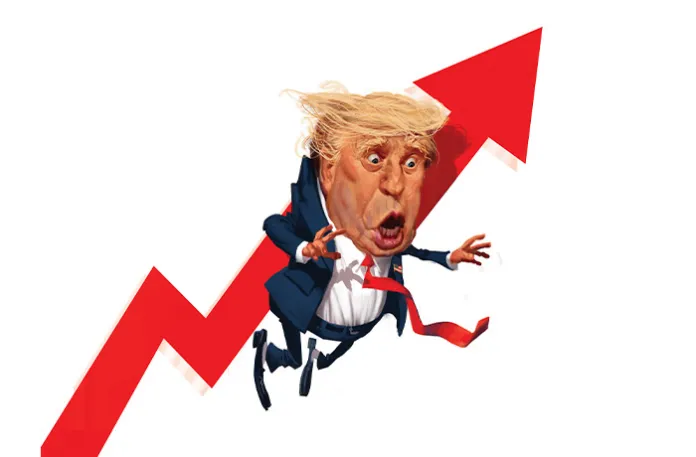
People wouldn’t stop talking about it, which magnified economic anxieties. The Bureau of Labor Statistics called this the “jobs-confidence loop” in a report. That doom spiral, more than anything else, is what made George H.W. Bush a one-term president.
Republicans took it on the chin in the 2025 elections and are looking awful for the 2026 midterm elections on the generic ballot. Why? Many explanations have been offered for this dismal result, following the previous year’s GOP sweep of the House, Senate, and White House.
Ultimately, it’s likely that Carville was right in a way that is still relevant today. Which is to say that it’s still the economy, stupid, but with a twist. This time, the issue is the prices, stupid.
Ripping up dollar bills
The song “Suffer,” by alt-country singer Boy Golden, begins with a common enough economic impression of the last several years. “Prices go up and they don’t come down / Cost 40 bucks just to hang around / I know people sleeping on the ground,” the protagonist sings, before coming to his chorus of protest:
“I wanna know where my money went
I want a new f***ing president
I wanna believe that God is benevolent
I wanna know where my money went”
Prices ballooned under former President Joe Biden. It happened because of moves that the Federal Reserve, the government-owned and -operated central bank of the United States, felt compelled to make. The Fed had to deal with the economic disruptions of the COVID-19 pandemic and lockdowns. It also had to finance a binge of pandemic-era and postpandemic spending that Biden himself had sought.
Biden was warned against this last round of COVID-19 spending, which took place as the lockdowns were being lifted, vaccines were being administered, and people were returning to work. “We’re taking very substantial risks on the inflation side,” former Treasury Secretary Larry Summers said in 2021, the year Biden’s so-called American Rescue Plan was passed by Democrats in a party-line vote. “Pouring roughly half a trillion dollars of gasoline on the inflationary fire that is already burning is reckless,” Jason Furman, chairman of the Council of Economic Advisers when Biden was vice president, said in response to the administration’s student loan forgiveness plans the following year. Both economists are Democrats, yet their counsel against inflationary policies went unheeded.
The result was brutal economically. We’ll get to the numbers, but first, dear reader, please take out a $1 bill and some Scotch tape. Eyeball about one-fifth of that bill, lengthwise, then tear that section off, crosswise.
Next, imagine that happening to every single dollar in your wallet, purse, or bank account. Then realize that you are not imagining things. It took $100 in 2024 to buy what $82.55 could buy in 2020, according to an inflation calculator provided by Alioth Finance.
Finally, use the tape to repair your $1 bill, because people need a lot more of those to pay for things these days.
What the Fed wrought
During the Obama years and Trump’s first term, monetary inflation had poked along, usually in the 1%-2% range. The value of the dollar fell as the Fed gradually increased the supply of dollars, but only slightly and slowly. In 2020, the year Biden was elected, inflation was 1.2%.
Then it skyrocketed, to 4.7% in 2021 and 8% in 2022. Even in 2023, when there was a significant reduction, inflation was still 4.1%. This effectively erased many of the salary gains workers had made over several years by making everything cost more, in a hurry.
During this period, the Fed practiced what it calls “quantitative easing,” which is one of those terms that has the general effect of making most people’s eyes glaze over. Starting in March 2020 and ending roughly two years later, this round of sustained economic activity injected trillions of dollars into the economy, initially to cushion the economic shocks caused by pandemic-related disruptions.
In short, the Fed created a great deal of money with which to buy securities. The Fed’s balance sheet, its list of owned financial assets that it bought by simply creating, or “printing,” more money, ballooned during this time.
“By the time [quantitative easing] ended in spring 2022, the size of the Fed’s balance sheet had more than doubled – from $4.2 trillion in assets to $8.8 trillion,” explains the website of financial technology firm American Deposit Management. “To put these numbers into perspective, the Treasury held assets equating to 36% of GDP at this time.”
Politicians, mostly of the Democratic variety, called for investigations into this or that industry during Biden’s tenure in office. The oil industry was allegedly too greedy, or the snack industry was too sneaky, and was cheating people by charging the same for less. It all amounted to a failed attempt to change the subject.
Prices are constantly rising and falling in a free market. This fluctuation happens because prices send economic signals back and forth from consumer to producer, dialing demand and supply up and down. When prices are rising across the board, however, the real culprit is the money supply. Under our system of fiat currency, the cause of that is the government itself.
The Fed increased the number of dollars available at a rate that was all out of whack with economic growth. That imbalance significantly altered the exchange rate between money and things that money can buy. With so many more dollars in the system chasing roughly the same number of goods and services, all of the individual dollars ended up being worth considerably less.
The public was, quite understandably, upset about this swift reduction in its purchasing power. The steep rise in prices started a price-confidence loop, and that made Biden a very unpopular president.
Granted, it might have been his disastrous, senior-moment-prone debate performance in late June 2024 that finished Biden off. Yet inflation is what put him on the ropes in the first place.
The politics of prices
It was Biden’s vice president, not the diminished man himself, who failed to stop Trump’s big White House comeback. From the voters’ perspective, Kamala Harris amounted to the same thing economically, and she did little to alter that impression.
In effect, people turned an administration out of office that seemed hellbent on pursuing its own agenda with indifference to the effects that this agenda was having on prices. Some critics charge that we are getting more of the same thing from the Trump administration, with its tireless pursuit of tariffs and with Trump’s own seemingly personal vendetta against current Fed Chairman Jerome Powell.
In his pre-Christmas speech, Trump made the case that his administration cares deeply about prices.
“The price of a Thanksgiving turkey was down 33% compared to the Biden last year,” he said. “The price of eggs is down 82% since March, and everything else is falling rapidly, and it’s not done yet. But boy, are we making progress.” In addition, he would be “standing up to the special interest to dramatically reduce the price of prescription drugs.”
Yet voters’ general impressions thus far are that the economy under Trump is not so great. Prices play an outsize role in that judgment. A December 2025 Navigator Research poll of 1,000 voters, for instance, found that Trump’s ratings are “especially poor on inflation,” with 61% of voters disapproving of Trump’s performance on inflation and the cost of living, versus only 35% who approve. Four percent were undecided.
The out party has more negative impressions of the economy when its opposite number is in office, so you would expect a more dour assessment from Democrats. Yet the Navigator poll also found some softness in the Trump coalition that could hurt in the midterm elections.
“Nearly one in six Trump voters regret their 2024 vote choice, citing Trump’s broken promises – especially on the economy,” the polling firm reported.
Stuck in a loop?
A price-confidence loop arose during the Biden administration. Prices went up, and people talked about it a lot, even when inflation had finally slowed down. For 2024, the year that Trump beat Harris, inflation clocked in at 2.9%.
That was a little high by recent historical trends, but not disastrously so. If that had been the average rate of inflation throughout the Biden administration, there’s a decent chance he would still be president today. That figure, 2.9%, is perhaps only slightly higher than where economists expect the needle to land on total inflation measured over 2025.
The Trump administration has done some things to bring prices down, especially on the regulation front. But Trump has also pressured the Fed to cut interest rates at the same time that it is trying to fight higher inflation, railed against Powell for not doing so until September, and is trying to fire one of the Fed governors, Lisa Cook, over alleged past mortgage fraud.
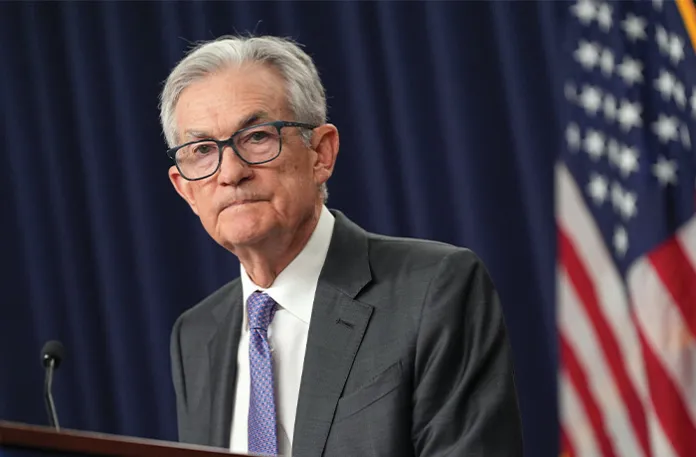
Powell’s term is up in 2026. Many financial analysts fear the president will appoint a replacement who will value short-term growth over price stability.
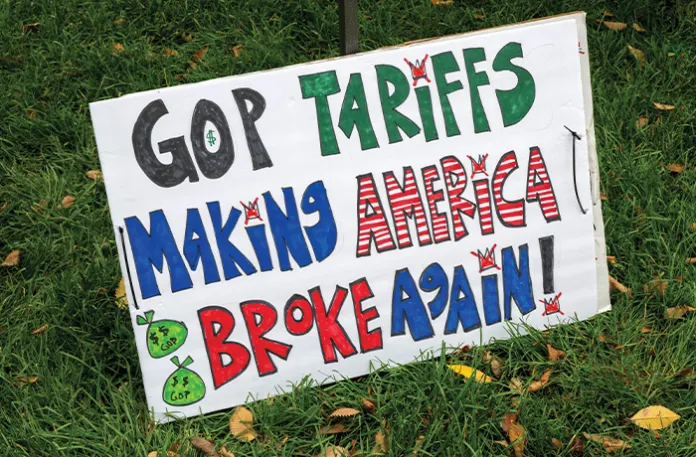
Then there is the problem of tariffs. “We had the worst trade deals ever made, and our country was laughed at from all over the world,” Trump said in his December speech, “but they’re not laughing anymore.” Neither were financial markets after “Liberation Day,” April 2, when Trump leveled tariffs on most nations and one island populated entirely by penguins.
The specter of a worldwide trade war loomed. Financial markets experienced a massive selloff globally, temporarily shedding a ballpark $10 trillion of value in a matter of days. A combination of the administration relaxing some tariffs, lawsuits that challenged its authority to do this in the first place, and some trading partners deciding that a trade war would hurt too many people with friendly fire eventually calmed things down.
The relationship between tariffs and inflation is complicated, but tariffs have demonstrable upward effects on many prices even in times of more straightforward trading. Under the current regime, tariffs have pushed up many prices already; harmed manufacturing jobs in the U.S., as many of the inputs are imported; and likely had knock-on bad effects on broader employment. Unemployment has ticked up at the same time that companies trying to navigate a new labyrinthine regime have had to eat some of the tariffs in the short run.
Looking forward to 2026, many companies were already baking tariff-driven price hikes into their pie charts. A survey by the Institute for Supply Management, for instance, found that 86% of manufacturers were planning to pass on all or at least a significant portion of the cost of tariffs on their wares by raising prices.
Members of the Trump administration have floated a “tariff dividend,” paid to citizens out of increased tariff revenues, to overcome the poll-measured skepticism of the majority of people toward its trade policies. However, this would still require the consent of a closely divided Congress and could be further undercut by an adverse ruling by the Supreme Court on tariffs.
TRUMP TRIES TO TURN ECONOMY BACK ON DEMOCRATS IN PREVIEW OF 2026 CAMPAIGN
The current price-confidence loop presents a tricky political problem for any party in power in that the country likely has to get well past it before the din ceases. After the November GOP shellacking in several state and local elections, Trump initially discounted concerns over “affordability.”
Trump’s party has a lot riding on public perceptions of prices and the economy in this year’s midterm elections. His address was thus a Yuletide pivot. The president gave his supporters the gift of at least appearing to take the issue of prices seriously. If he proves serious about tackling the issue in the new year, it could make a real difference for the political battles to come.
Jeremy Lott (@jeremylottdiary) is the author of The Warm Bucket Brigade: The Story of the American Vice Presidency.
