

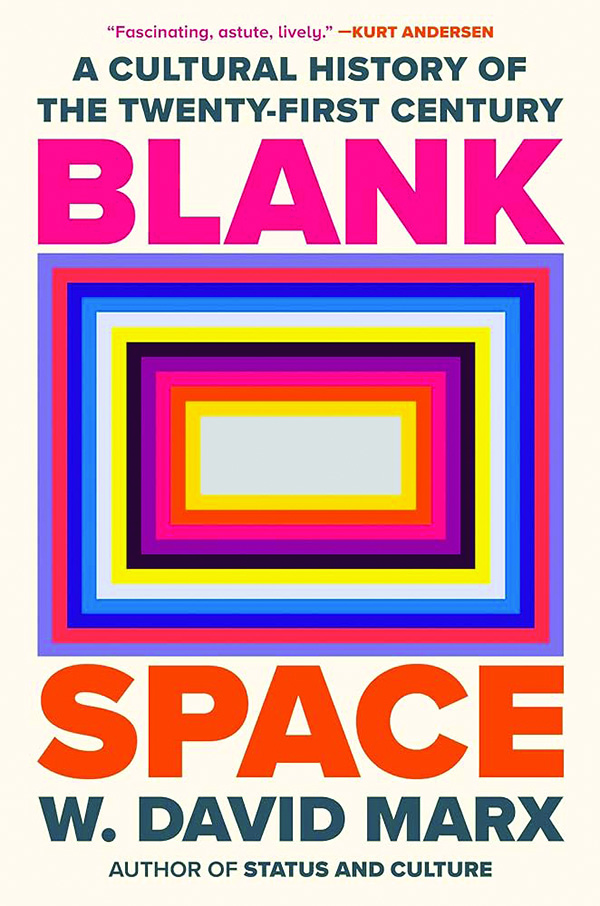
Cheekily titled after one of Taylor Swift’s biggest hits, Blank Space is an attempt by culture writer W. David Marx to do something extremely ambitious in an extremely compact package: a 375-page (with endnotes!) capsule summary of the entirety of global culture over the past 25 years.
Recommended Stories


Despite the book’s sprawl, Marx offers a straightforward thesis: Culture, once the purview of innovators who pushed society forward with their insight, transgression, and innovation, now serves “merely as entertainment, commerce, and politics,” with “a conspicuous blank space where art and creativity used to be.” (Emphasis his)
An honest reader would be hard-pressed to disagree with this conclusion, especially in the face of the shrill insistence from some quarters that AI-generated slop and puerile TikTok trends represent the next step in the tradition that gave us the Book of Psalms, “The Rite of Spring,” and the third act of “Boogie Nights.” But a book that dares to upend the received wisdom of the age needs a more coherent, compelling argument than the one Marx has to offer.
Marx careens from popular music to reality television to fashion, with a special emphasis on the latter (he sits on the board of directors of the Japanese streetwear brand Human Made, which goes oddly unmentioned as he waxes rhapsodic about the brand’s founder and fashion kingpin Nigo). The book’s vast scope gives his descriptions of recent events a disorienting, grocery-list quality, reminiscent of the at-first-glance meaningless “cruft” that populates the mega-novels of Thomas Pynchon and David Foster Wallace — even as he largely ignores fields such as film, television, and literature.
Surrendering to the forces of nominative determinism, he offers a ruthlessly materialistic explanation for our cultural decline that satisfies only in part. Admirably, he takes dead aim at poptimism — a set of beliefs put forward by culture’s high priests beginning in the mid-2000s, which asserted that the artifice and commercialism of Top 40-oriented pop music deserved just as much critical scrutiny, and respect, as that produced with the art-for-art’s-sake ethos of the 1980s and 1990s musical underground.
Poptimism wasn’t just a critical shuffling of priorities. It carried a moral imperative: If you laughed at Ashlee Simpson’s infamous Saturday Night Live lip-sync debacle, you were a misogynist, and probably hated young people writ large. If you preferred De La Soul’s workmanlike 2000s-era output to the brute-force club music coming out of Atlanta during the same period, wasn’t that a little fussy and elitist — or, let’s face it, racist? And God help you if you criticized Beyoncé.
Marx calls it like it is, arguing that this led to the lowering of cultural standards writ large and the ascent of entitled charlatans like Paris Hilton. He memorably cites a series of drooling, vacant, cheerleading responses to the 2015 publication by Rizzoli of a collection of Kim Kardashian’s selfies, which one Atlantic writer called “a new strain of capitalism … something admirable, and refreshing.” This incident neatly sums up his diagnosis, as put in the book’s conclusion: “Neoliberalism didn’t just create pernicious economic structures; it provided a set of extremely seductive ideologies that convinced us to stop idolizing artistic progress.”
No doubt. But what about the rest of culture — the stubbornly persistent fringes, and the resurgent cultural id represented by the maverick success of right-coded figures such as Joe Rogan or Barstool Sports’s Dave Portnoy? While the former largely escapes Marx’s attention, he argues that the vacuity of the poptimist mainstream “omniculture” created the opportunity for the Right to seize the mantle of the counterculture and fill the void with “agitprop with no artistic pretensions.”
Whatever one’s feelings about the collective cultural output of the Zynternet, the inversion of this dynamic is undeniable. But Marx, a man of the Left, has a major blind spot when it comes to the reason why progressives find themselves so culturally juiceless. The first step in his program for rebuilding culture is to “rebuild and enforce social norms” — as if the hectoring, punitive, society-wide enforcement of progressive norms isn’t a major, if not the primary, reason for the right’s cultural ascendance.
Culture has undeniably shifted to the right in the roughly year-plus since the Butler, Pennsylvania, attempt on President Donald Trump’s life, but not so much that these norms don’t still hold sway in the aeries of culture with which Marx concerns himself. Without being able to acknowledge this, Marx is fighting with one hand tied behind his back, unable to directly criticize the social and cultural beliefs that followed poptimism except to say, with depressingly necessary obviousness, that “complexity, ambiguity, and formal experimentation” are not, in fact, “elitist.”
This — ahem — blank space in the book’s argument drains it of some credibility, but not enough to discredit Marx’s core argument that the worship of commercialism has badly degraded the public imagination. So why does this book feel so unsatisfying?
In part, it’s a feature of the book’s scope: It’s impossible to give the attention due a subject like the Arab Spring, or the curious decadeslong trajectory of Proud Boys and Vice founder Gavin McInnes, or the election of America’s first black president, when in mere paragraphs one’s attention must turn to megachurch prosperity pastor Joel Osteen or the internal politics of Louis Vuitton. To make such a thundering argument as Marx does here, with such a grand scope, at mere monograph length would provide a stiff challenge for the most godly erudite writer.
It’s also a function of his frequent leaning on often insight-light observations from contemporaneous writers, when, this being such recent history, Marx’s own take would have more than sufficed. Often this is done in service of some of contemporary thought’s most hoary cliches: He compares the rise of Trump to — insight alert! — professional wrestling, citing a late-to-the-party 2023 Atlantic essay about his “WWE tactics.”
While tiresome, it’s ultimately no great crime to have an ideological blind spot, or to bite off more than one can chew as a writer, or to lean on your fellow critics. The one truly unforgivable quality of Blank Space is that, for a book that seeks to galvanize culture, written by someone clearly, profoundly steeped in it, the prose has absolutely no style.
The book is written in the dry, ironic, detached style of the academic tract, with little in the way of imaginative engagement with the subject matter beyond the application of Marx’s rigid material analysis. When the reader grows weary of this, he’s treated to moldy jibes like “Nevertheless, Trump persisted.” For a book that makes so many trenchant points, and which has such an urgent, valid, necessary message — “selling out” is not, in fact, noble; artistic standards exist and we should aspire to them — the rote, insistent quality of Blank Space limits its reach to those with the patience to endure it, and therefore those most likely to already agree.
Derek Robertson is a writer in Brooklyn.
