

HARRISBURG, Pennsylvania — Linda McMahon is having fun.
Stay informed.Stay ahead.
Join Washington Examiner for unlimited access to the news, analysis, and commentary that matter most.
Already a member? Log in
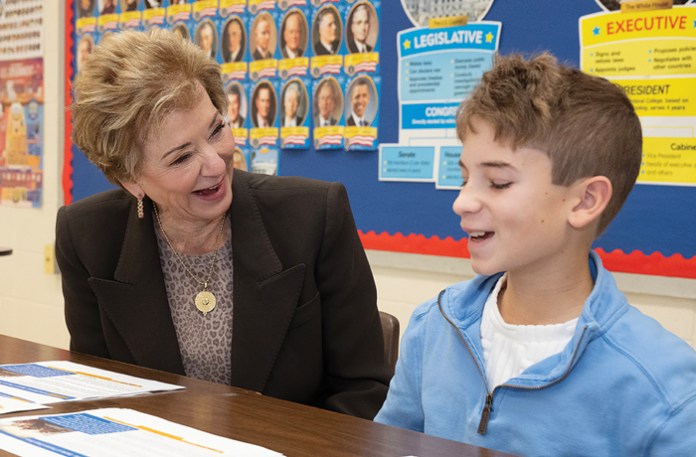
The education secretary, the 13th since the Cabinet department was founded during President Jimmy Carter’s administration, has just left a classroom in Dauphin County doing the 2026 version of Schoolhouse Rock! with a class full of children clearly enjoying the civics game.
It is early December 2025, and McMahon has just kicked off a 50-state “History Rocks!” barnstorm in Pennsylvania as part of an effort to engage with schoolchildren across the country about civics as well as instilling the aspirations of patriotism.
The initiative is part of a nine-month effort ahead of this year’s 250th anniversary of the signing of the Declaration of Independence. McMahon said in an interview with the Washington Examiner after her first of three events that the entire effort is a way to engage with young people to explain the importance and joy of patriotism, “as well as to draw us all together to enjoy our shared understanding of America’s founding principles.”
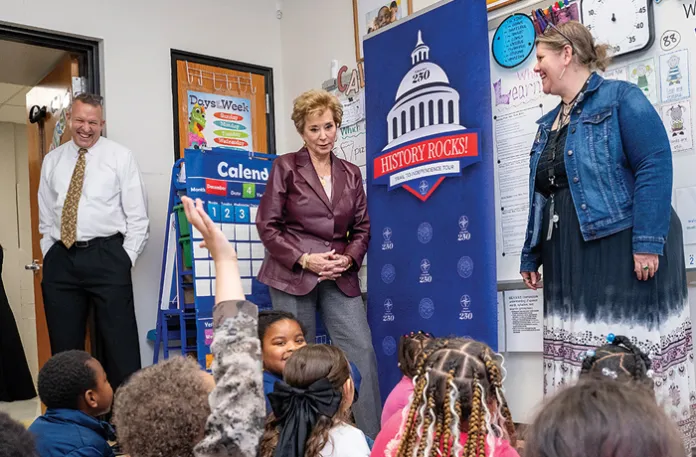
Spending time with the schoolchildren has her buoyant and excited about the months ahead in the lead-up to the 250th anniversary and being able to engage with them on a personal level.
McMahon, who was also making stops in Delaware and New Jersey as part of this trip, said the experience of working with the pre-K through fifth grade children on this day has already inspired her.
“We played a couple of games that included questions about who were the signers of the Declaration of Independence and how our country was founded, and they were so enthusiastic to be part of it,” she said of the game that had two teams competing to get the answers right first.
McMahon, who was brought up in the South and started her school day with the Pledge of Allegiance and the Lord’s Prayer, said she was stunned to find out in her new home state of Connecticut that there was no Pledge of Allegiance or national anthem to open her granddaughter’s high school graduation ceremony.
“I was so struck by that,” she said. “And so then I went back to find out a little bit about just schools in Greenwich, Connecticut. Did children say the Pledge of Allegiance? And not all of them did.”
So when Flag Day approached last June, she had the Education Department get approval ahead of time to distribute little flags for the children to have.
“They all came outside on the school grounds, and all the kids were waving their flags, and they were saying the Pledge of Allegiance and singing the national anthem,” she said. “And the school itself was so impressed by what they saw, they said they would very much like to repeat that this year.”
McMahon’s conclusion was not only that the school districts were not teaching patriotism, but they were also not teaching civics and the values of love of country.
“I recently saw a survey that was done, and it said that only 41% of 18- to 29-year-olds said that they love their country,” she said. “And I thought, ‘Wow, I really believe that they don’t love their country because they don’t know their country, or at least they haven’t really been immersed in the history of the country, what our country has gone through, how it’s evolved, and what a special place this is.'”
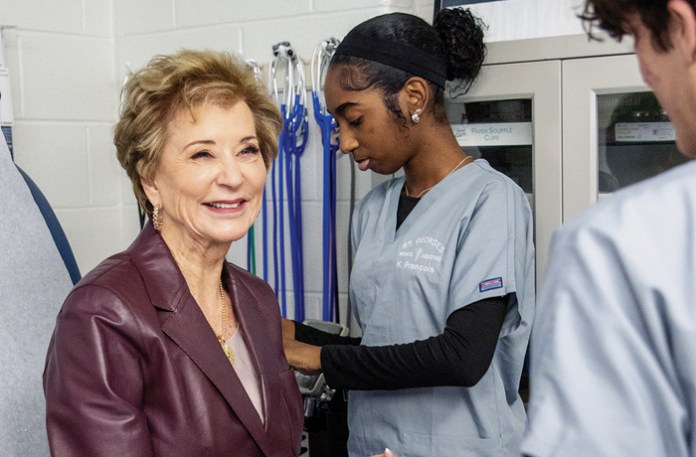
Her second stop of the day was in Delaware at St. Georges Technical High School, the first vocational technical high school she has visited in her role as the education secretary.
“I’ve been to community colleges, but this was the first 9-12 technology school that I’ve attended,” she said, adding that as part of her tour, she had her finger pricked by the students studying to be surgical technicians.
“They were also being trained in phlebotomy, so they offered to do a blood draw. I said, ‘I’d be very happy with just a finger prick today, thank you very much,’” she said, laughing.
McMahon said the trade school was made up of 10th, 11th, and 12th graders, with many of them set to walk out of school in May to join the workforce.
“I was talking an 11th grader that he said that when he graduated, he would have a certificate to go on into a professional position in a hospital as a tech person, and he was so thrilled to be able to have the opportunity to start a job, to start earning a living, which would help pay if he wanted to then expand his career,” she said.
Part of what she discussed at St. Georges was that its students are considered highly skilled and really sought after in the community once they graduate.
“In fact, a local Ford dealership donated a F-150 truck to the automotive repair class, and they will hire every student that passes through that course that works on the F-150,” she said. “They said the skills gap is so profound that they can’t train students fast enough to meet the demand.”
That skills gap was one of the comments she made to President Donald Trump during a Cabinet meeting in December 2025. “I think that we’re at a national emergency point with education in general in our country, but if we look at the skilled workforce, if we want to bring all of this technology and this manufacturing and all back to our country, we have to focus on training our skilled labor force,” McMahon said of her conversation with Trump.
McMahon said post-World War II families pushed their children to go to college because they didn’t want them to have to rely on blue-collar jobs, and they wanted them to have better opportunities than they had.
Our culture is changing on that thought process, she said, “and that is really key now to understanding the fastest growing group of millionaires in the country are our skilled workforce.”
McMahon said the 50-state initiative will include an overlapping discussion with state legislatures about returning education to the states.
“That’s a parallel tour that we’re doing, but our History Rocks! and the Road to Independence tour is to really just revitalize civics education and our country and to show that it’s fun,” she said.
While in the Pennsylvania State Capitol, McMahon met with Republican legislators to talk about giving states control of educational programming by dismantling the U.S. Department of Education.
In terms of Cabinet-level agencies, the Education Department is a relative newcomer. At its inception, it was, in fact, called the Department of Education during President Andrew Johnson’s administration when he signed legislation creating it. However, its mission was to collect information and gather statistics. It was very different from the massive department it is today.
Within a year, it was demoted to the Office of Education in 1868 and remained small, lightly staffed, and often under the umbrella of other agencies, such as the Interior Department and the former Department of Health, Education, and Welfare, which is now known as the Department of Health and Human Services.
Social strife in the 1960s, along with massive government expansion under President Lyndon Johnson, led to a rallying cry for the federal government to have a larger hand in the education of American children. In October 1979, Congress passed the Department of Education Organization Act, and the department, as we now know it, began operations in May 1980.
The COVID-19 years cast a long shadow over the nation’s students. American public education was turned on its head by school boards and teachers unions with prolonged shutdowns, remote learning, masking, and many school districts not reopening for an entire year. All of which led to not just a distinct lag in students’ academic performances, but also emotional damage, as students have struggled to reconnect after the dramatic extended shutdowns.
During his campaign for a second term, Trump pledged to shut down the Education Department. Several weeks after he was sworn in last year, he signed an executive order calling for the dismantling of the department.
“People have wanted to do this for many, many years, for many, many decades, and … no president ever got around to doing it, but I’m getting around to doing it,” Trump said at the signing.
The inevitable question for McMahon is how this drawdown of the department is going.
“Well, it is very interesting,” she said, smiling, adding that she’ll explain it through a story that Gov. Kevin Stitt (R-OK) told her not long ago.
“He said he was speaking to a conference of about 400-500 people, and he asked the question, ‘How many of you in here graduated before 1979?’ and most of everyone’s hands in the room went up,” she recounted. “He said, ‘Well, imagine that, we all graduated from high school and there was no Department of Education. Isn’t that amazing?’”
“So, really, I think as the president has rightfully said, education that’s closest to the child, he believes, is the best education, and I agree,” McMahon added. “What is best for each individual community or district or state can’t be dictated from Washington. We’ve tried a national curriculum. We’ve tried and, I think, with the best of intentions.”
She rattled off efforts such as No Child Left Behind, Race to the Top, and the Common Core curriculum as those with the best of intentions that fell short.
“You just can’t dictate it through a bureaucracy,” she said. “It has to be felt locally, and it has to be controlled locally. And so that is the goal.”
McMahon said they have started moving things out of the Education Department on what she calls a proof-of-concept basis. “Through the Authority of the Economy Act, we are able to utilize interagency agreements,” she said. “So our first one that we signed was with the Department of Labor, where we moved about 12 employees from the Department of Education over to the Department of Labor.”
The budget is still within the Education Department. The overall supervision of employees is with an Education Department supervisor, but they will now work in conjunction with a designated group of employees from the Labor Department to integrate education and labor.
“After a period of time when we believe we have done that successfully, then we will want to ask Congress to codify and make that move permanent,” she said, adding that is the larger goal.
McMahon has told every member of Congress whom she has had an opportunity to talk to that this is not a back-of-the-napkin, willy-nilly program.
“This is carefully thought through,” she said. “It is a careful look at the budgets, a very thorough proof of concept that lets us bring it to you and show you how it is more efficient.”
McMahon noted that the Labor Department has a more developed system for the distribution of grants that are awarded. It also distributes its own grants.
PENNSYLVANIA MANUFACTURERS CONTINUE TO SUPPORT TRUMP’S TARIFFS
“Our system at the Department of Education could best be described as being held together by bubble gum and rubber bands, so over at the Department of Labor, we’ve been able to utilize their system and already distribute grants,” she said.
“So why would we try to reinvent the wheel at the Department of Education when we can blend in and move things that were always in other agencies and not in the Department of Education and have them operate with greater expertise and more efficiency?” McMahon concluded. “It just is common sense.”
Salena Zito is a senior writer for the Washington Examiner and author of the New York Times bestseller Butler: The Untold Story of the Near Assassination of Donald Trump and the Fight for America’s Heartland.
