
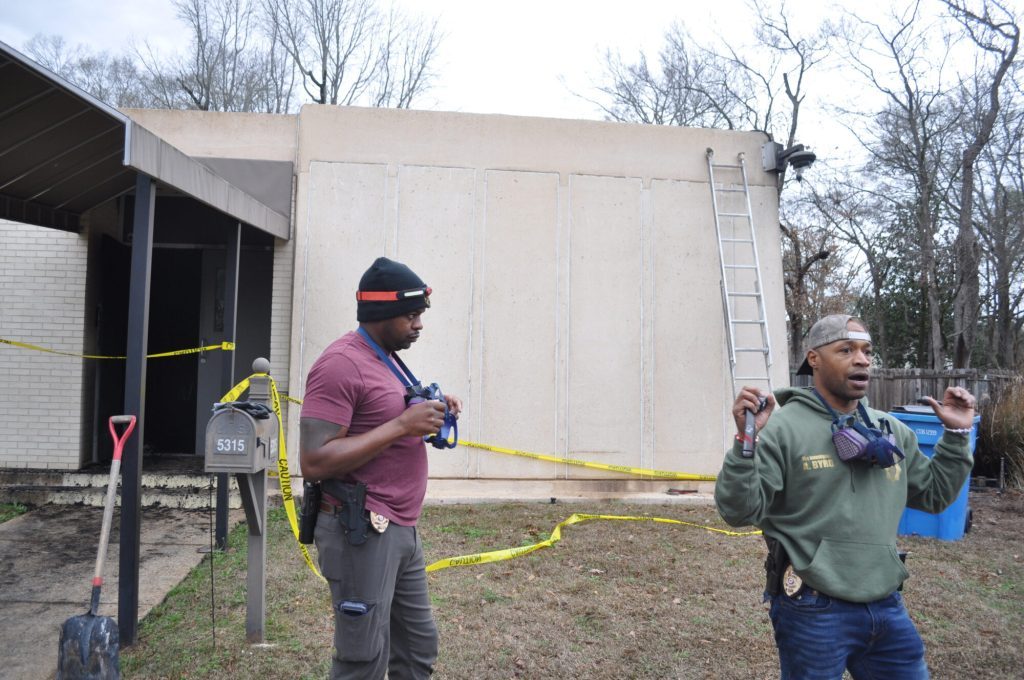
The arson fire that destroyed the Beth Israel synagogue in Jackson, Mississippi, last week underscored the spread of antisemitism in the United States — and the difficulty of protecting Jews and Jewish institutions. As incidents of violent antisemitism have increased, so, too, has criticism of Western governments for not doing enough to respond. The Australian government’s weak response to the mass murder on Bondi Beach exemplifies that concern.
In that context, there is much to cheer in a clearly distinct approach that’s been adopted in the U.S. In the wake of such horrific incidents as Pittsburgh’s Tree of Life synagogue shootings, Washington has intervened through the federal Nonprofit Security Grant Program, an unprecedented form of state support for religious institutions. Major grants for security infrastructure, welcomed by cash-strapped congregations, have at the same time demonstrated the complications of government support for religious institutions, even prompting some beneficiaries to have second thoughts.
The NSGP directs substantial grants for the installation of security infrastructure; think here of hardening synagogue buildings against terrorist attacks through car barriers, bullet-proof glass, and training for congregants, including children, on how to respond to an attack. The program, although not well-known, is significant; it will distribute $275 million this year, not exclusively to Jewish organizations but to a notable number of them. One Long Island synagogue received a $350,000 grant; 30 Jewish groups in the Baltimore area have been assisted, and 15 in Rep. Jerry Nadler’s (D-NY) district alone.
It’s easy to understand why such help is welcome. Not only is the threat level higher, but each synagogue is a financially independent institution that faces a literal cost of providing protection, as I learned firsthand as a member of a synagogue board of trustees. But many have developed second thoughts because of strings attached to security grants by the Trump administration.
In April, the Department of Homeland Security stipulated that NSGP grant recipients must agree not “to operate any programs that advance or promote discriminatory equity ideology” and to cooperate with immigrant law enforcement by agreeing to prohibitions against “harboring, concealing or shielding from detection illegal aliens.”
This did not go over well with the general political progressivism of organized, non-Orthodox Judaism. A public letter initiated by the national Community Safety Campaign, dedicated to “protecting Jewish life and the Jewish way of life,” signed by 70 organizations and 138 rabbis and religious leaders, denounced the “repressive conditions of the NSGP. We are committed to upholding our communal values but will not comply with these repressive conditions.”
The signatories are clearly groups from the progressive Left, including “Rabbis for Ceasefire” and “Jewish Voice for Peace.” One signatory, Rabbi Debra Anton of a Bloomfield, Connecticut, synagogue, said of the new rules, “We were able to strengthen some of the areas (of the synagogue) that were vulnerable to someone coming in, and also did some training that would prepare us in the event of a violent attack. But the new conditions completely go against our beliefs and our ethical values. So, it’s a terrible trade-off.”
The trade-offs include, in the context of church-state separation, the fact that security grants cannot be limited to any one religious group. Notably, signatories of the protest letter include the Council on American Islamic Relations, the Muslim rights group which the Anti-Defamation League views as antisemitic.
It is too facile to view this as a problem raised by the Trump administration. One can easily imagine a future Democratic administration insisting that security grants be conditioned on the right to use the bathroom of one’s choice — or even that congregations aver their status as sanctuaries for illegal immigrants from Immigration and Customs Enforcement raids. That these might align with progressive values does not make the entire entanglement of religious institutions with government any less complicated.
What one wishes for here is a civil society solution. Organized Jewish philanthropy has historically been robust and could, in theory, step forward to provide what’s needed for synagogue security. At the same time, the security grants can be viewed as an extension of the obligation of the government to provide protection for citizens.
TRUMP SHOULD HONOR HIS IRAN PROMISE WITH ACTION
The reality of strings attached to grants, even those which some of us might approve of, tells us that, as we approach the 250th anniversary of American independence, there has always been and remains wisdom in the First Amendment.
Howard Husock is a fellow at the American Enterprise Institute and author of The Projects: A New History of Public Housing.


