A character like Harry Reid


The life of former Senate Majority Leader Harry Reid presents a striking archetype for the self-made powerbroker, a man unwilling to accept his place in the world who “approached every deal trying to extract the most he could.” The Game Changer, Jon Ralston’s new book on the late Nevada senator, who died of pancreatic cancer in 2021, unveils an extraordinary, dogged figure whose determination (and arguably, moral compromise) briefly made him the most powerful legislator in the uncontested global hegemon of early 21st-century America.

Ralston writes vividly on Reid’s long journey from terrible poverty in a forgotten corner of southern Nevada to the senior ranks of the Democratic Party. He critiques his subject for his sins, but at times seems enamored by the senator’s artful backstabbing, gladhanding, and scheming.

Only in the acknowledgements does the reader discover the relationship between author and subject: Ralston, a longtime Reid watcher in Nevada state media, had his career upended when the senator conspired to get the journalist fired from a job at an NBC affiliate. (Ralston discovered Reid’s celebration of his misfortune in a trove of his emails while researching the book). That Reid would later select him to write his biography reeks of a doctrine that served him well through his career: There are no permanent friends and no permanent enemies.

The Game Changer: How Harry Reid Remade the Rules and Showed Democrats How to Fight
By Jon Ralston
Simon & Schuster
400 pp., $30.00
The Game Changer: How Harry Reid Remade the Rules and Showed Democrats How to Fight; By Jon Ralston; Simon & Schuster; 400 pp., $30.00

Reid grew up poor in rural Searchlight, Nevada. The family home consisted of “vestigial railroad ties, doused in creosote to repel termites and held together by chicken wire.” He dug graves to earn extra money. His father was tough but distant, an alcoholic who mainly earned his living as a hard rock miner — just $432 in 1939, the year Harry was born (less than $10,000 in today’s money). His mother earned extra cash as a laundress at the El Rey, the same brothel where Reid was taught how to swim. Reid’s uncle, Mason, the source of his middle name, was killed in a mine blast at the age of 26. His father ultimately shot himself at the age of 58.

For want of a consistent father figure, Reid habitually cultivated mentors. He began this habit in Searchlight, with “the biggest whoremonger in town” from whom he once stole a truckload of empty liquor bottles. A much more valuable relationship formed in his senior year of high school in Henderson, when Mike O’Callaghan, a war hero who’d lost a leg in Korea, arrived to teach history and government. O’Callaghan taught Reid how to box and noticed something unusual about his student: “he had no fear.” Reid also felt no pain, apparently. One Reid associate would recall how, on a fundraising road trip, he accidentally slammed the politician’s hand in the door of a car, and he’d barely reacted.

In the years after high school, O’Callaghan used his growing influence within the state Democratic Party to secure various favors for Reid, including a sinecure as a Capitol Hill police officer while he attended law school at George Washington. It’s hard to imagine Reid succeeding without him. As both men rose through the ranks of state and local politics, their symbiosis thickened. When O’Callaghan ran successfully for Governor in 1970, he did so with Reid as his running mate.

This early momentum was slowed by a number of setbacks. After losing a Senate race to Paul Laxalt in 1974 and a Las Vegas mayoral race in 1975, Reid was written off. O’Callaghan swooped in to save him, appointing him chairman of the highly sensitive Nevada Gaming Commission in 1977, where he built a reputation for integrity that launched his 1982 congressional campaign but also landed him in the crosshairs of the FBI, whose investigation into his alleged mob ties persisted well into his career on Capitol Hill.

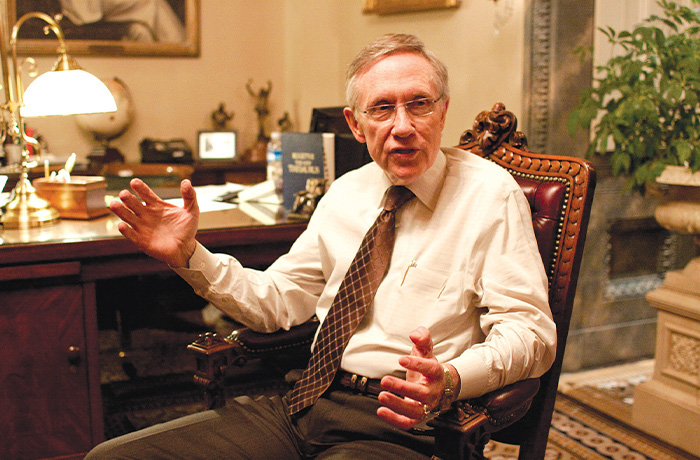
Senate Majority Leader Harry Reid (D-NV) on Capitol Hill in 2009. (Harry Hamburg/AP)

A defining trait of Reid’s was his loyalty to the various constituencies that supported his quest for power. Conservative LDS voters, pawn brokers in Henderson, and mob-linked casino operators in Las Vegas propelled his early career but soon gave way to bigger fish such as the NRA, Planned Parenthood, the mining industry, and above all, corporate gambling. He kept a Rolodex of powerful donors throughout his career, including, quite ironically, the New York real estate developer Donald Trump.

Reid always looked out for his people. To repay the Henderson pawnbrokers for securing him the chairmanship of a hospital board, he would later push through a state bill allowing them to charge higher interest rates. To repay the gaming industry for its years of support, he crushed a Clinton-era proposal to facilitate gambling on Indian reservations. In 2009, at the height of the financial crisis, Reid intervened (successfully) on behalf of MGM to save its multibillion-dollar CityCenter development in Las Vegas, employing thousands.

THE ORIGIN STORY OF THE ‘FAT SHOT’

Reid’s great strength was knowing how to thread the needle between state, national, and party issues in order to retain power. The man who arrived in the Senate staunchly pro-gun and pro-life would thus retire as a pro-choice gun control advocate. His stance on immigration “evolved” even more shamelessly. In 1993, he even introduced a MAGA-esque bill to outlaw birthright citizenship (he was on the opposite side of the issue within a decade). He called these cynical maneuvers “a sign of maturity.” Perhaps the most consequential policy reversal of Reid’s career concerned the so-called “nuclear option” to abolish the filibuster for presidential nominations, a concept which Reid had repeatedly lambasted before invoking it in 2013.

Ralston leads us through these sometimes dry, but more often enthralling episodes with an eye for character and consequence. Not only is The Game Changer an engrossing biography, but it also provides critical insight into the nature of the American political system and the unusual, calculating personalities who make it their home. Ralston, in short, does a beautiful job at revealing how the sausage is made. 

Carson Becker is an American writer.

Related Content
