
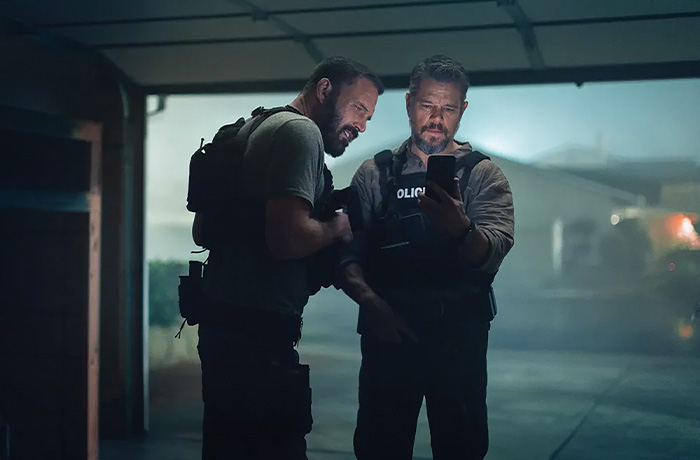
Netflix had me just where it wanted me this weekend: home. I was one among likely millions of Americans whose attention was divided between contending with Winter Storm Fern and watching streaming content. Both, in their fashion, constituted “work”: my driveway required regular shoveling if I had any hope of keeping ahead of the snow accumulation, but my mind needed to be focused, some of the time, on the new action movie I was scheduled to review in this space: The Rip, starring Matt Damon and Ben Affleck as morally questionable and/or compromised Miami police officers. Like a man possessed, I would dart between my cozy home office, where I would watch The Rip in increments, and my increasingly snow-covered driveway. Back and forth I went: Netflix, driveway; Netflix, driveway; Netflix, driveway.
What did it matter to them if I was consuming their content in dribs and drabs? At least I wasn’t in a movie theater — nor were too many others. The box-office totals this wintry weekend were grim: some ghastly-looking artificial intelligence thriller called Mercy was in the top spot with a measly $11 million, which was sufficient to outrank Avatar: Fire and Ash, Zootopia 2, and The Housemaid. Only Netflix knows how many of this weekend’s involuntary homebodies tuned into The Rip, but with stars like Damon and Affleck, numbers were likely not completely trivial.
But surely the bros who dreamt up Good Will Hunting are sufficiently loyal to the moviegoing habit to be incensed that their latest production would be watched distractedly amid the worst winter storm in memory? Then again, maybe not. In a recent interview with podcaster Joe Rogan, Damon sounded resigned to the Netflix way of working, which assumes audience inattentiveness. “The standard way to make an action movie that we learned was you usually have three set-pieces — one in the first act, one in the second, one in the third,” Damon said. “And now they’re like, ‘Can we get a big one in the first five minutes? We want people to stay tuned in. And it wouldn’t be terrible if you reiterated the plot three or four times in the dialogue because people are on their phones while they’re watching.’”

At least I did not watch The Rip on my smartphone. Damon is right, though: After my initially choppy and artificially protracted viewing experience, I sat down to watch The Rip in a single setting. But this made it even clearer that it was a movie conceived to be consumed by preoccupied viewers. The action is too wan and unoriginal to make an impact on a big screen, and the dialogue is too clunky and repetitive to be closely listened to. The advertising breaks that naturally cut into programming on lower-tier Netflix subscriptions were entirely apropos. Watching The Rip was like watching an episode of NCIS in isolation from its surrounding season: it is understood that some details will be missed, but the basic gist of the episode will be comprehensible to most sentient beings.
So what is the gist of The Rip? The movie opens with a series of images that suggest what AI would spit out if asked to produce an edgy South Florida crime movie: talk of burner phones, shots of cars cruising down the freeway at night, and a hastily assembled scene showing a masked team of assassins gunning down a police captain, Jackie Velez (Lina Esco), in what must be the action sequence Netflix demanded in the first five minutes. The incident inaugurates a series of internal-investigation scenes in which Lieutenant Dane Dumars (Damon) and Detective Sergeant J.D. Byrne (Affleck) are quizzed about their relationship to their fallen colleague and about alleged bad actors in various acronym-laden units, including TNT (Tactical Narcotics Team) and the apparently disbanded VCAT (Violent Criminal Apprehension Team).
Seemingly a lifetime ago, the Oscar-winning The Departed (2006) was a prestige project for Damon. These days, in this made-for-cable rehash of its general feel, he is reduced to sporting a graying beard and wearing eyeglasses to give his character an air of philosophical mystery. His dialogue certainly does not suggest any spark of intelligence. (“I’ve been waking up every night, like, thinking about time.” “Did you shoot up the garage, man?”)
Likely sensing that attention-span-challenged Netflix audiences were unlikely to sit for an actual procedural, The Rip quickly shifts gears to the seemingly livelier terrain of a “stash house,” which supposedly holds some huge cache of ill-gotten drug money. Led by Dumars and Byrne, the police turn up in Hialeah, whose sketchy reputation is set by a “Welcome to Hialeah: City of Progress” swiss-cheesed with bullet holes. On the other hand, the cul-de-sac on which the stash house sits looks to be something out of a slightly seedier version of Knots Landing, and the apparent owner of the house, Desi Lopez (Sasha Calle), puts up minimal resistance to having her residence searched in the absence of a warrant. Quickly resolving any lingering doubts, a cash-sniffing beagle clues the team into the existence of buckets of money stowed away in an attic wall.
Meanwhile, Byrne looks at protocol-eliding Dumars with increasing suspicion. Is Byrne a dirty cop? By God, could he have had something to do with Jackie’s death? Who else might be on the take? Why do Detectives Baptiste (Teyana Taylor) and Salazar (Catalina Sandino Moreno) zip-tie the door while they count all that money? Is Byrne trying to flush out the real dirty cop? Wait — could the local Hialeah officers be up to no good?
If any of these questions engage the viewer momentarily, they don’t do so with sufficient force to sustain the next hour or so of mostly interminable action. The movie is like a simulacrum of an action movie. The stash house being set on fire, police shooting at each other in the back of an armored vehicle — these are not things one would encounter in a real action movie. Its various reversals play like D-level Agatha Christie, and its “moral” is a betrayal of hard-nosed action movies everywhere.
DON’T KILL THE MORTGAGER: REVIEW OF ‘DEAD MAN’S WIRE’
This is not the sort of review in which the reviewer laments a film bypassing theaters for streaming, because this is not the sort of movie that would benefit in any way from theaters. It is only meant to be watchable, or tolerable, in small doses on small screens. The Rip was made by Damon and Affleck’s new production company, Artists Equity, through which they brokered a deal to compel Netflix to furnish bonuses for the cast and crew if the movie proves a hit for the streamer.
It is difficult to know which is more depressing: that Damon and Affleck have used a disposable piece of junk like The Rip to test out their new model for film industry remuneration, or that The Rip will, in all likelihood, generate enough viewers — even very casual, snow-shoveling ones — to make such remuneration possible.
Peter Tonguette is a contributing writer to the Washington Examiner magazine.
