Rubio: ‘No one knows’ who would take over if Iran’s supreme leader is removed

Secretary of State Marco Rubio acknowledged that “no one knows” who would take over governing Iran if the Supreme Leader Ayatollah Ali Khamenei is removed from power.

Rubio’s acknowledgement about the uncertainty regarding what could happen if Khamenei is no longer ruling in Tehran comes as President Donald Trump has threatened military operations if they do not work toward a new agreement over its weapons arsenal.

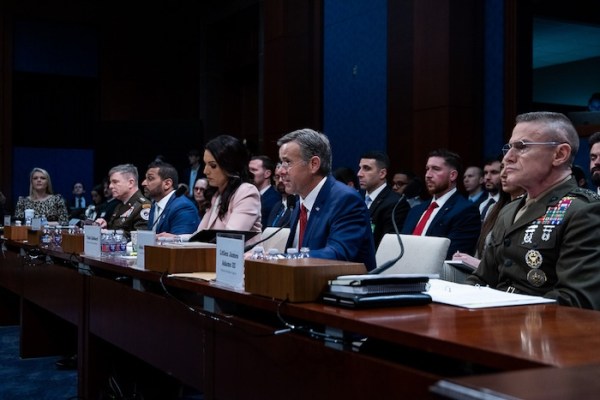
“No one knows what would take over,” Rubio said during his testimony in front of the Senate Foreign Relations Committee on Wednesday, noting that the system in Iran “is divided between the supreme leader and the [Islamic Revolutionary Guard Corps] that responds regularly to him” and “quasi-elected individuals” who “ultimately have to run everything they do by the supreme leader.”

“I don’t think anyone can give you a simple answer as to what happens next in Iran if the Supreme Leader and the regime were to fall, other than the hope that there would be some ability to have somebody within their systems, that you could work towards a similar transition,” he said, referencing Venezuela, which was the primary topic of the hearing.

He continued, “I would imagine it would be even far more complex than” the removal of former Venezuelan dictator Nicolas Maduro, whom U.S. forces and law enforcement captured and arrested in early January.

The U.S. military has bolstered its presence in the Middle East amid the ongoing threats shared between U.S. and Iranian officials about a possible military engagement. The Abraham Lincoln Carrier Strike Group arrived in the region earlier this week.

Trump, on Wednesday morning, warned that if Iran does not agree to a new deal regarding its military arsenal, a U.S. attack would be “far worse” than when the U.S. military targeted three Iranian nuclear facilities last June during the Israel-Iran 12-day war.

Rubio told lawmakers that the increased U.S. presence is in part meant to protect U.S. troops and assets already in the region in case Iran prepares to launch a preemptive attack. The U.S. has 30,000 to 40,000 troops stationed at eight or nine bases in the region that are within the range of Iranian weapons that “threaten our troop presence,” he said.

“We have to have enough force power in the region, just on a baseline, to defend against that possibility,” Rubio said. “That at some point, as a result of something, the Iranian regime decides to strike at our troop presence in the region, the president always reserves the preemptive defensive option. In essence, if we have indications that, in fact, they’re going to attack our troops in the region, to defend our personnel in the region.”

Iranian leaders, for their part, have not backed down to Trump’s threats.

MIDDLE EAST ANXIOUSLY AWAITS TRUMP DECISION ON POSSIBLE IRAN OPERATION

“Our brave Armed Forces are prepared—with their fingers on the trigger—to immediately and powerfully respond to ANY aggression against our beloved land, air, and sea,” Iranian Foreign Minister Seyed Abbas Araghchi said on social media on Wednesday. “The valuable lessons learned from the 12-Day War have enabled us to respond even more strongly, rapidly, and profoundly.”

Araghchi expressed a willingness to negotiate “a mutually beneficial, fair and equitable NUCLEAR DEAL—on equal footing, and free from coercion, threats, and intimidation—which ensures Iran’s rights to PEACEFUL nuclear technology, and guarantees NO NUCLEAR WEAPONS.”

Related Content