

Under President Donald Trump, Greenland has gone from the margins of the world to one of its most pressing issues, yet the wider public remains largely unaware of the tectonic political shifts that have brought the island to this position.
Greenland was granted home rule by Denmark in 1979, entailing significant autonomy. Its politics came to be dominated by two social democratic establishment parties for decades, until a sudden shift led to their collapse in support in the last election. For the first time in Greenland’s history, significant momentum is behind the prospect of independence, which some believe could be of major benefit to the United States.
Recommended Stories


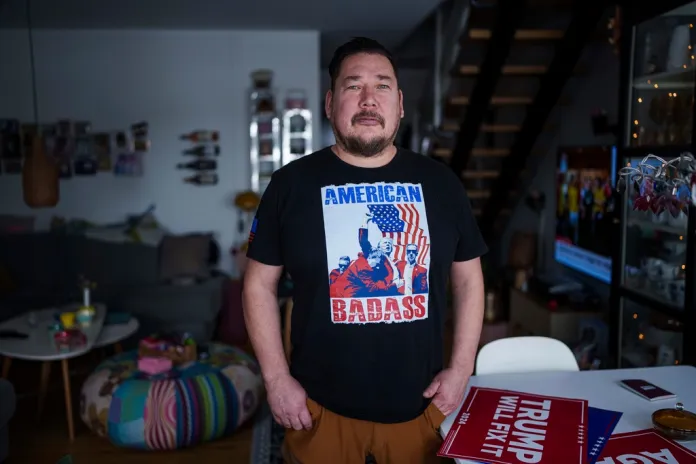
Jorgen Boassen, a former stonemason-turned-activist, stands today as arguably the most well-known Greenlander on Earth. He’s best known for his outspoken support for Trump, a largely unpopular prospect at home.
TRUMP’S GREENLAND BID DRAWS FOCUS TO RARE EARTHS MINING POSSIBILITIES
Boassen’s activism has seen his livelihood tarnished, his family hurt financially, physical assault, and even death threats against him. Despite this, he’s shown no signs of relenting in his political quest to improve Greenlanders’ perception of Trump and the U.S., as well as for Greenland’s independence.
Boassen’s diehard support of Trump has led some to the misperception that he supports the U.S. annexing the island. In reality, Boassen sees himself as a strong Greenlandic nationalist, and his ultimate goal isn’t annexation but full independence. He views Trump as a decisive force in driving Greenland toward independence and believes the U.S. has a central role as an ally in his homeland’s future.
Boassen sat down for an interview with the Washington Examiner, during which he outlined Greenland’s recent political history, what has driven recent changes in the nation’s outlook, and how Greenland and the U.S. could establish a mutually beneficial relationship.
Populist surge in Greenland
Since 1979, the socialist parties Siumut and Inuit Ataqatigiit held a near monopoly on Greenland’s politics. Despite both being democratic socialist parties, Boassen maintained that Greenlanders are deeply conservative people, with most coming from hunting and fishing families. Siumut and IA both appealed to these conservative social sentiments while pushing left-wing economic policies. Party loyalty was also fostered by families, with children supporting their parents’ dearly held loyalties.
The independence issue has dominated Greenland’s politics since Denmark granted home rule. Both parties supported a gradual slide toward independence, but privately realized the reality of the remote island nation’s reliance on subsidies from Denmark. This led to an almost unbroken pattern: Siumut and IA figures encouraging and tapping into popular sentiment demanding independence before elections, only to backtrack after they had won.
“They want to play in the doghouse,” Boassen said.
Aside from failing to follow through on independence, the records of Siumut and IA were further tarnished by deteriorating conditions on the island. Depression, suicide, and crime have become worsening problems. After nearly half a century in power, neither party was able to wean Greenland off its economic and financial reliance on Denmark.
The death blow, in Boassen’s view, wasn’t from a lack of results but rather from a sudden ideological shift leftward.
“It became woke. It became very, very woke,” he said.
In the context of Greenland politics, “wokeness” looked similar to its U.S. counterpart by stressing causes such as LGBT rights. The main issue, however, was its sudden attack on Greenlandic nationalism, undercutting Greenlandic identity.
“Siumut would say, ‘We shouldn’t even talk about what identity we have, who we are, like that,’” Boassen said. “And they also became very pro-LGBT, [but] traditional Greenlanders are very conservative people, we are still very much with nature. The cultural thing with hunting, fishing … it’s very conservative.”
After these shifts, Siumut and IA collapsed in support. In the most recent election last year, the two establishment parties plummeted to third and fourth place, an unprecedented shift in the nation’s politics.
PRO-INDEPENDENCE LIBERAL PARTY WINS UPSET IN GREENLAND ELECTIONS
Boassen argued that Siumut made a fatal mistake in trying to muddy the waters in questioning what Greenlandic identity meant. He and other Greenland nationalists are harshly critical of Siumut and IA’s contention that anyone can become a Greenlander, worrying that it would destroy the ethnic identity of the island nation.
These anxieties reflect the broader concerns about demographic changes across Western countries. Boassen portrayed Greenland’s struggle for independence in the wider context of nationalist struggles across Europe. He recalled attending a European nationalist conference, “Make Europe Great Again,” in Dubrovnik, Croatia. At the conference, academics warned of mass immigration and societal collapse, something that resonated with Boassen.
“In 15 to 20 years, Denmark will not be recognizable. … It will become another country toward being Muslim,” he said. “They already have a migrant crisis from people from the Middle East and Africa.
“And I will not be a part of that,” Boassen said, suggesting that European countries could start seeing civil wars within five years.
Breaking with Denmark
Though Greenland’s government has presented a united front with Copenhagen, Boassen argued that anti-Danish sentiment is at an all-time high. This was largely triggered by new revelations around a widespread sterilization campaign carried out by the Danish government against Greenlandic girls without their knowledge or consent.
Boassen argued the scandal was undersold in U.S. media. Thousands of women and girls were sterilized, meaning the island’s population of 50,000 is vastly smaller than it could have been.
Boassen believes the U.S. would be a much better partner for Greenland than Denmark. He even has an exact model ready for how an ideal relationship could be established: a Compact of Free Association between the U.S. and Greenland.
TRUMP WANTS TO TAKE OVER GREENLAND — AND HE HAS SEVERAL OPTIONS TO MAKE IT HAPPEN
A COFA is a deal in which the minor partner delegates all its military and security needs to the U.S., granting Washington exclusive military access. In return, the U.S. provides substantial economic assistance and investment. The minor partner maintains full independence.
Currently, there are three countries with a COFA: The Federated States of Micronesia, the Republic of the Marshall Islands, and the Republic of Palau. All of these territories were taken by the U.S. during its island-hopping campaign against Imperial Japan in World War II.
The plan has been floated by some Trump allies as a more realistic alternative to buying the island from Denmark. Trump advisers Kaush Arha, Alexander B. Gray, and Tom Dans have publicly advocated the proposal.
One barrier to this plan is the groundswell of anti-American sentiment enveloping Greenland. Asked why this is, Boassen blamed a certain naivete found among Greenlanders.
“Greenlanders have more feelings than common sense,” Boassen said. “Greenlandic people are very loving people. … They more think with their heart.”
He also blamed a “scare campaign” from Europe and Denmark, claiming that the U.S. would persecute indigenous Greenlanders and take away their healthcare. The relative absence of U.S. media in the country led most of the populace to believe the campaign’s talking points, according to Boassen.
“We have Danish television, Danish newspapers,” he said. “We don’t have so much American news, and that’s why it’s very important for me to come here and to show people in Greenland, here, we have nothing to be scared of.”
Trump’s role in Greenland’s independence
The former stonemason believes Trump is essential to any independence plan, not only because the U.S. could take on the role of Denmark, but also because he believes a Democratic president would be too adamant about placating Copenhagen.
“We should get independence. And we should be recognized as people,” Boassen said. “That’s why I went to campaign for Trump, because if a Democrat wins the election, it will happen again where the Danish speak on behalf of Greenlanders, and plead their own case against independence.”
He was so steadfast in this belief that he personally traveled to Pennsylvania in the days before the November 2024 election to door knock for Trump.
“There came a story where the Democrat had 100 Labour Party [activists]. [Republicans] get one Greenlander, and they won the election,” Boassen joked, referring to accusations that the United Kingdom’s Labour Party interfered in the 2024 election by campaigning for former Vice President Kamala Harris.
The party most open to a COFA with the U.S. is Naleraaq, a center-right populist party that favors the most rapid path to independence. It’s viewed by the other four main parties as the main opposition and gets frequently smeared as pro-American — an electoral death sentence in a time of increased anti-American sentiment.
Boassen said he believes Naleraaq, which came in second with 26% of the vote, would have won the 2025 election in a landslide if not for Trump’s comments about acquiring the island. However, the party’s fortunes in the next election are likely to be much better because of failures by the current ruling coalition of the four other major parties.
Boassen bemoaned that the recent anti-American sentiment has clouded Greenlanders’ judgment, leading many to prefer foreign influence over U.S. influence.
Boassen warned that Chinese influence is a real threat, and Greenland’s government is under the delusion that it is a far better partner than the U.S. He recalled an incident where he argued with former Greenland Prime Minister Kim Kielsen about a Chinese company that sought to build three airports in Greenland.
“I said to him, ‘You know, what you are doing is very dangerous.’ The Chinese can put rent, interest rates up so we can’t buy. … And then after [that], they want to own the airports and the city where they are. This is Chinese politics,” he said.
WHAT HAPPENED THE PREVIOUS THREE TIMES THE US ATTEMPTED TO ACQUIRE GREENLAND
Boassen argued that the U.S. should invest more in a hearts-and-minds campaign in Greenland, a campaign he’s currently nearly single-handedly waging despite immense pushback.
“I’m faithful America will be nice to us, and we will have new possibilities for our young generation,” Boassen said. “There’s a new door open for us. … The world’s greatest country and biggest economy … we can directly work with them. It would benefit us in many ways.”
